
The reading glasses are not where they should be. The bus is late and the appointment is in twenty minutes. Smoke starts to rise from the toaster. Two plans have ended up on the same afternoon. Each one asks for the same short run of thinking: notice what is actually wrong, come up with more than one way to handle it, guess where each choice leads, and pick a sensible first step. For many adults after a stroke, a brain injury, or a period of illness, that is where everyday life gets harder. Some people jump to the first idea, some freeze, and some miss the risk in an option that looks quick.
This page is about the “What would you do?” format: a realistic everyday situation with more than one reasonable answer, worked through in writing or as a spoken discussion. You can download a free moderate-level worksheet below (worksheet 13, The Missing Glasses), see how the 30-worksheet set moves from choosing between three options to planning around several problems at once, and read how everyday problem solving is looked at in occupational therapy and neuropsychology, and why a practice sheet is not an assessment.
Download the free problem solving worksheet
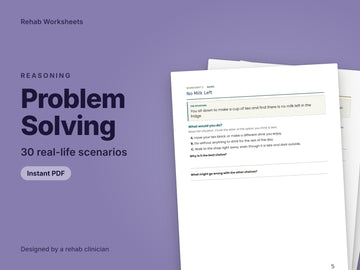
Download the PDFWorksheet 13 from the set, moderate level, The Missing Glasses. One situation in a shaded box (“You sit down to read the newspaper, but you cannot find your reading glasses anywhere.”), the instruction to write two different things you could do and what might happen for each, and writing space for Solution 1 and Solution 2, each followed by a “What might happen” line. The facilitator notes are not included; the gist for this worksheet is in the tips below. Free for personal, classroom, and session use.
Want the full set?
Personal-use license. Buying for a team? Choose the clinic license on the set's page.
- Level: moderate (worksheet 13 of 30)
- Situation: 1, the missing reading glasses
- Answers: 2 solutions, each with what might happen
- Timing: untimed, written or spoken
- Paper: US Letter

What is a problem solving worksheet?
Each worksheet in this set describes one ordinary situation in a few plain sentences: a door that closes behind you, a jar that will not open, a friend who is coming round in an hour. The person reads it and answers the question printed under it, “What would you do?” There is no trick and usually no single correct answer. The aim is the thinking and the discussion: what the problem is, what the options are, what could go wrong, and why one choice makes more sense than another. Every page can be answered in writing or talked through with a partner.
The format looks easy because the situations are familiar. It is tempting to give the first answer that comes to mind and stop. The worksheets slow that down by asking for reasons, a second option, or a backup plan, so the reasoning ends up on the page where it can be discussed.
Defining the problem
Saying what is actually wrong before reaching for a fix. On the complex pages this is step 1, a written list made before any solution is chosen.
Generating options
Coming up with more than one workable response. The moderate pages ask for two genuinely different solutions, not the same idea said twice.
Judgment and safety
Predicting what each choice might lead to and noticing risk. On many basic pages, one weaker option looks quick but is unsafe, like standing on a chair in a dark hallway.
Prioritizing
Deciding what comes first when several things compete. In Three Things at Once, the burning dinner and the smoke alarm come before the doorbell.
Is this a problem solving assessment?
No, and there is no single standardized test that this format copies. Unlike trail making or symbol digit tasks, “What would you do?” scenarios do not come from one published instrument. In occupational therapy and neuropsychology, everyday problem solving is usually looked at in two broad ways: by watching a person carry out real tasks, and through problem-solving and reasoning items within broader executive function batteries.
A well-known example of the first approach is the Executive Function Performance Test (EFPT), a performance-based assessment developed by occupational therapy researchers at Washington University in St. Louis. The person carries out four everyday tasks: simple cooking, making a telephone call, managing medication, and paying a bill. The therapist observes and records how much cueing is needed as the person starts each task, organizes it, sequences the steps, handles judgment and safety, and finishes. The focus is on what the person does, not on what they say they would do.
Assessments like these are given and interpreted by trained professionals and read alongside the rest of an evaluation. A paper scenario shows how someone reasons about a situation; a performance test shows what happens when the pan is really on the stove.
Worth knowing: the worksheets on this page are structured cognitive practice materials. They are not the EFPT or any other test, they have no norms or scores, and the suggested responses in the facilitator notes are a guide for discussion, not a marking key. They are not an assessment, and they are not a substitute for evaluation by a qualified professional. If there is a concern about how someone manages everyday problems or safety at home, raise it with the professionals involved in their care.
How the problem solving worksheets are graded
Ten worksheets at each of three levels, all titled “Everyday Problem-Solving: What Would You Do?” and all built around a situation box. What changes from level to level is how much the person has to produce on their own:
Basic
Worksheets 1 to 10. Read the situation, circle the best of three options (A, B, or C), then write why it is the best choice and what might go wrong with the other two. The weaker options tend to ignore the problem, give up on it, or take a risk that makes it worse. Titles include The Unlocked Door, No Milk Left, The Dark Hallway, Caught in the Rain, The Smoking Toaster, and The Stuck Jar.
Moderate
Worksheets 11 to 20. No options are given. The instruction reads: “There is more than one good answer. Write two different things you could do. For each one, write what might happen.” Titles include Locked Out, A Visitor in an Hour, The Missing Glasses, The Bus That Didn’t Come, The Forgotten Tablets, and Double-Booked. This is the level of the free sheet above.
Complex
Worksheets 21 to 30. Several problems arrive at once, and the page works through four steps: 1. What problems do you need to deal with? 2. What are your options? 3. What would you do first, and why? 4. What is your backup plan if that does not work? In Three Things at Once, dinner is burning, the smoke alarm is sounding, and the doorbell rings. Other titles include A Wrong Turn, The Power Cut, and The Leak Under the Sink.
Facilitator notes and suggested responses fill pages 36 to 39 of the 39-page PDF: a suggested best option for each basic page, reasonable options for each moderate page, and the problems, a strong first step, and a backup for each complex page.
| What you get | Free sample | Full set |
|---|---|---|
| Worksheets | 1 | 30 |
| Levels | Moderate | Basic, moderate, complex |
| Answer format | Two solutions, each with what might happen | Best of three options, then two solutions, then a four-step plan |
| Problems per situation | One | One on basic and moderate pages, several at once on complex pages |
| Facilitator notes and suggested responses | Not included | Yes, for all 30 worksheets |
| Paper sizes | US Letter | US Letter and A4 versions |
| Repeat sessions without reusing a page | One page | Weeks of practice |
Using it in a session or at home
- Read the situation aloud first. Before any answer, ask the person to say the problem back in their own words. If the problem is not clear, the solutions will not be either.
- Ask for the reasoning, not just the answer. On the basic pages the circled letter matters less than the two lines underneath: why it is best and what might go wrong with the others. There is no clock and no time field.
- Use the facilitator tip for the free page. For The Missing Glasses, the notes in the full set list reasonable options such as retracing steps to where the glasses were last used, checking the usual spots (the bedside, beside the chair, on top of the head), asking someone to help look, or using a spare pair. What to look for is a systematic search rather than random looking.
- Check that the two solutions are really different. “Look in the kitchen” and “look in the bedroom” are one plan, not two. Searching is one approach; asking for help or reaching for a spare pair is another.
- Talk it through when writing is hard. Every worksheet works as a spoken discussion. The person answers out loud and a partner writes the key words on the lines, so the page still records the reasoning.
- Move up when the reasons come easily. When the person can explain a basic choice and name the risk in the others, try the moderate pages. When two distinct solutions with realistic consequences come without prompting, try the complex pages. Step back a level if a blank page leads to freezing.
- Take it into planning next. When the scenarios come easily, the Executive Function Planning Task asks for a whole week of appointments and errands fitted around a few rules, the same reasoning stretched across many decisions.
Who uses problem solving worksheets
- Occupational therapists and speech-language professionals
- Hospital, outpatient, and community programs
- Educators working with adult learners
- Caregivers and family members supporting cognitive practice at home
- Adults looking for structured, printable reasoning and decision-making activities
All of our worksheets are designed to be adult-appropriate and visually clean, with everyday adult situations, plain type, and plenty of room to write.
The free worksheet above is one moderate page of thirty. The full Problem Solving set includes all 30 worksheets across basic, moderate, and complex levels, with facilitator notes and suggested responses at the back. It is also part of the Reasoning Worksheets Bundle, alongside the Safety Reasoning and Social Reasoning sets, which bring the same kind of judgment to safety and social situations. If putting the steps of a task in order is the focus, try the free task sequencing worksheet, and the executive function guide explains how the planning and reasoning sets fit together. For a longer planning task, our free executive functioning activities for adults page has a week of 12 appointments and errands to fit into a planner, with the answer key.
These materials support cognitive stimulation and structured practice. They are not medical treatment or an assessment, and no specific therapeutic outcomes are claimed.


