
The card reader says declined and there are people waiting behind you. The last bus of the night has gone two stops past your street. The clinic is running forty minutes late and your ride is due at three. A group chat has moved Saturday’s lunch twice and you are already on your way. Each one asks for the same short run of thinking: say what has actually gone wrong, think of more than one thing you could do, guess where each choice leads, and pick a first step. After a stroke, a brain injury, or a period of illness, that is often where life out of the house gets harder.
This page is about functional problem solving scenarios set out and about: realistic situations in the community, at work, on the phone, at appointments, with money and with other people, each with more than one reasonable answer. You can download two free worksheets below, one basic and one complex, with the facilitator notes for both, see how the 36-worksheet set is graded across three levels and six areas of everyday life, and read why a practice sheet is not an assessment.
Download the free problem solving scenarios
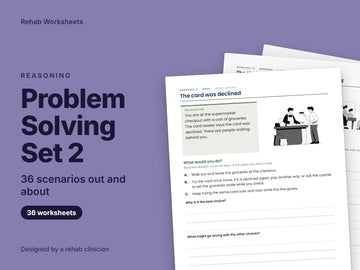
Download the PDFWorksheets 9 and 25 from the set. Worksheet 9, The card was declined, is a basic page: the situation in a shaded box with a line drawing of the checkout, three options to circle (A, B or C), and lines for why it is the best choice and what might go wrong with the others. Worksheet 25, The missed stop, is a complex page: a situation with three problems in it and the four steps to work through, with writing space for each. The third page is the facilitator notes for both, with the suggested option, the strong first step and what to look for. Free for personal, classroom, and session use.
Want all 36 scenarios?
Functional Problem Solving Scenarios for Adults, Set 2 (36 Worksheets with Facilitator Notes)$4.49
Personal-use license. Buying for a team? Choose the clinic license on the set's page.
- Level: one basic page and one complex page (worksheets 9 and 25 of 36)
- Situations: 2, each with a picture and a notes entry
- Answers: facilitator notes for both pages included
- Timing: untimed, written or spoken
- Paper: US Letter

What is a functional problem solving scenario?
Each worksheet in this set describes one ordinary situation in two or three plain sentences, with a picture of the scene beside it: a bus heading the wrong way, a prescription that has not come through, a wallet gone on the bus, a neighbor at the door about last night’s television. The person reads it, or hears it read, and answers the question printed under it, “What would you do?” The situations are functional in the plain sense: they are the problems that stop a person getting through an errand, a shift, a phone call or an appointment, away from home, where help is less to hand and the clock matters more.
There is no trick and usually no single correct answer. The aim is the thinking and the discussion: what the problem is, what the options are, what could go wrong, and why one choice makes more sense than another. The worksheets slow down the first answer by asking for reasons, a second option, or a backup plan, so the reasoning ends up on the page where it can be talked about.
Defining the problem
Saying what is actually wrong before reaching for a fix. On the complex pages this is step 1, a written list of the three problems in the situation, made before any solution is chosen.
Generating options
Coming up with more than one workable response. The moderate pages ask for two genuinely different solutions, not the same idea said twice.
Judgment and safety
Predicting what each choice might lead to and noticing risk. On every basic page one option looks quick but adds risk, like getting off a bus between stops or walking home in the dark with the groceries.
Prioritizing
Deciding what comes first when several things compete. In The first day back, the meeting in ten minutes comes before the login that does not work and the desk that has moved.
Is this a problem solving assessment?
No, and there is no single standardized test that this format copies. Unlike trail making or symbol digit tasks, “What would you do?” scenarios do not come from one published instrument. In occupational therapy and neuropsychology, everyday problem solving is usually looked at in two broad ways: by watching a person carry out real tasks, and through problem-solving and reasoning items within broader executive function batteries.
A well-known example of the first approach is the Executive Function Performance Test (EFPT), a performance-based assessment developed by occupational therapy researchers at Washington University in St. Louis. The person carries out four everyday tasks, simple cooking, making a telephone call, managing medication, and paying a bill, while the therapist records how much cueing is needed as the person starts each task, organizes it, sequences the steps, handles judgment and safety, and finishes. The focus is on what the person does, not on what they say they would do. Assessments like these are given and interpreted by trained professionals and read alongside the rest of an evaluation. A paper scenario shows how someone reasons about a situation; a performance test shows what happens when the card really is declined at a real checkout.
Worth knowing: the worksheets on this page are structured cognitive practice materials. They are not the EFPT or any other test, they have no norms or scores, and the suggested responses in the facilitator notes are a guide for discussion, not a marking key. They are not an assessment, and they are not a substitute for evaluation by a qualified professional. If there is a concern about how someone manages everyday problems or safety out of the house, raise it with the professionals involved in their care.
How the functional problem solving scenarios are graded
Twelve worksheets at each of three levels, the same three levels as the first Everyday Problem Solving set, and two worksheets at each level in each of six areas: community and transport, work and volunteering, phone and online, health appointments and pharmacy, money mishaps, and social plans. Every page has the situation in a shaded box, a black and white picture of the scene, and the question “What would you do?” What changes from level to level is how much the person has to produce on their own:
Basic
Worksheets 1 to 12. Read the situation, circle the best of three options (A, B, or C), then write why it is the best choice and what might go wrong with the other two. The weaker options give up on the problem, ignore it, or add risk. Titles include The wrong bus, The phone menu you did not catch, Breakfast before the scan, The card was declined, and An hour early. This is the level of the first free page above.
Moderate
Worksheets 13 to 24. No options are given. The instruction reads: “There is more than one good answer. Write two different things you could do. For each one, write what might happen.” Titles include The ticket machine will not take your card, Two requests at once, The code that did not arrive, The clinic is running late, and Charged twice.
Complex
Worksheets 25 to 36. Three problems arrive at once, and the page works through four steps: 1. What problems do you need to deal with? 2. What are your options? 3. What would you do first, and why? 4. What is your backup plan if that does not work? In The missed stop, the second free page, the last bus of the night has gone two stops past your street and you have no cash for a taxi. Other titles include The roster change, The missed call from the clinic, The lost wallet, and The noise complaint.
Facilitator notes and suggested responses fill the last six pages of the 47-page PDF: a suggested best option for each basic page, reasonable options and what to look for on each moderate page, and the problems, a strong first step and a backup for each complex page. The set comes in US Letter and A4.
| What you get | Free sample | Full set |
|---|---|---|
| Worksheets | 2 | 36 |
| Levels | Basic and complex | Basic, moderate, complex |
| Answer format | Best of three options, and a four-step plan | Best of three options, then two solutions, then a four-step plan |
| Areas of everyday life | Money, and community and transport | Six: community and transport, work and volunteering, phone and online, health appointments and pharmacy, money mishaps, social plans |
| Picture of the situation | On both pages | On every page |
| Facilitator notes and suggested responses | For the two sample pages | Yes, for all 36 worksheets |
| Paper sizes | US Letter | US Letter and A4 versions |
| Repeat sessions without reusing a page | Two pages | Weeks of practice |
Using it in a session or at home
- Say the problem back first. Before any answer, ask the person to say in their own words what has gone wrong. On the complex pages that is the whole of step 1. The problem in The card was declined is that this card will not pay right now, not that the person has no money.
- Use the picture, or cover it. The drawing sets the scene for someone who finds a block of text hard. When it gives too much away, cover it and read the situation aloud.
- Ask for the reasoning, not just the letter. On the basic pages the circled letter matters less than the lines underneath. The notes say why option B is suggested for the free page: one more try, then another way to pay, and if that fails, asking for the groceries to be set aside.
- Check that the two solutions are really different. On the moderate pages, “call the bank” and “call the bank tomorrow” are one plan. Calling the store that took the payment and calling the bank are two.
- First step, then backup. On the complex pages, the strong first step is usually the one with a clock on it. In The missed stop the working phone is the key fact; the notes look for the person noticing it and not staying on the bus to the depot.
- Talk it through when writing is hard. Every worksheet works as a spoken discussion. The person answers out loud and a partner writes the key words on the lines. When a page out and about leads to freezing, step back a level, or back to a home page from the first set.
Who uses functional problem solving scenarios
- Occupational therapists and speech-language professionals
- Hospital, outpatient, community reintegration and return-to-work programs
- Educators working with adult learners
- Caregivers and family members supporting cognitive practice at home
- Adults looking for structured, printable reasoning and decision-making activities
All of our worksheets are designed to be adult-appropriate and visually clean, with everyday adult situations, plain type, a picture on every page, and plenty of room to write.
The free pages above are two of thirty-six. The full Functional Problem Solving Scenarios for Adults, Set 2 includes all 36 worksheets across basic, moderate, and complex levels, with facilitator notes for every page. The first set, Problem Solving Worksheets for Adults, has 30 situations at home, and its own free problem solving worksheet. Both are part of the Reasoning Worksheets Bundle, alongside the Safety Reasoning and Social Reasoning sets, and the executive function guide explains how the planning and reasoning sets fit together. For a longer planning task, the free executive functioning activities for adults page has a week of appointments and errands to fit into a planner.
These materials support cognitive stimulation and structured practice. They are not medical treatment or an assessment, and no specific therapeutic outcomes are claimed.


