
A letter from the clinic says Wednesday at ten. The case manager wants a call on Wednesday or Thursday afternoon. A sister’s baby shower is Saturday at two, the car is booked for a tune-up the same afternoon, and somewhere in the week there has to be an hour for groceries. Most adults sort this out on the back of an envelope without noticing they are doing it. After a stroke, a brain injury, or a long illness, the same week can take a whole afternoon, and the clashes only show up when two things arrive at once.
This page is a guide to executive functioning activities for adults, built around one task that looks like real life: planning a week. The free printable PDF, no email required, is a complete session from the Executive Function Planning Task: the client page of a Level 2 scenario, the blank weekly planner, the scoring form, and the answer key. Below the download: what the task asks, the thinking skills behind it, the clinical assessment the format borrows from, how the seven scenarios are graded, how to run and score a session, eight planning strategies to coach, and how to carry the planner into real life.
Download the free planning task
Download the PDFFour pages from the Executive Function Planning Task. Page 1 is the client page of Scenario 2C, Level 2: Sam, 35, a hospital porter returning to work after an injury, with 12 appointments and errands and three rules. Page 2 is the blank Weekly Planner, Monday to Sunday with a row for every hour from 7:00 am to 8:00 pm, an item tracker, and boxes for what could not be scheduled and what carries over. Page 3 is the Scoring and Observation Form. Page 4 is the answer key for Scenario 2C: the reference week, the two conflicts to find, how to check each rule, and the distraction timing. Free for personal, classroom, and session use.
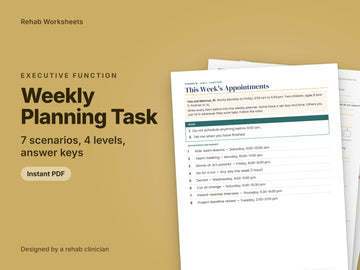
Want all 7 scenarios?
Personal-use license. Buying for a team? Choose the clinic license on the set's page.
- Level: 2 of 4, Scenario 2C
- Items: 12 appointments and errands, 3 rules
- Expected: 10 planner entries, 2 that cannot be scheduled
- Timing: untimed, with optional distractions at minutes 2 and 5
- Paper: US Letter, planner in landscape

What are executive functioning activities for adults?
Executive functioning activities for adults are tasks that put the organizing skills of everyday life to work: deciding what has to happen first, holding several rules in mind, noticing when two things clash, changing the plan when they do, and checking the result. The best ones look like the real thing. A weekly planning task is close to real life because almost every adult has to do it: appointments arrive with fixed times, errands have to be fitted around them, and a few rules, such as a rest day or the time it takes to get across town, shape what fits where.
The Executive Function Planning Task is written for adults, not students. Every scenario is a made-up person with an ordinary week: a hospital porter going back to work after an injury, a college student with shifts at a cafe, a retired teacher with a choir and a dog. The behaviors the task draws out are summarized at the end of the scoring form, and they fall into four groups:
Planning and organization
Reading the whole list before writing, finding the items with a set day and time, and placing them before the flexible ones. Sam’s three work shifts go in before the grocery shopping does.
Rule following and attention to detail
Keeping each rule in mind while writing, and copying days and times correctly. Nothing on Thursday, and at least 30 minutes between appointments.
Flexibility and updating
Noticing a clash, choosing which item to keep, blocking travel time, and taking in new information partway through. The Friday blood test and the Friday work shift cannot both happen.
Self-monitoring and distraction management
Checking the work before saying “finished”, estimating one’s own errors, and finishing an entry before answering a question. Sections A and F of the form compare the estimate with the count.
The Weekly Calendar Planning Activity, and how this task differs
The format borrows from the Weekly Calendar Planning Activity, or WCPA, a performance-based assessment of executive function developed by the occupational therapist Joan Toglia and published through AOTA Press. In the WCPA the person receives a list of appointments and errands and enters them into a weekly calendar while following a set of rules. The examiner records the time taken, the entries that are accurate, the rules followed, the strategies observed, and how the person rates their own performance before and after the task. Occupational therapists use it with adults in hospital, community, and research settings, and versions exist for different age groups.
The Executive Function Planning Task uses the same idea as a practice format rather than a test. It has its own scenarios, rules, and scoring form, and nothing in it is scored against norms. What it keeps is the structure that makes the format useful: fixed and flexible items, conflicts to notice, a distraction during the task, and a before-and-after estimate that shows how aware the person is of their own performance.
Worth knowing: the planning task is a functional task for observation and structured practice. It is not the WCPA, not a standardized test, and not an assessment, and it is not a substitute for evaluation by a qualified professional. Its scoring form is a practice record, not a test result.
How the planning task is graded
The full set has seven scenarios across four levels. Each level adds something to the week, and the one-page guide suggests where to start:
Level 1: first exposure
One scenario (1B) with 8 items, 1 conflict, and 1 scheduling rule. The guide suggests it for moderate impairment or a first session with the format.
Level 2: most adults
Two scenarios (2B and 2C) with 12 items. They add flexible items with a window to fit them in, a journey to block out, and 2 scheduling rules. The free scenario is 2C.
Level 3: return to work or school
Two scenarios (3A and 3C) with 17 items. They add an appointment whose day and time the person has to ask for, a phone call that changes the plan partway through, and 3 scheduling rules.
Level 4: high-functioning clients
Two scenarios (4A and 4C) with 17 items. They add pacing rules, such as no more than three appointments in a day, items that depend on each other, and an item that clashes with a rule.
Every scenario ends with the same closing rule, “Tell me when you have finished”, and the form records whether the person said it without being asked.
| What you get | Free sample | Full set |
|---|---|---|
| Scenarios | 1: Sam, Level 2 | 7, across 4 levels |
| Items per scenario | 12 | 8 to 17 |
| Rules per scenario | 3, including “tell me when you have finished” | 2 to 4 |
| Answer key | For Scenario 2C | For every scenario |
| Weekly planner and scoring form | Included | Included, one of each per session |
| One-page guide and My Planning Steps take-home sheet | Summarized on this page | Included |
| Sessions without repeating a scenario | One session | Seven, then repeat at a new level |
Running the planning task in a session
The one-page guide sets out the session in five steps. You need the client page, the blank planner, the scoring form, a pen with an eraser, and a timer. Keep the answer key out of sight.
- Give the instruction once. “Here is a list of appointments and errands for one week, and a blank weekly planner. Write every item into the planner so the week works. Some have a set day and time; others you fit in wherever they work best. Follow the rules at the top. Take as long as you need, and tell me when you have finished.”
- Ask the two before-task questions. “How hard do you expect this to be?”, rated from very easy to very hard, and “How many mistakes do you expect?” Then say “You can begin”, start the timer, and note when the pen first touches the planner.
- Stay neutral. Answer questions about the procedure. For questions about content, such as “Which one should I keep?”, say “Do what you think is best.”
- Add the optional distractions. The 2C key times them at minute 2, a question about the person’s favorite way to spend a day off, and minute 5, a pen or a set of keys dropped nearby and picked up without comment. Record how each was handled: C continued the entry then answered, A answered and returned cleanly, L lost their place, S stopped and needed a prompt.
- Stop at “finished”. Ask the after-task questions, how hard it was and how many mistakes they think they made, before giving any feedback. Then score.
Scoring: what to count
Scoring is behavioral and countable, which is what makes the task repeatable from session to session. Write one code per item, in the order of the client page:
- Tick, correct. Right day and the right half-hour row; a flexible item is correct anywhere in its window.
- M, missing. Not on the planner and not in either box.
- D, wrong day. Right time, wrong column.
- T, wrong time. Off by more than 30 minutes, travel not blocked, or outside the window.
- X, duplicate. Written twice, or the old entry left in place after the interruption.
- R, rule break. Placed where a rule forbids it.
Then count the items in the could-not-schedule box, the conflicts detected, and the rules followed, and compare the person’s estimate of their mistakes with the total: within one is accurate, fewer is under-estimating, which the guide notes is common after brain injury, and more is over-estimating. For Sam’s week the key expects 10 entries on the planner and 2 in the could-not-schedule box: the Friday work shift overlaps the blood test at the lab, and the baby shower overlaps the car tune-up. Either item of a pair may be kept, as long as the clash is noticed. The family dinner in the next town earns its tick only when the hour’s drive each way is blocked out as well.
Eight planning strategies to coach
The guide’s last section pairs one or two strategies at a time with the errors seen, each with a line the person can say to themselves:
- Read everything first. “Let me read the whole list first.”
- Rules first. “What am I not allowed to do this week?”
- Set times before flexible times. “Fixed first, flexible second.”
- Mark it as you go. “Done, cross it off.”
- Check the slot before you write. “Is this space really free?”
- Finish the entry, then answer. “One second, let me finish this.”
- Say your plan out loud. “Tuesday, nine o’clock, library.”
- Check your work at the end. “Every item, one more time.”
Section E of the scoring form lists the strategies observed, with a P beside any that appeared only after a prompt, so the next session can start from what the person already does.
Time management activities for adults: taking the planner home
The planner is also a time management activity for adults who want the habit to carry over. The full set includes My Planning Steps, a client take-home sheet with the same six steps (read, sort, place the fixed ones, fit in the rest, mark as you go, check) and a line for where the person is most likely to slip. The guide suggests fading the prompts as habits stick, then moving them to the person’s real calendar. A few ways to extend the practice:
- Replan a real week. Use the blank planner with the person’s own appointments and the rules they live by: a rest day, the bus to the clinic, no calls before nine.
- Repeat the level, change the scenario. Two scenarios at each of Levels 2 to 4 let a second session show whether the strategies held.
- Keep the estimate questions. The gap between expected and actual mistakes is often the most useful number on the form, and it is worth tracking across sessions.
- Change one thing at a time. The plan box at the end of the form offers four moves: repeat the level, add a cue card, fade the cue, or go to the next level.
- Describe, do not score. The guide asks for performance to be written up in notes rather than as a score, because this is a functional task, not a standardized test.
Who uses the planning task
- Occupational therapists and speech-language pathologists working on planning and organization with adults after a stroke or brain injury
- Return-to-work and return-to-school programs, where a week of shifts, classes, and appointments is the real goal
- Transition and special education teachers working with young adults on managing a week
- Community and day programs that practice life skills in small groups
- Families running a session at home with the four free pages
The free pages above come from the full Executive Function Planning Task: seven scenarios in four levels with the planner, the scoring form, the take-home sheet, and the one-page guide, 19 pages on US Letter. For the step-by-step side of planning, our free task sequencing worksheets put the steps of everyday activities in order, and our free problem solving worksheets work through everyday decisions. The paperwork behind the appointments, from reading an appointment card to planning a week of visits around a cancelled one, is practiced in Health Appointments & Forms. Our executive function worksheets guide shows how the formats fit together, and every set is in the executive function and reasoning collection.
These materials support cognitive stimulation and structured practice. They are not medical treatment or an assessment, and no specific therapeutic outcomes are claimed. Every person in the scenarios is made up.


