
Most people look for a cursive alphabet chart with one letter in mind: how a cursive capital G goes, where the f loops, why the z drops below the line. The charts that come up first are made for second graders, with bright borders, cartoon headers, and no sign of where the pen should start. Adults reach for cursive for a signature, a birthday card, a form that asks for it, or a stack of letters from a parent, and they need the letters plain, large, and in the order the pen moves.
This page has a free cursive alphabet chart for adults and teens: every capital and lowercase letter in a traditional looped hand, each with a dot where the pen goes down, an arrow for the way it travels, and numbers where it lifts. A second page turns the chart into practice, one letter family at a time. The letters are the same ones taught in the 30-worksheet Cursive Handwriting Practice set and the 120-page cursive workbook, so nothing has to be relearned later.
Download the free cursive alphabet chart
Download the PDFPage 1 is the chart: 26 capital and lowercase pairs with start dots, direction arrows and stroke numbers, a slant guide, and the four joins. Page 2 is a practice page: the five letter families to trace from the dot, then write on your own. Free for personal, classroom, and session use.
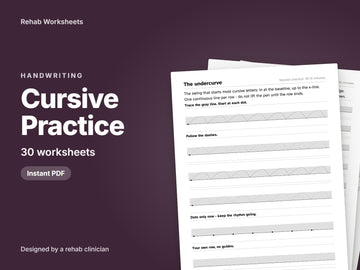
Want the full set?
Personal-use license. Buying for a team? Choose the clinic license on the set's page.
- Letters: 26 capitals and 26 lowercase
- Strokes: start dots, arrows, numbered lifts
- Joins: the four kinds
- Practice: 5 letter families
- Paper: US Letter

How to read the chart
Each pair sits on the same three-line lane as the worksheets: a top line, a dashed middle line, and a bold baseline, with a shaded band where the small letters live. A small print label above each pair says which letter it is, because cursive capitals such as G, I, J, and Q look nothing like their print forms.
The start dot
Where the pen goes down. Every lowercase letter starts on the baseline, at the beginning of its swing up. Capitals start where their first stroke begins: at the top for C, D, E, O, and Q, on the baseline for G and S, and at a small hook or curl for most of the rest. Find the dot before the pen moves.
The arrow
Which way the pen travels. On lowercase letters it shows the move after the swing: back around the bowl of an a, over the top of a loop, down from the point of an i. Bowls and loops go counterclockwise.
The numbers
Most cursive letters are one movement. A few lift the pen: the dots of i and j, the crosses of t and x, and the capitals B, F, H, K, P, R, T, and X. The numbers give the order.
The band
Small letters fill the shaded band. Tall loops reach toward the top line, tails drop below the baseline, and capitals stand about twice the height of the band. Size is half of what makes cursive readable.
Cursive letters A to Z
Every pair from the chart, larger, with a line on how it is written. Lowercase letters all begin with the same swing up from the baseline, so the notes describe what comes after it.
Jump to a letter: A B C D E F G H I J K L M N O P Q R S T U V W X Y Z
Cursive A and a

Capital A starts at the bottom left, climbs to the point and comes down the right side, then loops back across for its crossbar. Lowercase a swings up, then curves back over the top and around; close the bowl before the downstroke, or it reads as u.
Cursive B and b

Capital B is two strokes: swing up to the top and pull the stem straight down, then lift and start again on the stem for the two bumps. Lowercase b rides the swing up into a tall loop, comes down, and ends in a small bowl that finishes high, so the next letter joins from the top.
Cursive C and c

Capital C starts at the top right and curves up, over and down the left side to a small upturn. Lowercase c swings up and curves back over the top, like the start of an a, and stays open.
Cursive D and d

Capital D starts at the top of the stem: pull down, make a small loop at the foot, then sweep right, up and over the top. Lowercase d makes the bowl of an a, climbs to the top line, and comes straight back down.
Cursive E and e

Capital E starts at the top right: curve over and down to a small turn in the middle, then a bigger curve below. Lowercase e swings up into a small loop and back down; keep the loop open, or it reads as i.
Cursive F and f

Capital F is three strokes: the top bar, the stem from the bar down to its curl, and the short crossbar, left to right. Lowercase f is the only letter looped above and below the line: up into a tall loop, straight down past the baseline, and back up. A b starts the same way but closes into a small bowl instead.
Cursive G and g

Capital G starts on the baseline at the left, swings up into a tall loop, and finishes with a long stroke across. Lowercase g makes the bowl of an a, then drops into a tail loop below the line.
Cursive H and h

Capital H is two strokes: the left stem from a small hook at the top, then the right stem, which turns back up into the looped crossbar. Lowercase h is a tall loop followed by a hump, like n.
Cursive I and i

Capital I starts with a small hook at the top left, then one long stroke down that curls left at the foot. Lowercase i swings up, comes straight back down, and gets its dot last.
Cursive J and j

Capital J starts like I, then drops below the line into a loop and swings back up. Lowercase j swings up, drops into a tail loop, and gets its dot last.
Cursive K and k

Capital K is two strokes: the stem, then a curve in from the top right that touches the stem at the middle and kicks out. Lowercase k is a tall loop, then a small loop and a kick at the middle.
Cursive L and l

Capital L starts with a small curl at the left, rises into a big loop at the top, comes down, and finishes with a small loop and a wave along the baseline. Lowercase l is one tall loop; keep it open, or it reads as a stick.
Cursive M and m

Capital M starts with a small hook on the left and climbs to two sharp peaks. Lowercase m swings into three humps; n has two.
Cursive N and n

Capital N starts like M but has one peak, and it finishes high at the right. Lowercase n swings into two humps.
Cursive O and o

Capital O starts at the top, goes left and all the way around, then makes a small loop inside at the top. Lowercase o swings up, goes around, and finishes high with a small bridge into the next letter.
Cursive P and p

Capital P is two strokes, like B: the stem, then a lift and one bump at the top. Lowercase p swings up, drops a long stem below the line, and comes back up into a bowl.
Cursive Q and q

Capital Q starts at the top and goes around like O, then curls in to a point and kicks out to the lower right. Lowercase q makes the bowl of an a, then drops a tail below the line that loops back up.
Cursive R and r

Capital R is two strokes, like B: the stem, then the bowl, which tucks in at the middle and kicks out to the right. Lowercase r swings up to a small point, steps right along its shoulder, and comes down.
Cursive S and s

Capital S starts on the baseline at the left, swings up into a loop at the top, and curves back down and around. Lowercase s swings up to a point, then comes down and around to close against itself.
Cursive T and t

Capital T is two strokes: the top bar, then the stem from the bar down to its curl. It is an F without the crossbar. Lowercase t swings up to the top, comes straight back down, and is crossed last, left to right.
Cursive U and u

Capital U starts with a small hook at the top left, comes down and around the bottom, then climbs the right side and comes back down. Lowercase u swings up, comes down, and goes around and up again for its second stroke.
Cursive V and v

Capital V starts with a hook at the top left, comes down to a point at the bottom, and climbs to finish high at the right. Lowercase v swings into a hump, then finishes high with a small bridge.
Cursive W and w

Capital W starts with a hook at the top left, then goes down and up twice and finishes high. Lowercase w is like u, then up once more to finish high with a small bridge.
Cursive X and x

Capital X is two strokes: the first curve, over its hump and down, then a lift and the cross from the top right. Lowercase x swings over a hump and down, then is crossed last, from the top right down to the left.
Cursive Y and y

Capital Y is like U, but its second stroke drops below the line into a loop. Lowercase y is like u, but its second stroke drops into a tail loop.
Cursive Z and z

Capital Z is a wave across the top, a long slant down to the left, and a wave along the bottom. Lowercase z swings into a hump at the top, then drops into a tail loop below the line.
The four joins
A cursive letter on its own is only half the job. In a word, each letter hands off to the next, and the chart's bottom row shows the four ways that happens, with the letters light and the join dark:
- Baseline join. Most letters finish on the baseline and swing straight up into the next one, as in it, un, and tin.
- The dip. Before a, c, d, g, o, and q, the join dips to the baseline and climbs the far side of the bowl, as in ca, go, and add.
- The bridge. After b, o, v, and w, the letter finishes high, so the join leaves from the top like a small bridge, as in on, we, and bow.
- Into the loops. Into e, l, h, b, k, and f, the join rides straight up into the loop, as in le, the, and be.
The joins are where most adult cursive stalls, which is why the full set gives them six worksheets of their own. The free baseline joins worksheet practices the first one.
Slant and size
The model hand leans about 18 degrees, and the slant guide on the chart shows that angle behind the word little. Upright writing is fine too. What makes cursive look messy is slant that changes from letter to letter, so the goal is one angle, kept steady. Size works the same way: the small letters should all fill the band, and the loops should all reach about the same height.
Is this a handwriting assessment?
No. A cursive chart does not borrow from any standardized test, and none is implied. Questions about whether a writing difficulty has a name, or how handwriting compares with what is expected, belong with a qualified professional, typically an occupational therapist, who uses standardized measures alongside a history.
This chart and practice page are reference and practice materials. They are not an assessment and not a handwriting program, they do not identify any condition, and nothing here is a substitute for an evaluation by a qualified professional.
How the practice page works
The second page groups the lowercase letters into the five families the worksheets teach, because letters that start with the same move are easier to learn together. Each family gets two lanes:
Model
Each letter in black, with its start dot and its arrow. Look at it before writing anything.
Trace
Gray copies with a dot where the pen starts: three for each letter in the four-letter families (i u t w, r s p j), one in the six-letter families.
On your own
An empty lane under each family for writing the letters without help. The page ends with the self-check printed on every worksheet: circle your smoothest three.

| What you get | Free chart | Full set |
|---|---|---|
| Pages | 2: the chart and a practice page | 30 worksheets, plus a how-to guide |
| Letters | All 26, capitals and lowercase | All 26, by stroke family, with a tricky-letters clinic |
| Strokes | Shown with dots and arrows | 4 stroke worksheets before any letters |
| Joins | The four kinds, one pair each | 6 join worksheets, from baseline joins to a doubles clinic |
| Fading support | Model, gray copies, empty lane | Solid model, dashes, then dots alone on every page |
| Words, sentences, and your name | None | 8 worksheets |
| Repeat sessions without reusing a page | One page | Weeks of practice |
Using it in a session or at home
- Keep the chart beside the page. Look letters up while writing real words instead of copying the alphabet in order. A letter checked ten times in context sticks better than one copied ten times in a row.
- Start at the dot every time. Most letters that come out wrong started in the wrong place. Put the pen on the dot before anything moves.
- One family per session. One family on the practice page is a full ten to fifteen minutes. Stop while the strokes are still smooth.
- Lowercase first, capitals later. Nearly everything people write is lowercase. Capitals can wait until the small letters and the joins come easily.
- Check the slant, not the beauty. Hold a finished line up to the slant guide. Steady and readable is the goal; ornate is optional.
- Writing with the left hand? Turn the paper the other way, keep the hand below the line rather than hooked over it, and let the slant stand upright if that is steadier. The dots and arrows are the same for either hand.
Who uses a cursive alphabet chart
- Adults who learned cursive at school and want to read or write it again
- Teens who were taught print only and now meet signatures, cards, and forms
- People with dysgraphia, dyslexia, or ADHD who want adult materials rather than children’s ones
- Anyone relearning handwriting after a stroke or brain injury, with the OTs who work alongside them
- Teachers, tutors, and literacy programs working with older learners
The chart puts every letter on one page. To practice them properly, the full Cursive Handwriting Practice set has 30 worksheets and a how-to guide: strokes, lowercase by family, six worksheets on the joins, capitals, words and sentences, and your name and a short note, with three levels of fading support on every page. The Dysgraphia Cursive Handwriting Workbook for Adults is the whole course in 120 pages, and it is also a paperback on our printed workbooks page. The free baseline joins worksheet is a good next page, and the handwriting guide shows how print, cursive, and the color-coded paper fit together.
These materials support handwriting practice. They are not medical treatment or an assessment, and no specific therapeutic outcomes are claimed.

