
An eye appointment missed because the card stayed in a coat pocket. Keys that are never where they were left. The name of a new nurse, gone before the end of the visit. Lapses like these are often the first thing people and their families notice after a stroke, a brain injury or a change in memory with age. Memory strategies for adults are practical ways to remember the things that matter in a day, or to keep track of them when memory is unreliable.
They come in two broad kinds. Some keep the information outside your head, in a notebook, a reminder or a fixed place. Others change the way it goes in, by grouping it, picturing it or putting it in your own words. This page has a free memory strategy card with eight strategies in three groups, what the research says about who each kind suits, and how the 32-worksheet pack teaches these strategies for memory one at a time.
Download the free memory strategy card
Download the PDFStrategy card MSC, a printable memory strategies handout to keep: eight strategies in three groups, each with a picture, one line on how to do it and what it is good for. Below them, six everyday jobs to match to a strategy and a line for the one to try first. Page two is the key, with the best choice for each job and the others that also work. Free for personal, classroom, and session use.
Want all 32 worksheets?
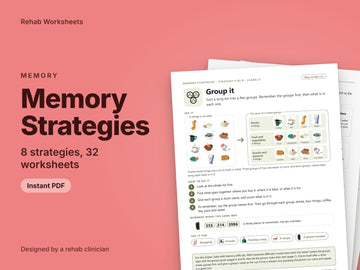
Memory Strategies Worksheets for Adults (32 Worksheets)$5.49
Personal-use license. Buying for a team? Choose the clinic license on the set's page.
- Strategies: 8, in three groups
- Match: 6 everyday jobs
- Key: included, with other good answers
- Keep it: by the notebook or the phone
- Paper: US Letter

Eight memory strategies for adults
The card sorts memory strategies for adults by where the remembering happens, because the three kinds suit different people. Published guidance recommends outside help for everyone, internal strategies mainly when memory difficulty is mild, and partner-led methods for specific names, facts and routines when it is more severe.
Help from outside your head
A notebook, a reminder and a fixed home for things hold the information. Strategies 1 to 3, for every level of memory difficulty.
Ways to take it in
Grouping, picturing and own words change how the information is learned. Strategies 4 to 6, mainly for milder memory difficulty.
Ways a partner can teach it
A helper teaches one name, fact or routine at a time. Strategies 7 and 8, when memory loss is more severe.
Compensatory memory strategies: help from outside your head
Compensatory memory strategies, often called external memory aids, put the remembering somewhere you can see it. They have the strongest research behind them and are usually the first to teach.
- 1. Write it in one place. One notebook or planner for everything, written in straight away and checked at set times, such as after breakfast, lunch and dinner. One book beats a dozen sticky notes: there is one place to look. Good for appointments and messages.
- 2. Plan the when. Set a reminder you will notice (an alarm with a label, a note where you will look, the thing itself in your way), then picture the moment you will do it: when I sit down to breakfast, I take my pill. Good for medicines and calls.
- 3. Keep it in its place. Give keys, glasses, phone and wallet one home each, near where you use them, and put them back every time. Good for the things families most often hunt for.
Internal memory strategies: ways to take it in
Internal memory strategies work on the information itself. They are also known as memory enhancing strategies, and the rhymes and first-letter words many people learned at school are one kind of mnemonic strategies. The three on the card are built for everyday things: a list, a name, a letter.
- 4. Group it. Sort a long list into a few groups, remember the groups first, then what is in each. Twelve things to buy become three named groups of four. Good for shopping and errands.
- 5. Picture it. Make a picture in your mind that joins things together. Big, odd pictures are the easiest to see again, such as glasses perched on a loaf of bread. Good for names and where you parked.
- 6. Make it your own. Say it in your own words, ask your own questions about it, then check yourself without looking. For a letter, the pack makes this five steps: look it over, ask, read, say it back, check. Good for letters and the news.
Ways a partner can teach it
When memory loss is more severe, or with dementia, guessing tends to get in the way: a wrong answer, once said, is easy to say again. A family member, therapist or care worker uses these two with the person.
- 7. Learn it without guessing. The partner gives the answer first, then a little less help each time (the whole answer, the first part, the first sound, the picture alone), so a wrong answer is never practiced. This is errorless learning. Good for a new name or routine.
- 8. Recall it at growing gaps. Ask for the same fact after 30 seconds, then 1, 2, 4 and 8 minutes, with other talk in between. If it slips, give the answer, have it said back, and go back to the last gap that worked. This is spaced retrieval. Good for a door code or where things go.
What the research says about memory strategies
Guidelines for memory after a brain injury, such as the international INCOG 2.0 guidelines, and the Cicerone reviews, which also cover stroke, give the same advice. Reminders, notebooks and other outside supports are recommended at every level of memory difficulty, with the person and those around them shown how to use them, and are the main approach when difficulty is severe. Internal strategies such as visual imagery are recommended mainly for milder difficulty. Errorless learning and spaced retrieval are named for teaching specific information, and training is meant to use everyday activities, not drills.
Reviews of the trials are more cautious. A Cochrane review of memory programs after stroke (13 small trials, 514 people) found that people rated their own memory as better right after the program, but not clearly at follow-up, and judged the evidence too limited for firm conclusions. A 2023 Cochrane review of goal-focused programs in mild to moderate dementia found people closer to the everyday goals they had chosen, while memory test scores changed little. A common thread is that a strategy rarely spreads to new tasks on its own, which is why the pack teaches each one in stages, on everyday tasks and then on the person's own week.
Worth knowing: these worksheets put published strategies into plain words and everyday tasks. They are structured practice materials, not a memory program or an assessment, with no scores or norms, and not a substitute for evaluation by a qualified professional. If memory is a new worry, or is getting worse, talk to a doctor first.
How the memory strategies pack is graded
Each strategy is taught in three stages: learn it, practice it on set tasks, then use it in daily life. Every strategy has four pages, 32 in all:
Learn it
A page to keep: what the strategy is, a worked example in pictures, four or five steps, what it is good for, and a box for the helper on who it suits.
Basic
Plenty of support: the groups, sections or places are given, and recall comes straight away or after a minute. Eight notes to file in the notebook, eight things to buy in two groups.
Moderate
Fewer cues and a wait of 5 to 10 minutes filled with other talk. Six phone messages to write down as a partner reads them, ten errands to sort by place.
Complex
The person sets the strategy up, with longer waits and real plans: a week planned from a clinic letter, an eye clinic card and a text message, or the names of a six-person care team.
The pack opens with a how-to-use page and the free card, and closes with a strategy log, one row a day for a week at home. Every worksheet has a model answer or filled example in a second PDF.
| What you get | Free card | Full pack |
|---|---|---|
| Strategies | All 8, one line each | All 8, each with a learn it page |
| Worksheets | 1, with 6 jobs to match | 32: 8 learn it pages and 24 worksheets |
| Levels | One | Basic, moderate, complex |
| Partner scripts | No | Printed on the partner pages |
| Answer key | Yes | A model answer for every worksheet |
| Strategy log for a week at home | No | Yes |
| Repeat sessions without reusing a page | One page | Weeks of practice |
Using it in a session or at home
- Choose one or two strategies at a time. Read the card together and circle the ones that sound like the person. Talking through the match is a good way in.
- Start outside the head. A notebook, reminders and a home for things suit every level of memory difficulty.
- Fill the waits. The wait before recall is part of the page. Talk about something else or do another page.
- Move up slowly. Stay at a level for a few sessions, and move on when the strategy gets used without a prompt.
- Bring it into speech therapy sessions. Strategy 6 fits the person's own mail, and strategies 7 and 8 fit a name or fact they want to learn. The partner can write down the person's words.
- Make it real. Once a page goes well, use the strategy on the person's own lists, names and appointments.
Who uses memory strategy worksheets
- Occupational therapists teaching memory strategies for everyday tasks after a stroke or a brain injury
- Speech-language pathologists using memory strategies in speech therapy sessions
- Memory groups and community programs taking one strategy a week
- Care teams teaching a new name or routine with the partner methods
- Family members helping at home, with the strategy log for the week
The free card comes from our Memory Strategies Worksheets for Adults: all eight strategies, each with a learn it page and three graded worksheets, plus a strategy log and a model answer for every worksheet. The Memory Worksheets Bundle has this pack and six more memory sets, 185 worksheets in all. The memory worksheets guide covers the kinds of memory and every memory set.
These materials support cognitive stimulation and structured practice. They are not medical treatment or an assessment, and no specific therapeutic outcomes are claimed.

