
Part of the cognitive rehabilitation worksheets guide
Almost every handwriting workbook is written for a seven-year-old. Adults and teens who want to rebuild print letters, learn joined writing, or simply make a form legible are left with cartoon pages, baby vocabulary, and lines the wrong size for a grown hand. Handwriting is also a skill that changes: after a stroke or brain injury, with dysgraphia, ADHD, or dyslexia, or just from years of typing instead of writing.
This guide covers handwriting worksheets and practice sheets for adults, built for older hands: print letter formation with stroke arrows, cursive taught through the joins, and color-coded paper that fades its support as placement becomes reliable. Four free downloads cover print letters, cursive joins, left hand writing, and color-coded paper, no email required.
Everything on this page is for handwriting practice and educational use, not treatment, therapy, or assessment.
Handwriting worksheets for adults, by format
Each free PDF opens directly, and the full set sits beside it with its price.
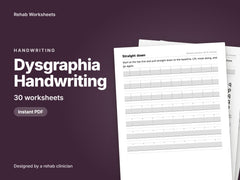
Print handwriting worksheets (dysgraphia set)
Thirty worksheets: pre-writing strokes, lowercase letters in six stroke families with numbered arrows, b and d reversals, capitals, numbers, and size and spacing. The curve letters worksheet is free.
The full set: Dysgraphia Handwriting Worksheets for Adults and Teens (30) $4.25
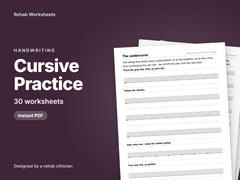
Cursive handwriting worksheets
Thirty worksheets in a traditional looped hand: strokes, letter families, six worksheets on the joins themselves, capitals, words, and your own name. The baseline joins worksheet is free.
The full set: Cursive Handwriting Practice for Adults and Teens (30) $4.25
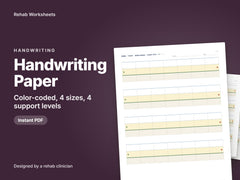
Color-coded handwriting paper (dyslexia paper)
Lined paper where every line has a job: a blue top line, a dashed midline, a bold green baseline, and a dotted descender guide. Four sizes, four support levels, letter boxes, and a guide. The color guide and a medium sheet are free.
The full set: Dyslexia and Dysgraphia Handwriting Paper $3.99
Dysgraphia Handwriting Worksheets
The full print set: 30 worksheets plus a how-to guide, with the three levels of fading support on every page and the legibility checklist.
$4.25
Cursive Handwriting Practice
The full cursive set: 30 worksheets and a how-to guide, from the first undercurve to a dated note written in your own hand.
$4.25
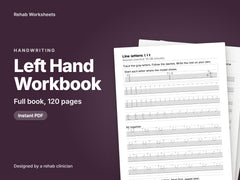
Left hand writing practice
For adults who have to write with their other hand after a stroke, injury, or surgery. The setup page and the first letters page of the 120-page workbook are free.
The full set: Left Hand Writing Practice Workbook for Adults (Full Book, 120 Pages) $6.00
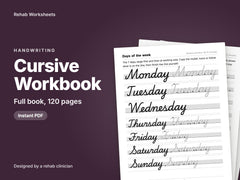
Cursive Handwriting Workbook for Adults
The full 120-page cursive book: strokes, letters, four kinds of join, capitals, and everyday writing, with benchmarks, a progress log, and practice paper.
$6.00
Everything for handwriting, from the first strokes to a signature. See the handwriting collection
Want every set in the shop? The Entire Shop Mega Bundle is $35.00 for 1,500+ pages, more than $170 bought one set at a time. See the Mega Bundle
What legible handwriting draws on
Legibility is not one skill. When writing looks messy, one of four things is usually off, and each one has its own kind of practice:
Formation
Each letter built with the right strokes, in the right order and direction. Where reversals such as b and d begin.
Size
Tall, small, and tail letters staying in their zones, and one size all the way through a word. The difference between “handle” and a row of loops.
Spacing
Even space inside a word and a clear gap between words. The pen-width gap that makes writing readable at a glance.
Placement
Letters sitting on the line rather than floating above it or sinking below. What ruled and color-coded paper is for.
Rhythm and control
Smooth, repeatable strokes at a comfortable speed. Practiced with lines, curves, and loops before any letter, and with the joins in cursive.
Those four points, formation, size, spacing, and placement, are the legibility checklist printed in the handwriting worksheets. Every practice sheet asks the writer to score their own work against them, which is how adults keep practicing without a teacher looking over their shoulder.
How the support fades
All three formats use the same idea: the page gives a lot of help at first and then takes it away in steps, the way a therapist would fade a cue in a session. Nothing is shrunk to make room, and no page depends on a skill that has not been practiced yet.
Trace the model
A solid grey letter, pair, or word to write over, with numbered arrows showing where each stroke starts and which way it goes. On the paper, every line carries its color.
Follow the outline, then the dot
A dashed outline the pen has to find, then only a dot marking where to start. The paper drops its colors one line at a time while the spacing stays the same.
On your own
An empty lane, then ordinary paper at the same spacing, then real form fields: name, address, date, phone. The self-check at the bottom of every sheet is the same each time: circle your best three.
Where to start
- Letters are formed with the wrong strokes, or b, d, p, and q get mixed up: start with the print set. Its six letter families group letters by the stroke they share, and three worksheets are given over to reversals alone.
- Letters are fine but float, sink, or change size mid-word: start with the color-coded paper. Pick the size where letters fit comfortably inside the zones, not the size that matches an age, and step down a level as placement becomes reliable.
- Print is settled and the goal is joined writing, a signature, or faster notes: go to the cursive set. It teaches the joins as their own skill, which is the part most cursive packs skip.
- Writing with the other hand after a stroke, injury, or surgery: start with the Left Hand Writing Practice Workbook. Every page is laid out for a left-handed writer, starting with control strokes before any letters.
- Handwriting changed after a stroke or brain injury: the pre-writing strokes at the start of the print set (lines, circles, arches, loops) are designed for exactly this, and the paper's widest size gives the hand room while control comes back.
A session is ten to fifteen minutes. Short and regular beats long and occasional, and it is better to stop while the strokes are still smooth than to push on until they get ragged.
Common questions
Are these worksheets a dysgraphia assessment or a handwriting program?
No. Occupational therapists use standardized handwriting assessments in clinical practice; these are structured practice materials for educational use. They are not scored against norms, and they are not treatment. Anyone with concerns about their handwriting, or a child's, should talk to a qualified professional.
Are the materials suitable for adults, or are they children's worksheets?
They are written for adults and teens: plain wording, everyday vocabulary such as “kitchen” and “problem”, real form fields, and no cartoons. Teachers and tutors do use them with older students, and the paper's four sizes are chosen by comfort rather than by age.
Do I need the paper as well as the worksheets?
The worksheets practice a skill; the paper is for everything written between worksheets: notes, lists, forms, a journal. Many people use the two together, practicing a letter family on the worksheet and then writing the day's list on paper at the same size and support level.
Print or cursive first?
Print first if letters are uneven in size or spacing, because cursive sits on the same baseline and inherits the same problems. If print is already steady, cursive can start straight away with the strokes and the joins.
Who are these designed for?
Adults and teens with dysgraphia, ADHD, autism, or dyslexia who want adult materials; anyone whose writing changed after a stroke or brain injury; adults who never learned cursive or want it back; and the occupational therapists, teachers, tutors, and literacy programs who work with them.
Start with a free page: the curve letters worksheet from the print set, the baseline joins worksheet from the cursive set, the left hand writing practice sheets, or free dyslexia paper. Everything for handwriting is in the Handwriting collection, and the other free guides are in the free worksheets directory. Prefer a printed book? The Dysgraphia Handwriting Workbook for Adults is on our printed workbooks page.