
Cognitive rehabilitation worksheets are printable tasks that practice one thinking skill at a time: attention, memory, visual perception, executive function, handwriting, and the everyday money and medication routines those skills feed into. Therapists use them in sessions after a stroke, a brain injury, or another neurological change, and families and adults themselves use them between appointments.
This page is the starting point for the whole collection. Download the free sampler, one whole task from each domain with its answers, then follow a domain guide to its free pages and graded sets. Every set is designed by a clinician and prints on US Letter.
Download the free cognitive rehabilitation worksheets sampler
Download the PDFPage 2: comparison worksheet SDC2C (attention, moderate). Pages 3 and 4: face and name worksheet FNM1A (memory, basic). Page 5: task sequencing worksheet TSW1F (executive function, level 2 of 4). Page 6: figure-ground worksheet VFG2A (visual perception, level 2). Page 7: dysgraphia worksheet 7, curve letters (handwriting). Page 8: the weekly medication tracker (money and medication). Page 9: answers and how to check each page. Free for personal, classroom, and session use.
Everything on this page is for educational and cognitive practice use, not treatment, therapy, or assessment.
Start with one free page per domain
One free page per domain. Each PDF opens directly, and the full graded set sits beside it with its price.
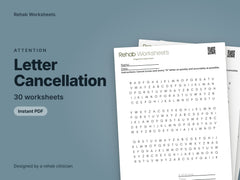
Letter Cancellation
Cross out every B and V in a grid of 300 letters. The attention format that shows scanning, misses, and time on one page.
The full set: Letter Cancellation Worksheets (30 Pages) $4.25
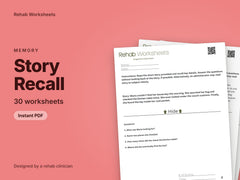
Story Recall
Read or listen to a short everyday story, then answer questions from memory. Verbal memory with room to note errors.
The full set: Story Recall Worksheets Bundle (30 Worksheets) $4.25
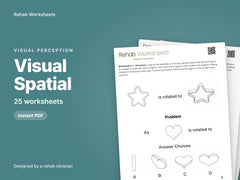
Visual Spatial
Turn a figure the same way as the example and pick the match. Motor-free visual perception, nothing to draw.
The full set: Visual Spatial Worksheets (25) $4.25
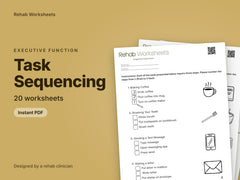
Task Sequencing
Put the steps of four everyday tasks in order. Four levels, from three steps to seven with extra steps to cross out.
The full set: Task Sequencing (20 Worksheets) $3.75
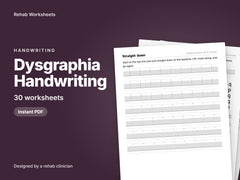
Dysgraphia Handwriting
Numbered stroke arrows, rows to trace, and mixed lines, written for adult hands. One full practice page free.
The full set: Dysgraphia Handwriting Worksheets for Adults and Teens (30) $4.25
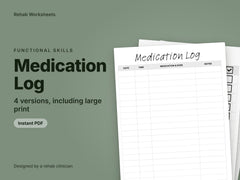
Medication Schedule
A weekly tracker with morning, afternoon, and evening rows and a checkbox for every day. The everyday routine the other skills serve.
The full set: Medication Log $1.99
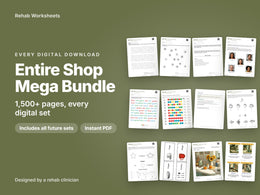
Every set in the shop, 1,500+ printable pages in one download, future sets included
The domains, and where each guide lives
Six domains organize everything in the store. Each has its own guide with free pages, the task formats explained, and the graded sets:
Attention
Staying with a task, scanning in an orderly path, and checking detail without drifting. Trail making, letter and shape cancellation, symbol digit, visual vigilance, comparison.
Memory
Taking in new information and bringing it back right away or after a delay. Story recall, picture recall, pattern recall, face and name memory, auditory working memory.
Visual perception
Making sense of shape, position, and orientation without a motor demand. Visual discrimination, figure-ground, visual closure, visual spatial, spot the difference.
Executive function
Planning, sequencing, reasoning through a problem, and checking the result. Task sequencing, Stroop, problem solving, safety and social reasoning, the weekly planning task.
Handwriting
Letter formation, size, and spacing for adult hands, including after a change of writing hand. Dysgraphia practice, cursive practice, color-coded paper, left hand writing.
Money and medication
The everyday routines that draw on all of the above. Medication management and trackers, bills and banking, health appointments and forms, scam and online safety.
Are these worksheets rehabilitation?
The phrase is the everyday name for a category of practice materials, and that is how it is used here. The pages are designed to support structured cognitive practice chosen and paced by the treating clinician, or by a family working from a therapist's plan. They are not a program, a test, or a treatment, and no outcome is promised from using them.
What they do offer is structure: one skill in focus, the same directions on every page of a set, graded levels, and something to write down (a time, a count of misses, a chosen answer) so the next session starts at the right level and change over weeks stays visible.
Worth knowing: several formats will look familiar from standardized testing: cancellation grids, story recall, figure-ground scenes. The worksheets borrow the format because it is clear and easy to repeat. The items are our own, there are no norms, and no score from these pages means anything outside your own sessions. If someone is due to be assessed, tell the clinician about any practice with similar formats.
How the sets are graded
Every set moves through levels of the same format, so only the load changes from page to page. Two examples from the sets behind the sampler:
Basic
Letter cancellation: one uppercase target in a grid of 15 rows of 20 letters, 300 in all. Task sequencing: four short routines of three steps each, with a picture beside every task.
Moderate
Letter cancellation: two targets at once on the same grid, some pairs a near match such as O and C. Task sequencing: five steps per task, then five steps with one that does not belong and must be crossed out.
Complex
Letter cancellation: a lowercase and an uppercase target together in a mixed-case grid of 375 to 385 letters. Task sequencing: three longer tasks of seven steps, two of them to cross out before numbering the rest.
The free page on each guide is usually a moderate-level page, a realistic middle point to try before choosing where to start.
Printable or on a screen
Everything on this page prints on US Letter. Many of the same tasks also run free in the browser on our tools site, with timing and a record kept for you: see tools.rehabworksheets.com. Paper suits sessions where the pen matters or a screen is tiring; the screen suits home practice between sessions.
Common questions
What are cognitive rehabilitation worksheets?
Printable, graded tasks that practice one thinking skill at a time, such as attention, memory, visual perception, or executive function, in formats clear enough to repeat week after week. They are practice materials, not an assessment or a treatment.
Who uses them?
Occupational therapists, speech-language pathologists, psychologists, and rehabilitation assistants in sessions; adults after a stroke or brain injury practising at home; families and caregivers supporting practice between appointments; day programs and community groups.
Are answer keys included?
The free sampler has an answers page for every task that has answers. Full sets include keys or scoring sheets where the format calls for one; tasks such as handwriting or a medication tracker have none.
Where should someone start?
With the domain that matters most day to day, at the free page on its guide. If it feels frustrating, the full set has basic pages below it; if it feels effortless, move up a level. The right level takes real effort but still ends in success.
What is in the Entire Shop Mega Bundle?
Every digital worksheet in the store in one download: 1,500+ printable pages across all six domains plus dementia care, daily routines, and coping skills, with every new set added as it is published. Personal-use and clinic licenses are both available.
Every free page in the store is listed by name on the free cognitive worksheets for adults directory, and the paperback editions are on the printed workbooks page. For every set at once, see the Entire Shop Mega Bundle.
These materials support cognitive stimulation and structured practice. They are not medical treatment or an assessment, and no specific therapeutic outcomes are claimed.