
Losing the thread halfway down a form. Forgetting a new neighbor's name before the conversation ends. Missing the one wrong digit on a bill. After a stroke, a brain injury, or another neurological change, everyday thinking shows up in moments like these, and the printable tasks used to practice it are what most people mean when they search for cognitive rehabilitation exercises: structured pages that work on one skill at a time, such as attention, memory, reasoning, or visual perception.
This page is a starting point across all four. The free sampler below has six pages, one task from each of the four domain bundles in the store. Below the download you will find what each domain covers, the full set and bundle each page comes from, how the sets are graded from basic to complex, and why these familiar test-style formats are practice materials, not an assessment.
Download the free cognitive exercises sampler
Download the PDFPage 1: comparison worksheet SDC2C (moderate), letters, symbols, and words in 25 rows each. Pages 2 and 3: face and name worksheet FNM1A (basic), a study page with five faces and their names, then a recall page. Page 4: the first basic figure combination page, a worked example plus items 1 to 4. Page 5: its answer key. Page 6: visual spatial worksheet VST1A (basic), one rotation problem with choices A to D. Free for personal, classroom, and session use.
Want every set?
Personal-use license. Buying for a team? Choose the clinic license on the set's page.
- Pages: 6, one task per domain
- Levels: basic, plus one moderate page
- Answers: basic figure combination key included
- Timing: untimed, with a completion time field on page 1
- Paper: US Letter

What are cognitive rehabilitation exercises?
The phrase is the everyday name for structured tasks that therapists, families, and adults themselves use to practice thinking skills: paper or screen exercises with clear directions and graded difficulty, a basic level to learn the format, then levels that add length, detail, or steps.
What separates a useful exercise from a puzzle book is structure: one skill in focus, the same directions on every page, and something to write down (a time, an error count, a chosen answer) so the next session starts at the right level. The sampler has one task from each of four domains:
Attention
Staying with a task and checking detail without drifting. The comparison page asks for 75 careful row checks.
Memory
Taking in new information and bringing it back later. Here, five faces and their names, recalled on the next page.
Reasoning and executive function
Working out a rule and applying it one step at a time. The figure combination items use only lines and shapes, no words.
Visual perception
Making sense of shape, position, and orientation. The rotation page asks how a heart looks after a turn.
The four domains, and where each free page comes from
Attention: comparison
Attention covers staying focused and checking detail row after row. On worksheet SDC2C, each category (letters, symbols, words) has columns A and B, and the task is to mark every row that is not identical, such as two swapped letters or a word with its last letters reversed. It comes from the Comparison Activity Worksheets (15 worksheets), one of six sets in the Attention Worksheets Bundle (165 worksheets). The attention guide has more free pages.
Memory: face and name recall
Memory covers taking in new information and getting it back when it is needed, and names are one of the most common everyday goals. The study page of FNM1A shows five faces, each with a full name, and three strategies: link a facial feature to the name, repeat the name, and form a mental image. The recall page shows the same faces rearranged, with a blank line under each and a space for errors. The full Face Name Memory set has 20 worksheets and belongs to the Memory Worksheets Bundle (120 worksheets across five sets). See the memory guide for the kinds of memory.
Reasoning and executive function: figure combination
This domain covers working out a rule, following steps in order, and checking the result. The free page (titled Line & Symbol Combination) opens with a worked example: a vertical line plus a horizontal line makes a cross. Items 1 to 4 each join two squares with a plus sign, and the answer square keeps every line from both. The full Figure Combination Worksheets set has 90 exercises with a key for every level, and is part of the Reasoning Worksheets Bundle with problem solving, safety and social reasoning, and pattern recognition. The executive function guide shows how these sets fit together.
Visual perception: mental rotation
Visual perception covers making sense of what the eyes take in, including position and orientation. On VST1A, an example star is shown before and after a turn; a heart is to be turned the same way, and the person chooses the match from A to D. Nothing is drawn. The full Visual Spatial Worksheets set has 25 worksheets with a scoring sheet, one of four motor-free sets in the Visual Perception Worksheets Bundle (70 worksheets). The visual perception guide explains each skill.
Are these exercises an assessment?
No. Neuropsychologists, occupational therapists, and speech-language pathologists use standardized tests to measure attention, memory, reasoning, and perception. Those tests have fixed materials, set instructions, timing rules, and norms that compare a score with people of a similar age, and trained professionals give and interpret them as one part of a wider evaluation.
Several formats here will look familiar from that world: checking items for differences, learning faces with names, combining figures, choosing a turned shape from several options. The worksheets borrow the format because it is clear and easy to repeat. The items are different, there are no norms, and no score from these pages means anything outside your own sessions.
Worth knowing: these worksheets are structured cognitive practice materials. They are not a test or an assessment, and they are not a substitute for evaluation by a qualified professional. If someone is due to be assessed, tell the clinician about any practice with similar formats, since familiarity can affect how a score is read.
How the worksheets are graded
Three of the four sets run basic, moderate, and complex; Face Name Memory has two levels, basic and complex:
Basic
Comparison pages use two-letter pairs, two-shape symbol rows, and short words, with three differences per category. Face and name pages show five faces. Figure combination adds two squares (30 exercises per level). Visual spatial has 11 worksheets with simple shapes and clear turns.
Moderate
Comparison strings grow to four letters and four shapes, the words to mostly six letters, with four differences per category. This is the level of the free comparison page. Figure combination adds a minus step: add two squares, then remove the lines in a third. Visual spatial has 8 worksheets with irregular, multi-part figures.
Complex
Comparison strings run to six or eight letters, symbol rows add an open circle among the filled shapes, and words become near misses (MORAL and CORAL), with five differences per category. Face and name pages show eight faces. Figure combination starts from busier figures, adds arrows, and has two minus steps in every item. Visual spatial has 6 worksheets with detailed figures and choices that sit close together.
| What you get | Free sampler | Entire Shop Mega Bundle |
|---|---|---|
| Exercises | 6 pages, 4 tasks | 1,500+ printable exercises |
| Domains | Attention, memory, reasoning, visual perception | Those four, plus executive function, functional skills, dementia care, routines, and coping skills |
| Levels | Basic, plus one moderate page | Graded from basic to complex |
| Answer keys | Basic figure combination key | Every figure combination key and the visual spatial scoring sheet |
| Copies | Personal, classroom, and session use | Unlimited copies for your own clients |
| Repeat sessions without reusing a page | Six pages | Weeks of practice |
Using it in a session or at home
- Pick one task per sitting. Four formats in a row is a lot. Start with the domain that matters most day to day.
- Work the comparison page one column at a time. Top to bottom, with a card under the row if the eyes wander. Write the completion time and the targets identified correctly at the bottom.
- Keep the study page out of sight. Allow a few minutes of study, as the page suggests, then turn it face down before recall. The full set suggests ways to adjust: first names only, a 30-second or 1-minute delay, or study time cut step by step from 2 minutes to 30 seconds.
- Hold back the answer key. Page 5 shows all 30 basic figure combination answers; only items 1 to 4 belong to the free page. If drawing is hard, the person describes the lines and a partner sketches them.
- Check the visual spatial answer. The scoring sheet in the full set gives D for VST1A. Ask for the example turn in words before looking at the choices, and if the answer is wrong, note which option was picked: a mirror image and a wrong angle call for different practice.
- Move up when a level feels easy. When basic figure combination comes right without the key, try the minus step. When the moderate comparison page is accurate at a steady pace, try complex.
Who uses cognitive exercises for adults
- Occupational therapists and speech-language pathologists with a mixed caseload
- Psychologists and therapy assistants who need a quick task in each domain
- Adults after a stroke or brain injury looking for structured practice at home
- Families and caregivers supporting practice between appointments
- Day programs and community groups running cognitive activity sessions
All of our worksheets are designed to be adult-appropriate and visually clean, with plain type, clear directions, and no childish artwork.
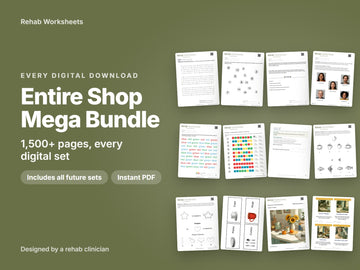
The sampler is six pages from four sets. The Entire Shop Mega Bundle includes every digital worksheet in the store, 1,500+ printable cognitive exercises in one download. If one domain is the focus, each free page also comes in its own bundle: the Attention Worksheets Bundle, the Memory Worksheets Bundle, the Reasoning Worksheets Bundle, and the Visual Perception Worksheets Bundle. For single free pages from many more sets, see the directory of free cognitive worksheets for adults.
These materials support cognitive stimulation and structured practice. They are not medical treatment or an assessment, and no specific therapeutic outcomes are claimed.


