
A phone number held just long enough to dial it. The next step of a recipe while the pan heats. Directions at a clinic: past the desk, then left at the elevator. Each leans on working memory, the small space where we hold something in mind while we use it. After a stroke, a brain injury or memory changes later in life, this is often where everyday slips show first.
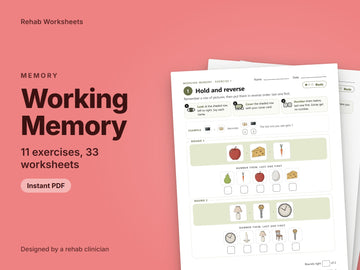
This page has free printable working memory worksheets for adults, in one PDF with no email needed: three basic pages with cover cards and answer keys. It also shows how the 33-worksheet set is organized (11 working memory exercises for adults, at three levels each), the research tasks behind them, from backward span to change detection, and why a practice page is not a test.
Download the free working memory worksheets
Download the PDFWorksheets WM1A (Hold and reverse), WM7A (Spot the change) and WM8A (Where was it?), all at the basic level. Each shows its steps in pictures (look, cover, answer), with name and date fields and a tally box. Also inside: a page of two cover cards to cut out, an answer key for each worksheet, and a last page about the full set. Free for personal, classroom, and session use.
Want all 33 worksheets?
Personal-use license. Buying for a team? Choose the clinic license on the set's page.
- Level: basic (A) on all three
- Exercises: 3 of the 11 in the full set
- Rounds: 2 or 3 a page
- Timing: 10 seconds to look on Spot the change
- Paper: US Letter

What is a working memory exercise?
A working memory exercise asks a person to hold a few things in mind and use them with nothing left to look at. On paper the steps are look, cover, answer, and the exercises differ in what is done with what is held.
On the free pages, Hold and reverse shows a row of 3 pictures. The person says each name, covers the row, then numbers a bank of 5 pictures last one first. The 2 extras get no number, so the answer cannot be read off the page. Spot the change allows 10 seconds with a 2 by 2 grid, then the person circles the one new picture in a second grid. Where was it? shows 3 pictures in a 3 by 3 grid, then asks for each one's letter, A to C, in its square of an empty grid.
Holding and reworking
Keeping a few things in mind while changing their order. On Hold and reverse, the last picture seen gets number 1.
Keeping it up to date
Letting older items go as new ones arrive. Keep track, Two back and Running list ask for it in the full set.
Remembering where things are
Holding a layout: what was there, and in which square. The free pages ask for it in Spot the change (WM7A) and Where was it? (WM8A).
Span tasks and working memory tests, and how these worksheets differ
The oldest working memory tasks are span tasks: a list is presented, the person repeats it, and the list grows until it can no longer be held. The longest list repeated correctly is the span. Backward span asks for the list last item first. A digit span subtest is part of the Wechsler scales, given and scored by trained professionals with norms.
The exercises are paper versions of classic research tasks:
- Hold and reverse: backward span
- Keep track: the keep-track task (Yntema 1963)
- Two back: the n-back task (Kirchner 1958)
- Do and hold, and Listen and point: complex and listening span (Daneman and Carpenter 1980), where items are held while a second job is done in between
- Spot the change: change detection (Luck and Vogel 1997)
- Where was it? Object-location memory (Postma and De Haan 1996)
- Route in mind: the Brooks matrix task (Brooks 1967), directions followed around a grid in the mind's eye
- Running list: running span (Pollack and colleagues 1959)
- Follow the steps: following spoken instructions (Gathercole and colleagues 2008)
The worksheets keep the shape of each task and change the rest: everyday pictures, an unhurried pace and a key for every round. Spot the change shows the gap most clearly: the lab version flashes the display for a split second, while the page allows 10 seconds, an easier and slower task.
Worth knowing: these worksheets borrow formats, not tests. There are no norms, and the tally box records one page, not a score to compare with anyone else. They are practice materials: not a test, not an assessment, and not a substitute for evaluation by a qualified professional. If someone is due to be assessed with a span task, tell the clinician about any practice with these formats.
How the 33 working memory worksheets are graded
Each of the 11 exercises comes at three levels: A basic, B moderate and C complex, with more to hold in mind and more to do while holding it.
Basic (A)
A little to hold: 3 pictures to reverse, one back instead of two back, 2 by 2 grids for Spot the change, the last 2 of a running list.
Moderate (B)
More to hold and more to do: 4 pictures to reverse, two back, 3 framed pictures held through the shopping bag questions, a 4 by 4 town map in view.
Complex (C)
Longer sequences and near misses: 6 pictures to reverse, 16 pictures in one two back round, 7 pictures to place in a 5 by 5 grid, and a town map from memory.
Seven exercises work alone, three of them with a window card that shows one picture at a time. Four use a partner who reads aloud from a partner page kept out of sight. The pictures are owned illustrations of everyday things, with no letter or number grids and little reading.
On your own
- Hold and reverse: number the pictures last one first; 3, 4 or 6 a round, 2 rounds a page
- Sort in your head: recall them smallest to biggest in real life; 3, 4 or 5 pictures a round
- Keep track: circle the last picture of each group; 2 groups in 8 pictures, 3 in 12, then 4 in 12
- Two back: check a picture that matches the one just before (A) or two before (B, C), with look-alike near misses at C that do not count
- Do and hold: circle Y or N for “Would it fit in a shopping bag?” while holding 2, 3 or 4 framed pictures, then number them in order
- Spot the change: 2 by 2 grids for 3 rounds, then 3 by 3, then 4 by 3 with two changes
- Where was it? 3 pictures in a 3 by 3 grid, 5 in 4 by 4, then 7 in 5 by 5
With a partner
- Listen and point: answer true or false to each sentence, then point to the things named, in order; 2, 3 or 4 sentences a set
- Route in mind: follow directions around a small town map; at C the map is studied for a minute and folded away, and each route ends with an X on an empty map
- Running list: point to the last 2, 3 or 4 things, in order, when the list stops without warning; the free auditory working memory worksheet does the same with letters
- Follow the steps: hear 2, 3 or 4 steps, wait for go, then circle, cross out, underline or draw a line
| What you get | Free sample | Full set |
|---|---|---|
| Worksheets | 3 | 33, in a 48-page PDF |
| Exercises | Hold and reverse, Spot the change, Where was it? | All 11: 7 alone, 4 with a partner |
| Levels | Basic | Basic, moderate, complex |
| Cards to cut out | Two cover cards | Two cover cards and a window card |
| Partner pages | No | 12, with what to read aloud |
| Answer keys | One for each worksheet | 28 pages, in a second PDF |
| Repeat sessions without reusing a page | Three pages | Weeks of practice |
Using it in a session or at home
- Print the cover cards first. Cut the page in half and lay a card over the shaded row or grid after looking. A folded sheet of paper works too.
- Settle the names before the cover goes on. Hold and reverse asks for each name aloud. If one comes out wrong, sort it out first, so the round is about holding, not naming.
- Keep the 10 seconds on Spot the change. Count them or use a phone timer; the other two free pages set no time.
- Read the slips, not just the tally. On Hold and reverse, the right pictures in the wrong order is a different slip from numbering an extra. On Where was it?, a letter one square off is closer than one in the wrong corner.
- Say or point instead of writing. A partner can write the numbers or letters while the person says them or points. Holding the pictures is the task.
- Move up when it feels steady. When most rounds go well, time after time, try the moderate level in the full set. Go back a level if a page feels like a struggle.
Prefer a screen? We also offer a free interactive span task, Digit Span on our tools site, which reads digits aloud, one a second, for the person to say back in the same order or in reverse. Strings grow one digit at a time, and each round ends at the longest string said back correctly. Digits can be heard or shown, with tap or spoken answers, in large print. Nothing to print, and free to use with a free account.
Who uses printable working memory worksheets
- Occupational therapists working with adults after a stroke or brain injury
- Speech-language pathologists, using the partner pages for listening tasks
- Hospital, outpatient and community programs, including memory groups
- Family members and caregivers, one reading and one answering
- Adults doing working memory activities alone, with the seven exercises that need no partner
The free pages come from our Working Memory Worksheets for Adults: 33 worksheets, all 11 exercises at three levels, with partner pages, cards to cut out and a second PDF of answer keys. The Memory Worksheets Bundle has this set and six more memory sets, 185 worksheets in all. The memory worksheets guide covers the kinds of memory, and the free memory strategy card adds everyday ways to remember.
These materials support cognitive stimulation and structured practice. They are not medical treatment or an assessment, and no specific therapeutic outcomes are claimed.

