
A booking reference read out over the phone. A pharmacist spelling a name back at the counter. Directions that end with “then it is the third house on the left.” Each asks the listener to hold the last few things heard while more keep arriving, and to have them ready the moment the speaker stops. After a stroke or brain injury, or with changes in attention, the tail end of what was just said is often the first part to slip away.
This page is about the auditory working memory worksheet, one of the simplest auditory memory activities for adults to run at a table: a partner reads letters aloud, the sequence stops without warning, and the listener says back the part a rule asks for. You can download a free level 3 worksheet below (AWM2E, say back the last four letters), see how the 25-worksheet set is graded across five recall rules, and read how the format borrows from span tasks such as the Wechsler Digit Span subtest and running memory span, and why a practice sheet is not the test.
Download the free auditory working memory worksheet
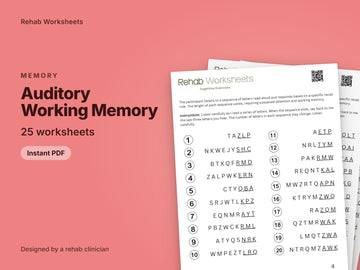
Download the PDFWorksheet AWM2E from the set, level 3: the task description and the reader’s instructions at the top, then 20 numbered letter sequences in two columns of ten. The sequences run from 4 to 8 letters long, and the last four letters of each one are underlined for the reader to check. Free for personal, classroom, and session use.
Want the full set?
Personal-use license. Buying for a team? Choose the clinic license on the set's page.
- Level: 3 of 5 (worksheet AWM2E)
- Rule: say back the last four letters
- Sequences: 20, from 4 to 8 letters long
- Reader: a partner reads aloud, about one letter a second
- Paper: US Letter

What is an auditory working memory task?
An auditory working memory task asks a person to hold what they have just heard and do something with it. Here a partner reads a sequence of letters aloud, one at a time, then stops. The listener, who never sees the page, says back the part the rule asks for: on the free sample, the last four letters heard. Twenty sequences make a page, and every page carries its worksheet ID.
The catch is length. On the free page the sequences run from 4 to 8 letters in no fixed order, so the listener cannot know which letter will be the last. Waiting for the end and reaching back for four letters rarely works. The listener has to keep the newest four in mind and let older ones go with every new letter. Letters carry no meaning to lean on, only sounds and their order. For listening practice with meaning, the free story recall worksheet on this blog asks for the details of a short story instead.
Auditory attention
Following one voice for the whole sequence, with each letter heard only once. There is nothing on the table to look back at, so a drift in attention costs letters.
Working memory updating
Replacing the oldest letters with the newest as the sequence runs on. Because the end is unknown, the last four keep changing until the voice stops.
Serial order
Keeping the letters in the order they were heard. Right letters in the wrong order is a different slip from a missing one.
Holding a rule
Keeping the recall rule in mind across all 20 sequences. On levels 2, 4, and 5 the opening letters must be held while the end keeps changing.
Digit span, running span, and how these worksheets differ
The format borrows from span tasks, one of the oldest ways of looking at working memory. The best known is the Digit Span subtest of the Wechsler intelligence scales: the examiner reads a string of digits at about one per second, and the person repeats them in the same order (forward), in reverse (backward), or from smallest to largest (sequencing). Strings grow longer until the person misses both tries at one length. Letter-Number Sequencing, another Wechsler working memory subtest, reads out a mix of numbers and letters and asks for the numbers in order, then the letters in alphabetical order.
The closest relative of these worksheets is the running memory span task, a long-standing tool of memory research. A list of unpredictable length is read aloud and stops without warning, and the person reports the last few items. The worksheets pair that running format with rules of their own, some of which also ask for the first letters.
The Wechsler scales are published, standardized instruments with norms, given and interpreted by trained professionals as part of a broader evaluation. Their working memory subtests are used to look at how much heard information a person can hold and work with.
Worth knowing: the worksheets on this page borrow the format, not the test. They use letters only, the recall rules and sequences are the set’s own, there are no norms, and nothing here produces a score that can be compared with a population. They are structured cognitive practice materials. They are not the Digit Span subtest, not an assessment, and not a substitute for evaluation by a qualified professional. If someone is due to be assessed with a span task, tell the clinician about any practice with this format, since familiarity can affect how a result is read.
How the auditory working memory worksheets are graded
Five levels with five worksheets each, 25 in all. Every worksheet has 20 sequences of mixed length, the reader’s instructions, and the target letters underlined. What changes from level to level is the recall rule:
Level 1: the last three letters
Worksheets AWM1A to AWM1E, with sequences from 4 to 10 letters. Only the end matters: keep the newest three letters as the list runs on.
Level 2: the first letter and the last two letters
Worksheets AWM1F to AWM1J, sequences from 4 to 10 letters. Still three letters, but one comes from the start and has to be held while the rest goes by.
Level 3: the last four letters
Worksheets AWM2A to AWM2E, sequences from 4 to 12 letters, the longest in the set. One more letter to keep updated at the end of the list. The free sample, AWM2E, is the fifth worksheet of this level, with sequences of 4 to 8 letters.
Level 4: the first two letters and the last two letters
Worksheets AWM2F to AWM2J, sequences from 4 to 10 letters. Four letters split between the two ends, so the opening is held while the end is updated.
Level 5: the first two letters and the last three letters
Worksheets AWM3A to AWM3E, sequences from 5 to 11 letters. Five letters from both ends. On the shortest sequences the answer is every letter that was read.
| What you get | Free sample | Full set |
|---|---|---|
| Worksheets | 1 | 25 (32-page PDF) |
| Levels | Level 3 | Levels 1 to 5 |
| Recall rules | The last four letters | Five rules, from the last three letters to the first two and last three |
| Sequences per page | 20 | 20 on every page, 500 in all |
| Sequence length | 4 to 8 letters | 4 to 12 letters |
| Reader’s instructions and underlined answers | Yes | Yes, every page |
| Repeat sessions without reusing a page | One page | Weeks of practice |
Using it in a session or at home
- Keep the page with the reader. The underlined letters are the answers, so the sheet stays out of the listener’s sight. Sit facing each other in a quiet room, so the voice is the only thing to follow.
- Read at an even pace, once. About one letter a second is the span-task convention. Keep the voice level on every letter, including the last, so a falling tone does not give the end away, and avoid grouping letters in threes like a phone number.
- Mark each sequence, then look at the pattern. Tick each sequence that comes back correctly and write the total out of 20 on the page. Misses on the longest sequences point to load. Misses on the short ones, such as item 5 on the free page (E B A T, where the whole sequence is the answer), can mean the listener was waiting for a longer list.
- Check hearing before memory. Many letters sound alike: B, C, D, E, G, P, T, V, and Z rhyme, and so do M and N. If a letter comes back as its rhyme, read that letter again on its own to see whether it was heard correctly.
- Adapt the reply, not the listening. If speaking is hard, the listener can write the letters, type them, or point to them on a printed alphabet card while the reader checks. Hearing and holding the sequence is the task; the reply can take any form.
- Move up one level at a time. Eighteen or more correct out of 20 on two pages in a row is a reasonable cue to try the next rule. Levels 2, 4, and 5 add letters from the start of the list, which feels different from holding more at the end, so step back if the score drops sharply.
Prefer a screen? We also offer a free interactive version, Listen and Recall on our tools site, which reads each string of letters or numbers aloud in a steady voice, so no partner is needed to read. A tone marks the end of each string, its five rules match the five printed levels, and the answer can be tapped in or said aloud for a partner to mark. Results show strings correct, items in the right place, and accuracy by short, medium, and long strings. For the classic whole-string version, forward and backward, the free Digit Span tool reads digits aloud and finds the longest string said back correctly. Nothing to print, and free to use with a free account.
Who uses auditory working memory worksheets
- Occupational therapists and speech-language professionals
- Hospital, outpatient, and community programs
- Educators working with adult learners
- Caregivers and family members, one reading and one listening
- Adults looking for structured, printable listening and memory activities
All of our worksheets are designed to be adult-appropriate and visually clean, with large letters, plain type, and no childish decoration.
The free worksheet above is one level 3 page of 25. The full Auditory Working Memory set includes all 25 worksheets across the five recall rules. It is also part of the Memory Worksheets Bundle, 120 pages, and our memory worksheets guide explains how auditory working memory fits alongside the other memory sets.
These materials support cognitive stimulation and structured practice. They are not medical treatment or an assessment, and no specific therapeutic outcomes are claimed.


