
On a Tuesday morning in an outpatient clinic, an occupational therapist lays three papers on the table: an electric bill, a bank statement, and a pay stub. The client across the table, home after a stroke, ran the household money for twenty years. Today the goal is smaller: find the due date on the bill. Across town, a transition teacher hands out the same kind of paperwork to students getting ready for first jobs, and a support worker in a supported home checks a receipt with a resident.
This page is a guide to money management worksheets for adults, with two free worksheets to print today, no email required: a pay stub to read, and a second stub to work out what came off the pay, each with its answer page. Below the download: what the worksheets cover, the skills behind them, the four levels, how to run a session, how to read a pay stub with the free pages, and how the full set is organized.
Download the free money management worksheets
Download the PDFFour pages from Bills, Banking & Paychecks: two pay stub worksheets and their answer pages. Page 1: worksheet A5, Read a pay stub (Level 1, Find), Marcus Hill’s stub for September 28 to October 11, 2026, with questions on the pay date, take-home pay, and hourly rate. Page 2: worksheet A12, What came off my pay? (Level 2, Use), his next stub, with questions on gross pay, the amount taken off, and the biggest deduction. Pages 3 and 4: the two answer pages, with the answers filled in and, on the second, a note for the helper. Free for personal, family, and care-program use.
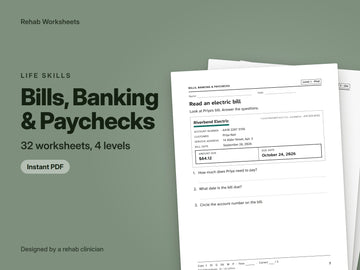
Want all 32 worksheets?
Personal-use license. Buying for a team? Choose the clinic license on the set's page.
- Worksheets: A5 and A12, Levels 1 and 2 of 4
- Questions: 3 on each worksheet
- Pay stubs: 2, for back-to-back pay periods
- Answers: a filled-in answer page for each
- Paper: US Letter, portrait

What do money management worksheets for adults cover?
Money management worksheets for adults, sometimes called life skills money worksheets, practice the paperwork that keeps a household running: reading a bill, checking a receipt, knowing what a paycheck is worth, and deciding what to pay first. In this set the pages use adult paperwork and adult lives, and nothing is written for children. Its cover names four strands, and the 32 worksheets work through them:
Bills
Electric and phone bills, a rent receipt, due dates, late fees, autopay and past-due notices, and which bill to pay first. The first worksheet asks for one amount and one due date; the last checks someone else’s bill plan for three mistakes.
Bank statements
Statements, plus debit receipts, ATM slips, and a payment confirmation in a banking app. Later levels match a receipt to a statement and find a charge the person did not make.
Pay stubs
Take-home pay, hours times the hourly rate, and why one pay is smaller than the last. The free pages are the first two pay stub worksheets.
Budgets
A bill calendar, two paydays, a simple monthly budget, a subscription check, and a call about a bill. Each Level 4 plan has something change partway through, such as a surprise bill.
The thinking skills behind managing money
Paying a bill on time looks like one task, but it draws on several thinking skills at once, much like those our money and medication guide describes:
- Reading. Finding one fact on a busy page, such as a due date, an account number, or the net pay.
- Calculation. Adding totals, working out change, multiplying hours by the rate, and taking a bill away from a balance.
- Judgment. Deciding which bill to pay first, whether a charge belongs, and what a past-due notice means for the next step.
- Planning and checking. Holding several papers and rules in mind, coping with a change, and checking the plan.
How the money management worksheets are graded
The 32 worksheets climb through four levels, eight at each. Levels 3 and 4 use two pages, the papers and then the questions, so every document prints full size.
Level 1: Find
One fact from one document, in one or two steps, with nothing to ignore. Whole dollars and simple times, and the answer is circled or copied, as on the free worksheet A5.
Level 2: Use
One document, two or three steps, and one or two things to ignore, with cents, days, and durations. The answer is written in: on the free A12, gross pay minus net pay.
Level 3: Compare and decide
Two documents, including information the person does not need, three or four steps, and one or two rules, such as a budget or a deadline. The person chooses and gives a reason, as in Which bill first?, with four bills and money for three.
Level 4: Plan and check
Three or more documents, five or more steps, three or more rules, and a change partway through, such as a dental bill that arrives mid-month. The person plans, then checks the work.
How to run money management activities for adults
The pack’s how-to-use pages set out a simple way to run a session:
- Start one level below. Begin one level below where you think the person is, and move up if the first two sheets feel easy.
- Change the support, not the sheet. Read the sheet aloud, cover what the person does not need, highlight the key facts, or allow a calculator; an answer page can serve as a model before a similar sheet.
- Record the help needed. At the bottom of every worksheet, circle the most help needed: I (independent), IV (indirect verbal), G (gesture or visual), DV (direct verbal), M (model), or P (physical help). Then note the time and the number correct.
- Move up or down by a rule of thumb, not a test rule. Move up after two sheets in a row done with I or IV cues and 80 percent or more correct; move down after two in a row that needed DV, M, or P, or scored under 50 percent.
- Finish with real life. Eight Try it for real cards repeat the skills with the person’s own paperwork, phone, or calendar, such as circling the pay date and net pay on their own pay stub.
How to read a pay stub, with the free worksheets
The free pay stub worksheets double as a short lesson in how to read a pay stub. Work from top to bottom on Marcus’s stub on worksheet A5:
- Name and number. The stub belongs to Marcus Hill, employee number 1047, at Greenleaf Garden Center, all made up.
- Pay period and pay date. The pay period, September 28 to October 11, 2026, is the time the pay covers; the pay date, October 16, is the day it is paid.
- Earnings. Hours times the hourly rate: 48.00 hours at 18.00 is 864.00, his gross pay.
- Deductions. Federal income tax, Social Security, Medicare, state income tax, and city income tax, totaling 130.50. Social Security and Medicare, often grouped as FICA, are for employees generally 6.2 percent of wages, up to a yearly limit, and 1.45 percent: 53.57 and 12.53 here.
- Net pay. Gross pay minus total deductions: 864.00 minus 130.50 leaves $733.50, the take-home pay, deposited to an account ending 4417.
Worksheet A12 gives Marcus’s next stub without a total deductions line, so the person works it out: 837.00 minus 711.87 is $125.13, and the biggest deduction is Social Security, $51.89. Real pay stubs often carry more, such as medical insurance, retirement contributions, and year-to-date totals; the practice stubs keep to one pay period and five tax lines.
Tips for money management practice
- Practice on made-up papers first. Every name, company, and phone number in the set is made up, so nobody’s real account is on the table.
- Name the document first. Ask what the paper is and who sent it; a bill, a receipt, and a statement can look alike.
- Mix the strands. A bill one day and a pay stub the next keeps practice close to real life.
- Talk about the real routine. Ask how bills arrive, how they get paid, and who helps; the answers show which strand matters most.
- Bring in private papers with care. The Try it for real cards suggest a trusted person for anything private, such as a bank balance.
Is this financial advice?
No. The worksheets practice reading and working with everyday paperwork; they do not tell anyone what to do with their own money. The rates on this page are general U.S. figures for employees, and tax rules differ by state and change over time. For questions about a person’s own pay, ask the employer’s payroll or HR team, and for tax questions, a tax professional.
Worth knowing: these worksheets are practice materials for a daily living skill. They are not financial, tax, or legal advice, a treatment, or an assessment, and their cue and score records are a practice record, not test results. They do not replace the person’s own clinicians, an employer’s payroll team, or a tax professional.
How the full set is organized
The full set is 114 pages in two PDFs on US Letter: how to use the pack, a contents page, a cue and progress sheet, the 32 worksheets, 8 practice cards, and 3 blank templates, plus an answers file with an answer page for every worksheet.
| What you get | Free sample | Full set |
|---|---|---|
| Worksheets | 2: A5 and A12 | 32, 8 at each level |
| Levels | 1 and 2 | All 4: Find, Use, Compare and decide, Plan and check |
| Strands | Pay stubs | Bills, bank statements, pay stubs, and budgets |
| Answer pages | For both worksheets | For every worksheet, in a separate file |
| Cue and progress sheet | Summarized on this page | One sheet for all 32 worksheets |
| Practice cards and templates | Not included | 8 cards, plus a bill calendar, a budget, and a payday plan |
Who uses money management worksheets
- Occupational therapists and speech-language pathologists working on money skills with adults, including after a stroke or brain injury
- Transition and special education teachers preparing students for work and independent living
- Group homes, supported living staff, and day programs
- Job coaches and recovery programs helping adults set up a routine for bills and pay
- Families helping an adult relearn money skills at home
The free worksheets above come from the full Bills, Banking & Paychecks: Life Skills Worksheets for Adults, 32 money management worksheets with an answer page for each. For hands-on practice with U.S. practice currency, see the Money Management Kit, U.S. edition. Two other free articles cover neighboring skills: our free life skills worksheets for adults include a page of money and fraud scenarios to talk through, and dyscalculia in adults has a free large-print page on making change. Our money and medication guide shows how the pieces fit together, and more sets are in the life skills worksheets for adults collection.
These are practice materials, not an assessment. They are not financial, tax, or legal advice, no specific therapeutic outcomes are claimed, and every person, company, and number in them is made up. For questions about your own pay, ask your employer’s payroll team.


