
“What are we doing now?” In a house where someone lives with dementia, the day can lose its shape. Breakfast is asked about at eleven, the walk is forgotten and then refused, bedtime arrives too early or not at all, and every change of activity turns into a negotiation. The caregiver spends the day announcing what comes next, and the person spends it being told.
This page is a guide to a daily routine for dementia patients, with a free printable visual schedule to start on today, no email required: the six morning cards from the Dementia Daily Routine Cards, one blank card, and the deck’s quick-start page. Below the download: what a visual schedule for adults is, how to set up a daily routine in five steps, a sample day built from the cards, five ways families and care staff use them, what to do when a card is ignored, and how routine cards differ from step-by-step cue cards.
Download the free morning routine cards
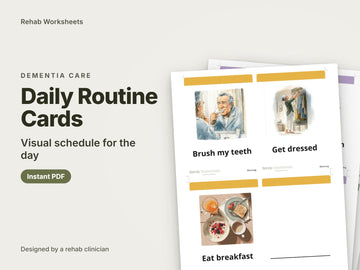
Download the PDFPages 1 and 2 are the two Morning sheets from the Dementia Daily Routine Cards, four cards to a sheet with crop marks: the deck’s title card, Wake up, Good morning, Use the bathroom, Wash my face and hands, Brush my teeth, Get dressed, Eat breakfast, and one blank card to write your own. Page 3 is the Welcome and quick start page from the how-to-use guide: who the cards are for, what is in the deck, and the five steps to your first day. Free for personal, family, and care-program use.
Want all 36 cards?
Dementia Daily Routine Cards$3.99
Already laminated and packed: Dementia Daily Routine Card Kit (17 Laminated Cards and Signs) $39.99, ships to you.
Personal-use license. Buying for a team? Choose the clinic license on the set's page.
- Cards: 6 morning cards and 1 blank
- Group: Morning, 1 of 6
- Size: 3.5 by 5 inches, 4 to a sheet
- Print: white cardstock or paper, cut along the crop marks
- Paper: US Letter, portrait

What is a visual schedule for adults with dementia?
A visual schedule for adults is a row of picture cards that shows the shape of the day: what is happening now, what comes next, and what is finished. Each card carries one activity in a few large-print words and one picture, and the cards sit where the person will see them, on the fridge, the kitchen table, or a small easel. It does the same job a diary or a wall planner does for everyone else, with pictures doing the work that reading and remembering used to do.
The Dementia Daily Routine Cards are a deck of 36 illustrated cards in six color-banded groups, plus four blank cards. They are drawn to look adult: watercolor rooms, objects, and hands rather than cartoons, because, as the guide puts it, memory loss is not a return to childhood. The six groups cover the whole day:
Morning and evening
Wake up, use the bathroom, wash face and hands, brush teeth, get dressed, eat breakfast; then dinner, television, a phone call with family, getting ready for bed, teeth again, and reading before bed. The free download is the whole Morning group.
Afternoon
Take a walk, eat lunch, read or do a puzzle, listen to music, spend time outside, rest. The part of the day most often left empty.
Night, health, and safety
Turn off the lights, go to sleep, stay in bed if you wake, the bathroom at night, and two cards about asking for help; then morning and evening medication, drinking water, a snack, the walker or cane, and calling 911 in an emergency. The cards for the questions asked at two in the morning.
Connection
Family is visiting, look at family photos, send a card or letter, pet the dog or cat, sit and talk, and a card that simply says it’s a good day. For the parts of the day that are not tasks.
How to set up a daily routine for dementia patients
The quick-start page in the free download gives the first day in five steps. The guide describes the cards as a tool, like a calendar or a grocery list, that takes some of the pressure off remembering, and it is clear that fewer cards work better than more.
Print and cut
Print the sheets on white cardstock or paper and cut along the crop marks. Four cards to a sheet, each 3.5 by 5 inches, large enough to read from across a kitchen.
Sort the colors
Sit somewhere quiet and sort the cards into their six groups by the color band: yellow for morning, blue for afternoon, purple for evening, navy for night, green for health and safety, coral for connection.
Choose four to six cards
Pick the cards that match the person’s actual day, not an ideal one. The guide says not to use all 36 at once; too many cards is more confusing than helpful.
Put them where the day happens
On the fridge, the kitchen table, a small easel in the bedroom, or a metal board with magnets, in part-of-day order and at eye level.
Use them gently
Point at the card. Hand it over. Say the words on it aloud, calmly, and wait. The guide suggests at least ten seconds before saying anything else, because processing takes longer than it looks.
A sample daily schedule for dementia patients
There is no single right day, and the guide’s first rule is to match the cards to the person’s real routine. As a starting point, here is a day built from the deck, six to eight cards at a time, which is the number the guide suggests for a daily flow on the fridge:
- Morning. Wake up, Good morning. Use the bathroom. Wash my face and hands. Brush my teeth. Get dressed. Eat breakfast. Take morning medication.
- Midday and afternoon. Take a walk, or Spend time outside. Eat lunch. Rest. Then Read or do a puzzle, or Listen to music.
- Evening. Eat dinner. Take evening medication. Phone call with family, or Watch TV. Get ready for bed. Brush my teeth. Read before bed.
- Night. Turn off the lights. Go to sleep. If I wake up at night, stay in bed. Bathroom at night.
Keep the morning anchors the same every day and let the afternoon vary. A card such as Family is visiting or Have a snack goes up on the day it applies and comes down afterward, so the schedule never promises something that is not happening.
Five ways to use the cards
The guide describes five approaches that families and care professionals have found helpful:
- Daily flow on a fridge. Six to eight cards in part-of-day order, with a small magnet or clothespin moved from card to card as the day goes on.
- Pocket pack. Four or five cards in a small pouch when going out, pulled out when needed: “We are going to eat lunch now.”
- One card at a time. For a person who is overwhelmed by choices: put one card down, say the words, wait.
- Shared decision. Hold up two cards and let the person point to the one they want: read, or take a walk?
- Photo album. Slide the cards into a small 4 by 6 photo album so they can be flipped through without being lost.
Routine cards or step-by-step cue cards?
Two kinds of card do two different jobs, and most homes end up with both. The routine cards on this page answer “what is happening now?” and give the day its shape. Step-by-step cue cards answer “what comes next?” inside one task, posted exactly where the task happens: eight pictures beside the toilet, six above the sink. Our guide to dementia cue cards for daily routines covers that second kind, with a free toilet routine card to print.
The Daily Routine Cards Bundle has all five step-by-step sets as printable PDFs: using the toilet, washing hands, brushing teeth, cleaning dentures, and getting dressed, each with a simplified version, high-contrast cards, and a sign for the spot. If you would rather not print, cut, and laminate, the Dementia Daily Routine Card Kit arrives ready to hang: 17 laminated cards and signs, a full and a simplified card for each of the five routines, 10 removable wall strips and 5 hooks, and a double-sided caregiver guide, in a standard or a high-contrast edition. It ships flat from Canada, with free shipping to Canada and the US.
Tips that make a real difference
- Match the card to the moment. Do not show the dinner card at nine in the morning; it confuses the sense of time.
- Use the first-person voice. Read the card as if it were the person’s own thought: “I am going to brush my teeth.”
- Slow down. Wait at least ten seconds after showing a card before saying anything else.
- Do not quiz. The cards are not a test. Never ask “What does this say?”
- Put an upsetting card away. Some people resist anything that feels like instruction. Try again later, or skip that card for good.
- Customize freely. The four blank cards take a dog’s name, a favorite garden chair, or a grandchild’s name, or a real photograph of the object in the person’s own home.
When the cards are not working
- If the cards are ignored. Move them to a more visible spot, or use only two or three at a time.
- If the person says “I don’t need those”. Agree gently and put them aside. The guide notes that the cards sometimes work better when the caregiver uses them and the person simply notices, without the cards being framed as a tool for them.
- If looking at them causes anxiety. Stop for now. They may be useful later.
- If one picture confuses. Replace it with a blank card and a simpler drawing, or paste in a photograph of the actual object.
The guide also says who the cards suit: adults living with early-to-mid-stage dementia or Alzheimer’s, adults after a stroke or brain injury with memory or sequencing difficulties, and older adults with mild cognitive impairment. In late-stage dementia, photographs of the person’s own home and family may work better than drawings.
Is a visual schedule a therapy for dementia?
No. A visual schedule is a daily living aid, in the same family as a calendar, a labeled cupboard, or a list on the fridge. It does not change the condition. It changes how much the person has to hold in mind to get through the day, and how often they have to ask. The guide says the same in its own words: the cards are a structured cognitive support activity, one tool among many.
Worth knowing: these cards support daily living and routine. They are not medical treatment, not a therapy, and not an assessment, and they do not replace the person’s own physician, care team, or hands-on help where it is needed. If a person’s abilities change quickly, speak with their physician.
How the full set is organized
The full download is 14 pages: 11 card sheets, four cards to a sheet, and the three-page how-to-use guide, in US Letter and A4 layouts.
| What you get | Free sample | Full set |
|---|---|---|
| Cards | 6 morning cards and 1 blank | 36 cards in six groups, and 4 blank cards |
| Groups | Morning | Morning, Afternoon, Evening, Night, Health and Safety, Connection |
| Health and safety cards | Not included | Medication morning and evening, drink water, a snack, walker or cane, call 911 |
| Guide | The Welcome and quick start page | Three pages: quick start, five ways to use the cards, tips, troubleshooting, and a note about dignity |
| Paper sizes | US Letter | US Letter and A4 |
| Days covered | One morning | The whole day, every day |
Who uses a visual schedule
- Family caregivers supporting a parent or partner at home
- Adults with memory loss who like to see their own day laid out
- Care staff in memory care, assisted living, and long-term care
- Home care agencies that want every visiting worker to follow the same routine
- Occupational therapists setting up routine and orientation aids after a stroke or brain injury
The free cards above come from the full Dementia Daily Routine Cards, a 36-card visual schedule with the three-page guide, and the same deck is part of the Dementia Activities Bundle. For the two questions a routine cannot answer on its own, our free printable calendar for dementia patients shows the day of the week, and the home labels set marks cupboards and doors. The step-by-step side of the day is covered by the Daily Routine Cards Bundle and the laminated Dementia Daily Routine Card Kit. Everything is in the Dementia & memory care collection.
These materials support daily living and routine. They are not medical treatment, and no specific therapeutic outcomes are claimed. If a person’s abilities change quickly, speak with their physician.


