
Somewhere in the middle of a task, the next step goes missing. The pants are down but the person is standing still. The toothbrush is in hand with no toothpaste on it. Talking someone through it works, but it turns an ordinary moment into being managed, and most people with dementia feel that. A cue card answers the question “what comes next?” quietly, one picture at a time, from the wall right beside the task.
This page covers our daily routine cue cards for adults with dementia or memory loss: using the toilet, washing hands, brushing teeth, cleaning dentures, and getting dressed. You can download the full 8-step toilet card below for free, see what each set includes, and read how an occupational therapist sets them up at home.
Download the free toilet routine cue card
Download the PDFThe complete 8-step “Using the toilet” card from the set. Print it, slip it in a plastic sleeve or laminate it, and post it at eye level beside the toilet. Free for family, care-home, and session use.
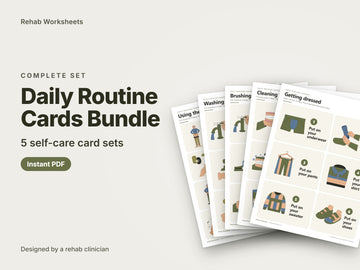
Want all five routines?
Daily Routine Cards Bundle$10.99
Bought one at a time, the same 5 sets cost more than $17.
Personal-use license. Buying for a team? Choose the clinic license on the set's page.

What is a dementia cue card?
A cue card is a task broken into its steps, with one simple picture and a few large-print words per step, posted exactly where the task happens. Beside the toilet. Above the sink. Next to the chair where tomorrow's clothes are waiting. The person looks, finds the step they are on, and carries on. When they stall, the caregiver points to the card rather than speaking.
Two things make this format work well for adults with dementia. Recognizing a picture generally stays easier than following spoken instructions or reading a paragraph, so the prompt stays usable longer. And pointing to a step is far less confronting than being told what to do, which keeps the person doing the task themselves rather than having it done to them. The cards do not teach a new skill. They support a well-practiced one for as long as possible.
The five routine card sets
1. Using the toilet
The card you can download above is the full 8-step sequence: pull down your pants and underwear, sit on the toilet, wipe, paper in the toilet, pull up, flush, wash your hands with soap, dry your hands. The Toilet Routine Cards set adds a simplified 4-step card, high-contrast large-print versions of both, a “Toilet” door sign for the later stages, and a caregiver quick-start guide.
2. Washing your hands
Six steps from turning on the water to drying your hands, posted above the sink. One detail from the clinic made it onto the card: step five reads “rinse, then turn off the water”, because a tap left running is one of the most common bathroom problems caregivers describe. The Hand Washing Cards set includes a 3-step version, high-contrast cards, a “Wash your hands” sink sign, and a guide on placing soap within reach and guarding against hot water.
3. Brushing your teeth
Turn on the water, wet the brush, toothpaste on the brush, brush all your teeth, spit and rinse, rinse the brush and put it away. The Teeth Brushing Cards set comes with a 3-step version, high-contrast cards, a sink sign, and a guide that covers making the brush easier to hold, brushing together at the mirror, and why a sudden refusal to brush or eat is worth a look inside the mouth. For a step-by-step guide to helping at the sink, with the 6-step card free to download, see how to help someone with dementia brush their teeth.
4. Cleaning your dentures
An evening routine in six positive steps, from taking the dentures out to leaving them in the glass overnight. The card only shows what to do; the do-nots (no hot water, no toothpaste, a towel in the sink for drops) live in the caregiver guide where they belong. The Denture Care Cards set includes a 3-step version, high-contrast cards, and a “Dentures” spot sign so the glass lives in the same place every night, which is the habit that stops lost dentures.
5. Getting dressed
The only set with his and hers versions, because the order of clothing is different and the pictures should look like the person's own clothes. Six steps each, plus 3-step simplified cards, high-contrast versions, and a “Today's clothes” hanger sign for the outfit laid out the night before. The Getting Dressed Cards set guide covers sitting to dress, dressing the weaker side first, and choosing clothing that cooperates.
All five together: the Daily Routine Cards Bundle contains every card above, 34 print-ready pages, for about the price of three single sets. It is the version most families and care homes choose, since the routines tend to need support together rather than one at a time.
Three levels of cueing in every set
Dementia changes over time, so a single card would only fit for a while. Every set is built in three levels of the same routine, and the caregiver guide explains when to move between them:
Full sequence
Six to eight steps, one picture each. For someone who can follow a sequence but loses their place partway through.
Simplified sequence
Three or four combined steps. For when the full card is ignored or steps are skipped, and fewer prompts work better.
Single-word sign
A door sign, sink sign, or spot sign. For the later stages, when marking the place matters more than listing the steps.
Every card also comes in a high-contrast large-print version, dark text on plain white, for low vision or for a bathroom with poor light.
Setting up a cue card at home
- Post it where the task happens, at eye level. Beside the toilet, above the sink, by the mirror, next to the dressing chair. A card across the room does not get used.
- Protect it. Bathrooms are wet. A laminating pouch or a plastic sleeve and two pieces of removable tape keep a card readable for months.
- Point, do not quiz. When the person stalls, tap the next step on the card. Avoid “do you remember what's next?” It tests instead of helps.
- Use the card's words. If you do speak, say exactly what the card says. The same short phrase every time is easier to hold onto than a new explanation each day.
- Start before it is urgent. A card introduced while the routine is still mostly intact becomes familiar. One introduced in the middle of a crisis is just another new thing.
- Step down, not out. When the full card stops working, try the simplified one, then the sign. Keep the person doing whatever part they still can.
Who uses these cards
- Family caregivers supporting a parent or partner at home
- Care staff in memory care, long-term care, and day programs
- Occupational therapists setting up routines after a stroke or brain injury
- Home care agencies that want the same cues used by every visiting worker
All of the illustrations are drawn for adults: simple, dignified, and free of childlike clip art. Every card is a print-ready US Letter page.
Cue cards work best in a home that has been set up for them. Our home labels set marks cupboards, drawers, and doors with large-print picture signs, and the daily routine visual schedule anchors the shape of the whole day. A cross-off calendar on the wall answers “what day is it?” without anyone having to ask. Our guide to a printable calendar for dementia patients has a free month page to try. If you would rather not print and laminate, the Dementia Daily Routine Card Kit arrives with all five routines already laminated, a sign for each spot, and the strips and hooks to hang them. Everything is in the Dementia & memory care collection.
These materials support daily living and routine. They are not medical treatment, and no specific therapeutic outcomes are claimed. If a person's abilities change quickly, speak with their physician.


