
Almost every cursive workbook is written for seven-year-olds. If you never learned joined writing, lost it somewhere along the way, or are rebuilding your handwriting after a change, the materials on offer are the wrong shape: cartoon pages, baby vocabulary, and A-to-Z tracing sheets with no path between the letters. Meanwhile the places an adult actually needs cursive have not gone anywhere: a signature that looks like one, a name on a card, a short note that someone else has to be able to read.
This page covers cursive practice built for adults and teens. You can download a free worksheet below (the baseline joins sheet, the one most packs skip), see how the full 30-worksheet set is organized, read how the support on each page fades the way it would in a clinic, and find a few ways to run the page in a session or at home. There is no standardized test behind this format, and the page says plainly what the worksheets are and are not.
Download the free cursive joins worksheet
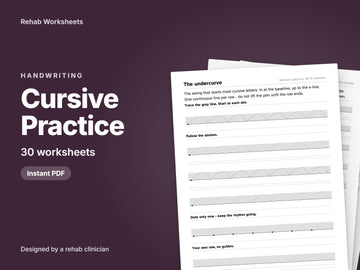
Download the PDFWorksheet 13 from the set, Baseline joins: six pairs (it, ti, tu, un, iu, wi), each traced from a solid model, followed from a dashed outline with an entry dot, then written from the dots alone, with a last line for the whole set from memory. Ten to fifteen minutes of practice. Free for personal, classroom, and session use.
Want the full set?
Personal-use license. Buying for a team? Choose the clinic license on the set's page.
- Level: joins, first of six
- Pairs: it ti tu un iu wi
- Support: solid model, dashed outline, dots alone
- Session: 10 to 15 minutes
- Paper: US Letter

Why the joins, not the alphabet
Joined writing usually falls apart between the letters, not in them. A person can form every letter well and still produce a hand that stalls at each connection, because the swing from one letter into the next was never practiced on its own. A-to-Z tracing sheets never get there.
The free worksheet above is the workhorse of the whole system: the baseline join, where one letter finishes at the baseline and swings straight into the next entry. Six pairs, it, ti, tu, un, iu, and wi, each get a row of their own in a shaded lane with a dashed midline and a bold baseline. Every row opens with a solid model, gives two grey pairs to trace over and two dashed pairs to follow from an entry dot, and then leaves only the dots. The last line asks for the whole set from memory (it, ti, tu, un, iu, wi, tt, ui), and the page ends with the self-check printed on every sheet: circle your smoothest three. The full pack gives the joins six worksheets of their own:
- baseline joins, the swing between most letters
- joining into round letters, the dip before a, c, d, g, o, and q
- bridge joins after b, o, v, and w, the join that leaves from the top and makes “on” and “wa” feel awkward
- joining into e and the tall loops (le, be, el, ll, th)
- a hard-pairs clinic: ss, rr, ff, oo, we, oe
- a join review built around the clusters that carry most English words: -ing, -and, -the
Is this a handwriting assessment?
No. Unlike a trail making or symbol digit page, a cursive joins sheet does not borrow its format from any standardized test, and none is implied. People who search for a handwriting assessment for adults usually want to know whether a difficulty with writing has a name, or how their handwriting compares with what is expected. Those questions are answered by a qualified professional, typically an occupational therapist or a psychologist, using standardized measures of handwriting speed and legibility alongside a history. A practice sheet cannot answer them.
These worksheets are practice materials. They are not an assessment and not a handwriting program, they do not identify any condition, and nothing here is a substitute for an evaluation by a qualified professional. If handwriting is a concern, that belongs with a professional first. What the worksheets offer is structured practice in joined writing, in an adult format, with the support faded one step at a time.
How the 30 worksheets are organized
One skill per page, in the order a therapist would introduce it, so nothing on a page depends on something that has not been practiced yet:
Strokes (4)
The undercurve, overcurves and loops, the downcurve bowl, then all four in alternation. The raw material of every letter.
Lowercase by family (8)
Letters grouped by the stroke they share, a tricky-letters clinic for b, o, v, w, f, and s, the whole alphabet joined, and a size check.
Joins (6)
The six worksheets above. The heart of the set, and the part other packs leave out.
Capitals (4)
Oval, angular, and loop-and-stem groups, then capital-into-word starts such as Th, Ch, and Wh.
Words and sentences (6)
Days, months, ten everyday words, and whole sentences with room for your own.
Functional cursive (2)
Your name at three sizes with initials, and a short dated note in your own hand. The two things adults actually need cursive for.
The hand itself is a traditional looped cursive, the style most adults in North America were taught and the one forms and signatures still expect. Not a simplified or italic script. The set runs to 34 pages in all: the 30 worksheets and a short how-to guide that explains the fading support and the self-check.
Support that fades, like a clinic fades it
Every letter, pair, and word on every page appears at three levels of support, and then none:
Trace the model
A solid grey model to write over, so the hand feels the full movement before it has to produce it. On the free page, two grey pairs follow the black model in every row.
Follow the dashes
A dashed outline with a dot marking where to enter. The shape is still there, but the pen has to find it. Two dashed pairs per row.
Dots, then nothing
Entry dots alone for the rest of the row, then an empty lane. On the free page that is the last line, where all eight pairs are written from memory. This is where the movement becomes yours.
The sheet ends with the same self-check every time: circle your smoothest three. Smooth beats pretty. Cursive is judged on rhythm, not ornament, and a person who evaluates their own work for smoothness tends to loosen the grip and speed up, which is exactly what joined writing needs.
| What you get | Free sample | Full set |
|---|---|---|
| Worksheets | 1 | 30, plus a how-to guide |
| Joins covered | Baseline joins | All six join worksheets |
| Strokes and letter families | None | 4 stroke pages and 8 lowercase pages |
| Capitals | None | 4 worksheets |
| Words and sentences | None | 6 worksheets |
| Functional pages (name and note) | None | 2 worksheets |
| Fading support and self-check | All three levels, plus the self-check line | All three levels on every page |
| Repeat sessions without reusing a page | One page | Weeks of practice |
Using it in a session or at home
- Find the entry dot first. Every pair on the page starts from a dot. Put the pen on it before anything moves; a join that starts in the wrong place has nowhere to go.
- Keep the pen down through the join. The whole point of a baseline join is that the pen does not lift between the two letters. If it lifts, go back and trace the solid pair once more before trying the dashes again.
- Trace with a finger before the pen. When the hand is stiff or tires quickly, run a finger over the solid model two or three times first. The movement is the same and the cost is lower.
- Judge smoothness, not neatness. Circle your smoothest three at the end of the page. A slightly wobbly pair written in one continuous movement is ahead of a tidy one written in two pieces.
- Stop at fifteen minutes. Coming back often matters more than staying long, and it is better to stop while the joins are still smooth than to push on until they get ragged.
- Move on when the set from memory is smooth. When all eight pairs on the last line come out in one movement each, the next join worksheet (joining into round letters) is ready.
Working on print letters as well? The free curve letters worksheet uses the same fading-support method for print, and the color-coded handwriting paper gives every line a job for the writing in between.
Who uses cursive practice worksheets
- Adults who never learned cursive, or who learned it and want it back
- Teens who were taught print only and now face signatures and handwritten forms
- People with dysgraphia, ADHD, or dyslexia who want adult materials rather than children's ones
- Anyone rebuilding handwriting after a stroke or brain injury, with the OTs who work alongside them
- Teachers, tutors, and literacy programs working with older learners
Pair it with the right paper
Cursive sits on the lines differently than print: loops reach higher, tails drop lower, and the baseline has to be steady for the joins to work. Two companions from the same series help:
- If print letters are still uneven in size or spacing, start with the Dysgraphia Handwriting Worksheets first. Same fading-support method, applied to print formation, size, and spacing.
- For everyday writing between worksheets, the color-coded handwriting paper gives every line a job: a top line for tall letters, a dashed midline, a bold baseline, and a descender guide, in four sizes and four support levels.
The free worksheet above is one of thirty. The full Cursive Handwriting Practice set includes all six parts (strokes, lowercase by family, the six join worksheets, capitals, words and sentences, and the two functional pages), the how-to guide, and the three levels of fading support on every page: 34 pages in all. Print handwriting, cursive, and the color-coded paper are all in the Handwriting collection, and the handwriting guide explains how the three fit together.
These materials support handwriting practice. They are not medical treatment or an assessment, and no specific therapeutic outcomes are claimed.


