
At the kitchen table, a man home from the hospital after a stroke wants the can opener. He can say it lives in the drawer by the stove, and his hand turns an invisible handle in the air, but the word itself will not come. Everyone has tip-of-the-tongue moments, more of them with age and on tired days. After a stroke or brain injury, and with aphasia, they can come many times a day, and the pauses wear on everyone at the table.
This page is a practical guide to word finding exercises for adults, with a free set to print today, no email required: the complete Wisdom and Life Lessons theme from our Finish the Phrase worksheets, 16 familiar sayings and the answer page. Below the download: the main kinds of word finding activities, a cue ladder for practicing at home, easier and harder versions, tips for conversation partners, and how the full set is organized.
Download the free word finding exercises
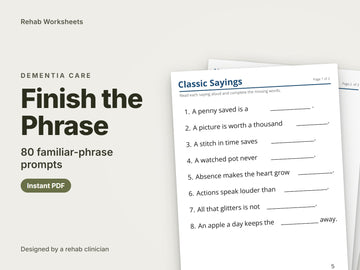
Download the PDFThe complete Wisdom and Life Lessons theme, set 5 of 5 from Finish the Phrase Worksheets for Seniors. Page 1 has sayings 1 to 8 and page 2 has sayings 9 to 16: familiar proverbs in large print, each with its last word left as a blank line. Page 3 is the theme’s answer page, a table of all 16 prompts with their answers. Free for personal, family, and care-program use.
Want all 80 sayings?
Personal-use license. Buying for a team? Choose the clinic license on the set's page.
- Theme: Wisdom and Life Lessons, set 5 of 5
- Sayings: 16, eight per page
- Answer page: all 16 answers in a table
- Print size: 24-point sayings
- Paper: US Letter, portrait

What are word finding exercises for adults?
Word finding is the split-second search for the word you need while you speak. When it fails, you know what you mean, and perhaps the first letter, but the word stays out of reach. Aphasia is a language difficulty that can follow a stroke or brain injury, and it can affect speaking, understanding, reading, and writing; trouble finding words is a common part of it. Persistent difficulty finding words is sometimes called anomia.
Word finding exercises for adults give that search a small, clear target: a prompt with one good answer, a partner, and time. On paper and in conversation, most fall into four kinds:
Sentence completion
A familiar sentence with its last word missing, such as “Look before you…”. The free pages are this kind: the sentence narrows the search.
Naming from a description
A partner describes something and the person names it: “You open cans with it.” Picture riddle cards work the same way, with a photo as an extra clue.
Category naming
Naming things that belong together: fruits, tools in a toolbox, things in a kitchen drawer. Start with one the person knows well, such as an old trade or hobby.
Opposites and associations
One word calls up its partner: hot and cold, salt and pepper, needle and thread. Pairs used together for a lifetime often come with little searching.
A fifth exercise turns this around: describing a word instead of finding it. Describe an everyday object without naming it (what it looks like, what it is for, where it is kept) while a partner guesses. In conversation, a clear description can get a message across while the word stays out of reach.
How to practice word finding at home, step by step
Any of the exercises above works this way, and the free sayings are an easy start. At its heart is a cue ladder: when the word does not come, give a little more help at each step, and stop climbing as soon as the word arrives.
Set up a short, calm session
Pick a rested time of day, turn off the television, and sit where you can see each other’s faces. Plan on ten to twenty minutes, and keep the answer page on your side of the table.
Read the prompt, then wait
Read the saying slowly, stop at the blank, and say nothing: the full set’s instructions suggest waiting 10 to 20 seconds. A long pause is the person searching, and early help can cut the search short.
Give a meaning cue
If nothing comes, hint at what the word means without saying it. For “Rome wasn’t built in a…”, try “It’s shorter than a week.” Speech-language pathologists call this a semantic cue.
Then the first sound
Still stuck? Give only the opening sound: “It starts with d…”. This is called a phonemic cue.
Then a choice of two
Offer the word alongside one other: “Is it a day or a year?” Picking the right word is usually easier than recalling it, and the answer is still the person’s own.
Then say it, and move on
If the choice does not help, say the word warmly and go on to the next saying. Two tries on one prompt is plenty; you can come back to it at the end of the page.
Notice which step usually brings the word; if the person sees a speech-language pathologist, mention it.
Word finding activities for adults: easier and harder versions
A good level leaves the person searching for a moment and then finding the word, more often than not. If every prompt needs the whole ladder, step down; if every word comes at once, step up.
- Easier. Use strong frames, such as well-worn sayings and pairs (“salt and…”), offer two written choices to point to, and stop after a handful of prompts. The full set’s instructions suggest starting with Classic Sayings, its most familiar theme.
- Harder. Take the frame away: name things from a description, list as many things in a category as come to mind, or find the opposite of a less common word, such as “generous”.
- More words, not just one. Ask what a saying means, or when the person last heard someone use it. The caregiver tips suggest the Wisdom and Life Lessons theme, the free one, for more challenge.
- Mixed days. Ability can change from morning to evening. Let today’s answers set today’s level, and finish on a prompt you expect to go well.
Aphasia exercises on paper: when reading and writing are hard too
Because aphasia can affect reading and writing as well as speech, aphasia worksheets often need a few changes before they suit the person. A partner can read each prompt aloud, so the task is about finding the word rather than reading it. Answers can be spoken, written, or picked from two words the partner writes down. A sheet of paper over the other prompts keeps attention on one line at a time.
If the person sees a speech-language pathologist, ask which aphasia exercises suit them right now and which cues to use. Their advice comes first, and pages like these can fit around it.
Tips for conversation partners
Most word finding happens in everyday talk, not on a worksheet. A few habits help:
- Give time. Wait before you help, with a relaxed face. A calm pause tells the person there is no hurry.
- Ask before you jump in. “Would you like a hint?” lets the person choose; some would rather keep searching than have a sentence finished for them.
- Welcome other routes. Describing, pointing, gesturing, writing the first letter, or a quick drawing can all get the message across.
- Ask one question at a time. On hard days, questions with a yes or no answer, or a choice of two, keep things moving.
- Check what you heard. Say back what you understood, such as “You want the can opener?”, so the person can confirm it or correct you.
- Keep it adult. Talk about real things, include the person in group conversation, and never talk about them as if they were not there.
Are word finding exercises speech therapy?
No, not on their own. Therapy for aphasia is planned by a speech-language pathologist (SLP), who chooses tasks, cues, and goals for the person in front of them. Speech therapy activities for adults can look a lot like the exercises on this page, and an SLP may choose to use printed pages like these in sessions or for practice between sessions.
The pages are not an assessment either. Nothing is scored, and a missed word on a tired afternoon is not a result. If finding words has become harder, raise it with the person’s doctor or ask about seeing an SLP. Sudden trouble speaking or understanding is different: call emergency services right away.
Worth knowing: these pages are practice and conversation materials. They are not speech therapy, an assessment, or a treatment, and they make no claim to change word finding, speech, or language. They do not replace advice from the person’s own healthcare team or the plan made by their speech-language pathologist.
How the full set is organized
The full Finish the Phrase Worksheets for Seniors is one 19-page US Letter PDF, written for older adults and memory care; its page for SLPs and OTs also covers adults with aphasia or trouble finding words. After a cover come a how-to-use page, caregiver tips, and that page for SLPs and OTs, then the five themes, 16 sayings each over two pages, and an answer page for every theme.
| What you get | Free sample | Full set |
|---|---|---|
| Themes | Wisdom and Life Lessons | All 5: Classic Sayings, Animals, Weather, Home and Food, and Wisdom and Life Lessons |
| Sayings | 16 | 80 |
| Worksheet pages | 2 | 10 |
| Answer pages | 1, for this theme | 5, one for every theme |
| How to use and caregiver tips | Summarized on this page | 2 pages, including cues and what to avoid |
| Page for SLPs and OTs | Not included | Yes, on word retrieval practice |
Who uses word finding exercises
- Adults practicing at home after a stroke or brain injury, with a partner
- Spouses, adult children, and friends who want a structured way to practice together
- Speech-language pathologists choosing materials for sessions or for practice between sessions
- Occupational therapists and activity staff running small conversation groups
- Older adults and memory care programs looking for a gentle word game built on familiar sayings
The free pages come from the full Finish the Phrase Worksheets for Seniors, with all 80 sayings, the answer pages, and the caregiver tips. Another complete theme, Weather, is free in our guide to free finish the phrase worksheets for seniors. For naming from a description, the Guess It! picture riddle cards pair a short riddle with a close-up photo clue; four are free in our guide to free games and puzzles for dementia patients. When words will not come at all, our free communication boards for adults and the full Communication Boards for Adults give the person pictures to point to. For the thinking side of conversation, such as hints and sarcasm, see our free cognitive speech therapy activities for adults. Finish the Phrase is also one of the ten sets in the Dementia Activities Bundle.
These materials support practice and conversation. They are not speech therapy, medical treatment, or an assessment, and no specific therapeutic outcomes are claimed. For questions about speech or language, speak with a speech-language pathologist.


