
Ask an older parent living with dementia what they did this morning, and the answer may not come. Start a saying they have heard all their life, “every cloud has a silver…”, and the last word often arrives before anyone has to think. The same thing happens in a care home lounge on a long afternoon, and with an adult after a stroke who knows exactly what they want to say but cannot find the word. Familiar phrases are often one of the places where words still come easily, and a shared moment of getting it right, with no pressure attached, is worth having.
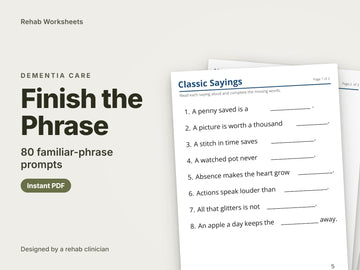
This page covers finish the phrase worksheets for seniors: printable pages of well-known sayings, proverbs, and idioms with the last word left blank. You can download the complete Weather theme for free below, both worksheet pages and its answer page. The full set has 80 prompts in five themes of 16, with caregiver tips and a page for speech-language pathologists and occupational therapists. Further down you will find how the themes are ordered, how to cue gently when a word does not come, and why sentence completion, a format familiar from word-finding practice, is not a memory test.
Download the free finish the phrase worksheets
Download the PDFSet 3 of 5 from the full set, the complete Weather theme: page 1 with prompts 1 to 8, page 2 with prompts 9 to 16, and the Weather answer page listing all 16 answers. Free for personal, classroom, and session use.
Want the full set?
Finish the Phrase Worksheets for Seniors (80 Prompts)$3.99
Already laminated and packed: Wipe-Clean Dementia Activity Boards (30 Activities) $34.99, ships to you.
Personal-use license. Buying for a team? Choose the clinic license on the set's page.
- Theme: Weather, set 3 of 5
- Prompts: 16, eight per page
- Answer page: included
- Session: 10 to 20 minutes
- Paper: US Letter

What is finish the phrase?
Finish the phrase is a simple word activity, also called finish the saying, complete the phrase, or fill in the blank sayings. Each worksheet shows the first part of a well-known saying with the final word blanked out. A caregiver or group leader reads the prompt aloud, slowly, with a clear pause at the blank, and the person says the missing word. If reading is comfortable, they can read the prompt themselves. Writing the answer on the line is optional; for most people the spoken answer is the activity.
The Weather theme shows how it works. “Make hay while the sun…” and “Save it for a rainy…” are phrases most older adults have heard and said for decades. The sentence does most of the work, so the answer can come without a long search, and many of these sayings carry a memory with them: a parent who said it, a farm, a wet summer. That is what makes it a no-fail activity when it is run well. There is nothing new to learn, a missed word is simply supplied, and each saying is a natural opening for conversation.
Long-term verbal memory
Language learned early and used for a lifetime. The reason a proverb can come back when this morning does not.
Word retrieval
Finding the one word that fits the gap. The sentence frame narrows the search, which is why the format turns up in word-finding practice.
Listening
Following a spoken sentence through to the pause. Reading slowly, with a clear stop at the blank, keeps each prompt easy to follow.
Conversation
Moving from a saying to a story or an opinion. “Who in your family used to say that?” can turn one prompt into a real conversation.
Is finish the phrase a memory test?
No. Finishing a familiar saying is not a measure of memory, and a missed word is not a result to record. The task draws on language stored long ago and practiced over a lifetime, which is different from remembering something new. That is the general reason it often stays within reach as recent memory fades, and the reason it is offered as an activity rather than a check. It also explains why the same person may finish phrases easily one day and not the next: tiredness, hunger, hearing, and mood all play a part.
When there is a question about memory or language, clinicians use standardized cognitive screening tools and language assessments, given and interpreted by trained professionals alongside the person's history. Sentence completion does appear in clinical work, but as a practice and cueing format: speech-language pathologists often use a familiar sentence frame to help a person reach a word they are struggling to find. The full set includes a page for speech-language pathologists and occupational therapists that describes this use with adults who have aphasia or word-finding difficulty: cued naming, sentence completion, and confrontation naming hierarchies, paired with phonemic and semantic cues, with pages sent home as carryover practice. That same page states plainly that the worksheets are not a standardized assessment.
Worth knowing: these worksheets are practice and engagement materials. They are not a memory test, they have no norms or scores, and they are not an assessment or a screening tool. They are not a substitute for evaluation by a qualified professional. If you are worried about changes in someone's memory or speech, raise it with their physician or the professionals involved in their care.
How the finish the phrase worksheets are graded
There are no basic, moderate, and complex levels in this set. Each of the five themes has 16 prompts over two pages, eight to a page, with its own answer page at the back. The order comes from the caregiver tips in the PDF, which say where to start and where to go when someone wants more:
Start: Classic Sayings
Set 1. The tips recommend starting here, and coming back here whenever you are unsure, because it has the highest familiarity: the best-known proverbs, the kind most people heard growing up.
Choose by interest: Animals, Weather, Home and Food
Sets 2, 3, and 4. The tips do not rank these three; choose by the person's interests and how they are doing. Animals gathers sayings and comparisons about dogs, cats, birds, horses, and more. Weather, the free theme above, moves from rain, sun, and storms to idioms that borrow from the sky. Home and Food draws on the kitchen and the table.
More challenge: Wisdom and Life Lessons
Set 5. The tips suggest moving here when someone is doing well. Some of these proverbs are longer (two run over two lines), and they suit the follow-up questions the tips recommend: “What do you think that saying means?” and “Have you ever used that one?”
| What you get | Free sample | Full set |
|---|---|---|
| Themes | 1, Weather | 5 themes |
| Prompts | 16 | 80 |
| Worksheet pages | 2 | 10 |
| Answer key | Weather answer page | All five answer pages |
| How to use and caregiver tips | Not included | Yes, two pages |
| Page for speech-language pathologists and OTs | Not included | Yes |
| Repeat sessions without reusing a page | One theme | Weeks of practice |
Using it in a session or at home
- Read slowly, then wait. Pause clearly at the blank and give 10 to 20 seconds for an answer. Silence is part of the task, so resist the urge to fill it.
- Give the first sound before the answer. If the word does not come, offer its first sound, a phonemic cue. For “It never rains, it…”, say “It starts with p…”. If that does not help, offer two choices: “Is it pours or drizzles?”
- Then share it and move on. If the cues do not work, give the answer cheerfully and go to the next prompt. Do not correct the same prompt again and again; after two misses, move on. Avoid anything that points at memory loss, such as “You used to know this.” The answer page is for you, and the person does not need to see it.
- Let a saying become a story. After a phrase, ask “When did you first hear that one?” or “Who in your family used to say that?” The conversation that follows matters more than finishing the page.
- Keep it short and stop on a good note. Ten to twenty minutes is plenty. Sit at eye level in a quiet, well-lit space, avoid times when the person is tired or hungry, and end while it is still enjoyable. If frustration builds, stop, offer a snack or a change of activity, and try another day.
- Adapt it when speech, reading, or writing is hard. Answers can be spoken, written, or pointed to between two written choices. In speech-language sessions the prompts pair with phonemic and semantic cues, and a page can go home for carryover practice. For repeated use, slip the pages into clear plastic sleeves and use a dry-erase marker.
Who uses finish the phrase worksheets
- Family caregivers looking for a calm, shared activity with a parent or partner at home
- Activity coordinators in care homes, assisted living, and adult day programs
- Memory care staff who want a no-fail activity that ends in conversation rather than a score
- Speech-language pathologists using familiar sentence frames for word retrieval practice in aphasia
- Volunteers and visitors who want an easy way into conversation with older adults
The pages are large print and uncluttered, with adult sayings and adult wording throughout, and nothing that feels like a children's worksheet.
The free PDF above is one theme of five. The full Finish the Phrase Worksheets for Seniors set includes all 80 prompts across Classic Sayings, Animals, Weather, Home and Food, and Wisdom and Life Lessons, with the complete answer key, the caregiver tips, and the page for speech-language pathologists and OTs. It is also one of the ten sets in the Dementia Activities Bundle. For more no-fail activities, the Reminiscence Cards pair 40 warm illustrations with gentle prompts about the past, the Picture Matching Cards use 30 pairs of photo-realistic pictures, and the Guess It! picture riddle cards pair each riddle with a close-up photo clue. If you would like reminiscence cards, picture riddles, and spot the difference too, the free dementia activity pack includes eight reminiscence cards, four riddle cards, and an easy spot the difference scene, along with the first pages of Classic Sayings and Animals. Browse all of our dementia activities and memory care printables, or our free printable worksheets for adults.
These materials support engagement and connection. They are not medical treatment, and no specific therapeutic outcomes are claimed. If you have concerns about a loved one's memory, please speak with their physician.


