
An afternoon visit can stall in the same place every time. The television is on, the conversation has run dry, and the puzzle book on the side table was made for someone else: tiny print, cartoon pictures, or crossword clues that ask for a word that will not come. Look for games for dementia patients and much of what turns up has the same problem. It is made for children, or it tests the very thing that has become hard: pulling a name out of memory on demand.
This page starts with a free sheet of picture riddle cards and the caregiver guide from our Guess It! set, no email required. Below that: how the 30-card set is organized, the three ways to play, the other no-fail games and puzzles in the shop, and how to choose between them as needs change. Every format rests on the same idea: no score and no wrong answer, only a small moment of recognition and the conversation that follows.
Download the free picture riddle cards
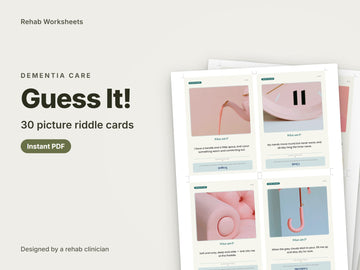
Download the PDFCards 1 to 4 of the Guess It! Picture Riddle Cards, from the “Around the home” theme. Page 1 is the how to play caregiver guide. Page 2 is one sheet of four “What am I?” cards, each with a close-up photo clue, a two-line riddle, and the answer and a conversation prompt printed upside down at the foot. Cut along the corner marks to make four cards. Free for personal, family, and care-program use.
Want the full set?
Guess It! Picture Riddles for Adults with Dementia (30 Cards)$5.49
Already laminated and packed: Wipe-Clean Dementia Activity Boards (30 Activities) $34.99, ships to you.
Personal-use license. Buying for a team? Choose the clinic license on the set's page.
- Theme: around the home, 1 of 5
- Cards: 4, numbered 1 to 4 of 30
- Ways to play: 3, from riddle only to a choice of two
- Timing: untimed, no score
- Paper: US Letter, 4 cards per sheet

What is a picture riddle game?
Each card describes an everyday object in a short rhyming riddle, written as if the object were speaking: “My hands move round but never wave, and all day long the time I save.” Above it sits a close-up photograph showing only part of the object, such as the spout of a teapot mid-pour, so it hints without giving the answer away. Under the words “turn the card to check”, the answer is printed upside down with a gentle conversation prompt. On the clock card, the prompt asks whether there was a clock at home that chimed on the hour.
Riddles are among the oldest brain teasers, but many printable brain teasers for seniors are word puzzles or logic problems with nothing to fall back on when an answer will not come. Good games for seniors with dementia share a few features, and this one is built around them. The objects are familiar from a lifetime of daily use. The pictures are real photographs, not cartoons. And there are several ways in: someone who cannot name the object from the riddle can often recognize it from the photo, or choose between two words and enjoy the story that follows.
Recognition
Knowing a familiar object from a partial view, such as a spout, a handle, or a dial. The photo clue leans on this, and it is often the easiest way in.
Word finding
Reaching for the name of an object from a spoken description. The riddle-only round asks the most of it.
Long-term memory
Drawing on objects and routines known for decades, like a pot of tea or a chiming clock. The conversation prompts are written to open these memories.
Conversation
Taking turns, sharing a story, and laughing together at a near miss. For many players this is the real game.
Are these games a memory test?
No. When memory or thinking needs to be checked, clinicians use standardized cognitive screening tools, such as the Mini-Cog or the Montreal Cognitive Assessment (MoCA). These are given and scored in a set way, and a score is only one part of a wider evaluation. A picture riddle has none of that structure, and it is not meant to.
These cards are for engagement, conversation, and enjoyment. Nothing is timed or scored. A card that sparks a long story about a grandmother's kitchen has done its job better than one answered in two seconds.
Worth knowing: the Guess It! cards and the other games on this page are practice and engagement materials. They are not an assessment or a screening tool, and they are not a substitute for evaluation by a qualified professional.
How the game is graded: three ways to play
The caregiver guide offers three ways to play, from the most demanding to the most supported. Any card works at any of them:
Just the riddle
Read the riddle aloud and keep the picture hidden, so the guess comes from the words alone. This asks the most: holding a spoken description in mind, then finding the word with no picture to lean on.
Add the clue picture
Show the close-up photo for a helping hand. Now recognition does much of the work, and the riddle becomes a hint rather than a puzzle.
Check the answer
Turn the card to read the answer at the foot, or offer a simple choice of two, as in the guide's example, “Is it a teapot or a kettle?” That asks only for recognizing the right word when it is heard. Then read the conversation prompt aloud.
Moving between them within a card is part of the game: show the picture when a guess stalls, and offer a choice before the pause becomes uncomfortable.
| What you get | Free sample | Full set |
|---|---|---|
| Cards | 4 | 30 |
| Themes | Around the home | 5 themes, 6 cards each |
| Photo clue, riddle, and answer on every card | Yes | Yes, every card |
| Conversation prompt with every answer | Yes | Yes, all 30 |
| How to play caregiver guide | Yes | Yes |
| Paper sizes | US Letter | US Letter and A4 |
| Repeat sessions without reusing a card | One sheet | Weeks of sessions |
More games and puzzles for dementia patients
The shop has four more no-fail formats for adults living with dementia, none with a score.
Picture matching cards
Sixty photo-realistic cards make thirty pairs across five themed sets. Matching asks the player to recognize that two pictures are the same, not to recall anything, which is why it tends to stay within reach longer than most games. The guide grades play from a few pairs face up to a full memory game. See the Picture Matching Cards (30 pairs).
Spot the difference
Two versions of the same realistic scene, such as a morning kitchen or a garden bench, sit side by side, and the player looks for what changed. Star ratings run from a few obvious changes to subtle ones, and every scene has an answer page. See the Dementia Spot the Difference Worksheets (30 realistic scenes), or start with our free spot the difference pictures for adults.
Finish the phrase
Eighty familiar sayings, proverbs, and idioms with the final word left blank, in five themed sets, large print, with a complete answer key. Well-known phrases draw on long-practiced language, which often stays accessible as recent memory fades. See the Finish the Phrase Worksheets for Seniors (80 prompts), or download our free finish the phrase worksheets for seniors.
Reminiscence cards
Not a game with an answer at all: forty illustrated cards, each pairing a warm picture with a gentle question about earlier life. They are a natural next step when a riddle card's prompt opens a memory. See the Dementia Reminiscence Cards (40).
To try several formats at once, our free dementia activity pack has pages of finish the phrase, reminiscence cards, picture riddles, and spot the difference.
For every format on this page in one download, the Dementia Activities Bundle collects ten dementia sets, more than 400 cards and pages. For a table where nothing needs printing at all, the Wipe-Clean Dementia Activity Boards are a physical kit of 30 activities on 15 laminated boards, from dot to dot and mazes to match the pairs and finish the saying, with a dry-erase marker so each board is ready again the next day.
Prefer a screen? Picture matching also runs as a free interactive game, Memory Match on our tools site: the classic pairs game in large print, with clear line drawings and their names, 4 to 8 pairs on the free settings, and no clock on screen. Cards can turn back by themselves or stay up until the next tap, and the easiest round starts with a five-second look at every card. It counts turns, pairs found, and time. Nothing to print, free to use.
Choosing a game or puzzle by stage
A useful general pattern: recognition (seeing a familiar thing and knowing it) tends to stay accessible longer than recall (bringing a word or fact to mind with no cue), and long-practiced language such as old sayings often holds up better than anything recent. Every person is different, so let their response guide you.
- Earlier on. Riddles with the picture hidden, finish the phrase, and subtler spot the difference scenes can offer a satisfying challenge.
- As recall gets harder. Lean toward recognition: riddles with the photo shown, a choice of two answers, matching pairs laid face up, and scenes with a few obvious changes.
- When words are scarce or attention is short. One card can be the whole activity. Look at the photo together, read the answer and prompt aloud, and welcome any response, whether a nod, a smile, or a story.
- On any given day. Ability can vary from morning to evening. If a game feels hard today, step down to an easier way of playing.
Using it in a session or at home
- Pick the way to play. If following the riddle is hard, lead with the photo and use the riddle as a hint.
- No rush, no score. As the guide says, a guess that is “wrong” is still a good talking point. Confirm the answer warmly and move on.
- Use the reveal as a conversation. Read the prompt aloud when you turn the card. “A good pot of tea fixes most things. How do you take yours?” is often worth more than the guess.
- Follow their lead. If a card sparks a memory, set the game aside and enjoy it. The rest will keep for another day.
- Keep it short and finish on an easy one. A handful of cards is plenty. End with one you expect them to get.
- Adapt for a group. In a care home lounge, day program, or memory cafe, read the riddle to the room, then pass the card around. Laminate cards that will be handled often.
Who uses these games
- Family caregivers at home
- Activity staff in care homes, assisted living, and day programs
- Memory cafes and community groups
- Occupational therapists planning engagement for clients living with dementia
- Volunteers and visitors looking for an easy conversation starter
The free sheet above holds 4 of the 30 cards. The full Guess It! Picture Riddles for Adults with Dementia (30 cards) covers five themes (around the home, food and kitchen, animals and nature, in the garden, and bygone days) in US Letter and A4, plus the caregiver guide. Every set on this page is also in the Entire Shop Mega Bundle, and the full range is in our dementia activities and memory care printables.
These materials support engagement and connection. They are not medical treatment, and no specific therapeutic outcomes are claimed. If you have concerns about a loved one's memory, please speak with their physician.


