A mug left on the wrong shelf. A picture frame hanging slightly crooked. A chair pulled out from a table that was tidy this morning. Noticing what has changed in a familiar room is an everyday skill, and it rests on a careful kind of looking: sweeping the scene in order and comparing what is there now with what was there before. After a stroke or brain injury, or with memory loss, that comparison can take real effort. And many of the puzzle books offered to adults are drawn for children.
This page offers free spot the difference pictures for adults: one complete puzzle from our 30-scene set, with its answers, to download and print. Below it: what the puzzle draws on, why no standardized test uses this format, how the easy, medium, and hard scenes are graded, and ways to use the pages at home, in a care home, or in a session.
Download the free spot the difference puzzle
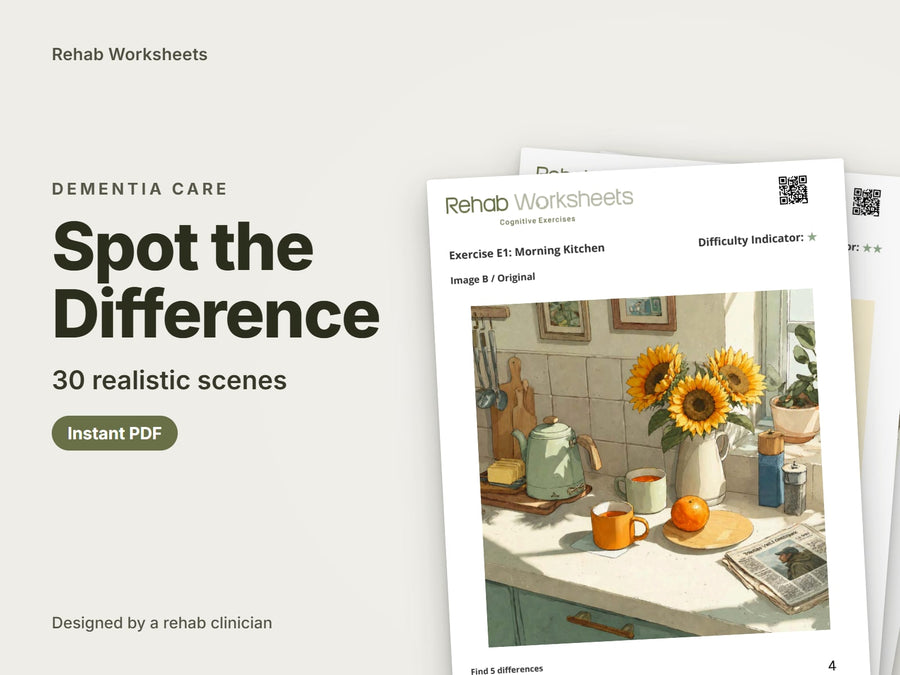
Download the PDFExercise M1, Painter’s Studio, the first scene of the medium (two-star) level. Page 1 is the original picture, labeled Image A. Page 2 is the changed picture, Image B, marked “Find 8 differences”. Page 3 is the answer page from the full set, with all eight differences circled; it also shows the circled answers for two neighboring scenes, E10 Front Porch and M2 Library Reading Room. Free for personal, classroom, and session use.
Want the full set?
Dementia Spot the Difference Worksheets (30)$3.99
Already laminated and packed: Wipe-Clean Dementia Activity Boards (30 Activities) $34.99, ships to you.
Personal-use license. Buying for a team? Choose the clinic license on the set's page.
- Level: medium, two stars (2 of 3)
- Differences: 8
- Suggested time: 8 to 12 minutes, no clock needed
- Answers: included, all 8 circled
- Paper: US Letter

What is a spot the difference puzzle?
Two versions of the same picture, with a set number of changes between them. In the second picture something has been added, taken away, or altered, and the task is to find each change and circle it. The number to find is printed on the page, so there is always a clear finish line.
In this set every scene is a two-page puzzle: the original scene on the first page, the changed scene on the second, printed and laid side by side. On the free Painter’s Studio puzzle, a few changes stand out within the first minute, and others only show up on a slow second look at the window or the floor.
Visual scanning
Sweeping the whole picture in an order so no area is skipped. In the Painter’s Studio, both the far edge of the window and the floor around the palette hide a change.
Attention to detail
Looking past the large shapes to the small things in a scene. A studio full of jars, brushes, and paint tubes gives the eyes plenty to check.
Visual discrimination
Judging whether two similar things are exactly the same. The easel, the stool, and the jar are in both pictures; the question is whether each one has changed.
Working memory
Holding a detail from one picture in mind while the eyes move to the other. With the two pictures on separate pages, every check is a trip across the table.
Why spot the difference works for adults and seniors
Almost everyone already knows spot the difference from newspapers and puzzle books, so there are no rules to explain. It needs no reading, no spelling, and no recall of facts, which keeps it open to people for whom words or memory have become harder. And the printed count tells the person how far there is to go and when they are done.
What matters most is that the pictures look made for grown-ups. The scenes in this set are painted everyday settings (a morning kitchen, a garden bench, a bakery counter, a country general store), chosen to look like a page from an art book rather than a children’s activity book. For someone living with memory loss, the aim is no-fail engagement: a calm task with a clear finish, often done together, where every difference found counts and nothing is a quiz.
Is spot the difference a test?
No. There is no standardized test built on this format. Spot the difference is a puzzle-book pastime, and the scenes here are arranged by difficulty for practice and enjoyment, not scored against anyone else. A count of differences found says how one person did on one picture on one day, and nothing more.
The puzzle does draw on everyday visual skills that clinicians also look at, with published, normed instruments given by trained professionals: scanning a scene in order, noticing fine detail, telling near-identical things apart, and holding one image in mind while checking another. That overlap makes it useful practice, but it does not make a puzzle page a measure of those skills.
Worth knowing: these pictures are practice and enjoyment materials. They are not a test, not an assessment, and not a substitute for evaluation by a qualified professional. If you have concerns about someone’s memory, attention, or vision, please speak with their physician or care team.
How the spot the difference pictures are graded
Thirty scenes in a 72-page PDF, ten at each of three levels, with a difficulty indicator of one to three stars on every page. A how-to-use page gives a suggested time for each level, and the answer pages (from page 63) circle every difference, three scenes to a page:
Easy, one star (10 scenes, E1 to E10)
5 to 7 differences per scene, with a suggested time of 3 to 6 minutes. Seven of the ten have 5 changes; Garden Bench has 6, and Bookshop Window and Birdwatcher’s Window have 7. The settings are calm and familiar, such as Morning Kitchen, Tea Tray, and Front Porch. For easy spot the difference, start here.
Medium, two stars (10 scenes, M1 to M10)
7 to 10 differences per scene, with a suggested time of 8 to 12 minutes. Seven scenes have 7; Painter’s Studio (the free sample) has 8, Train Platform has 9, and Library Reading Room has 10.
Hard, three stars (10 scenes, H1 to H10)
7 to 12 differences in busier pictures, with a suggested time of 10 to 15 minutes. Antique Market, Wood-Paneled Study, and Seaside Fishing Dock have 7; Botanical Greenhouse, Kitchen at Christmas, Hat Shop, and Music Room have 10; Village Square and Cluttered Potting Shed have 11; and Country General Store, with its crowded shelves, has 12.
| What you get | Free sample | Full set |
|---|---|---|
| Scenes | 1, Painter’s Studio | 30, in a 72-page PDF |
| Levels | Medium, two stars | Easy, medium, and hard |
| Differences per scene | 8 | 5 to 12, 226 in all |
| Settings | An artist’s studio | Kitchens, gardens, shops, a library, a train platform, a fishing dock, and more |
| Suggested time | 8 to 12 minutes | 3 to 15 minutes, by level |
| Answers | Answer page, all 8 circled | Every scene circled, three per page |
| How-to-use page | Not included | Levels, times, and getting-started steps |
| Repeat sessions without reusing a page | One puzzle | Weeks of practice |
Using it in a session or at home
- Print both pages and lay them side by side. The pack’s own steps: plain white paper at 100% scale, good light, and a pencil to circle each difference on the changed picture. Fold the answer page away until the end.
- Leave the clock off. The pack sets no time limit; the suggested 8 to 12 minutes for a medium scene is only a guide. If you want to follow pace over weeks, note the minutes and the number found, and compare the person only with themselves.
- Search in an order. Agree a route first: across the top, then down, or one quarter of the picture at a time. Watch for a corner that never gets checked; on the free page, one change sits right at the edge of the window.
- Keep it no-fail. Offer a gentle clue when a search stalls (“look near the stool”), and count what was found rather than what was missed. Stop while it is still enjoyable, ideally on a find or on looking at the answer page together.
- Point instead of circling. If holding a pencil is hard, the person points to each difference and a partner circles it. No speech or writing is needed, which suits group sessions.
- Step up, or step back. The pack suggests an easy scene first, to learn the format. If a scene feels like too much, cover half of both pictures with paper and compare one half at a time; when medium scenes go well without clues, try a three-star scene.
Prefer a screen? For free spot the difference games for adults online, we also offer an interactive version, Spot the Difference on our tools site, with the same 30 painted scenes. A tap on a change circles it on both pictures, optional hints point to the right quarter of the picture, and each round records differences found out of the total, false positives (taps where nothing had changed), and time. Three easy scenes are free with a free account, up to 5 rounds a day. Nothing to print, free to start.
Who uses spot the difference pictures
- Older adults who enjoy puzzles and want spot the difference for seniors that looks like art, not a children’s book
- People living with memory loss, with a family member or caregiver alongside
- Care home and day program activity staff running a calm table activity for one person or a small group
- Occupational therapists using it as a visual scanning task that feels like a pastime
- Adults after a stroke or brain injury who want structured visual practice at home
The free puzzle above is one of thirty. The full Dementia Spot the Difference Worksheets set includes all three levels and an answer page for every scene. The Picture Matching Cards (30 pairs of everyday pictures) make a good companion, and both sit among our dementia activities and memory care printables. Prefer a bound book? The Find the Difference Book for Adults and Seniors has 25 garden, village, and seaside scenes printed large and in full color, the two pictures on facing pages. More free pages: the free dementia activity pack, free dementia games and puzzles, and a free visual discrimination worksheet. Our guide to visual perception worksheets for adults explains how the formats fit together.
These materials support cognitive stimulation and structured practice. They are not medical treatment or an assessment, and no specific therapeutic outcomes are claimed.