
Telling a quarter from a nickel at the checkout. Picking your own reading glasses from two similar pairs on the table. Noticing that two keys have different teeth, or that two pill bottles with the same white cap hold different things. Each of these depends on visual discrimination: seeing the small detail that makes two similar things different, and being sure when two things are exactly the same. After a stroke, a brain injury, or another neurological change it can take real effort, even when eyesight is fine.
This page covers visual discrimination worksheets for adults: a free moderate-level page to download (worksheet VDT2B, answers further down), what visual discrimination is, how the format relates to standardized tests such as the TVPS and the MVPT (and why a practice page is not the test), and how the 15-worksheet set is graded.
Download the free visual discrimination worksheet
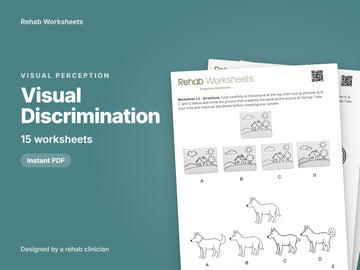
Download the PDFWorksheet VDT2B (worksheet 2.2), the second page of the moderate level: a soccer ball above four soccer balls labeled A to D, then a banana above four bananas labeled A to D. Circle the exact match under each picture. The answers are further down this page. Free for personal, classroom, and session use.
Want the full set?
Personal-use license. Buying for a team? Choose the clinic license on the set's page.
- Level: moderate (level 2 of 3)
- Pictures: 2 per page, 4 options each
- Response: circle A to D, no drawing
- Timing: untimed, the directions say to take your time
- Paper: US Letter

What is visual discrimination?
Visual discrimination is the ability to notice what sets two similar things apart (shape, size, shading, orientation, a small mark) and to confirm when nothing does. It is a visual perceptual skill, separate from eyesight itself: a person can read the bottom line of an eye chart and still find two near-identical pictures hard to tell apart.
Each worksheet in this set holds two problems: a target picture at the top and a row of lettered options underneath. Most problems have four options, A to D; three have more, with five cubes, six teacups, and ten books in two rows. Exactly one option is identical to the target. The others are the same object with a detail changed, so naming the object does not help: every option on the free page is clearly a soccer ball or a banana. The printed directions ask the person to compare carefully, check all the details, and circle the one that is exactly the same.
Visual discrimination
Spotting the one detail that separates near-identical pictures. Every option is the right object, so the answer is in the details.
Visual scanning
Moving across every option in order so none is skipped. The ten-book problem on worksheet 2.5 makes an orderly sweep essential.
Working memory
Holding the target’s details in mind while each option is checked. The eyes return to the top picture many times per problem.
Attention to detail
Checking every option before circling instead of stopping at the first close one. A first glance finds four soccer balls; only a careful look finds the match.
Visual discrimination on the TVPS and MVPT, and how these worksheets differ
This skill is one of the areas covered by standardized visual perception instruments such as the Test of Visual-Perceptual Skills (TVPS) and the Motor-Free Visual Perception Test (MVPT). Both are published, normed tests given and interpreted by trained professionals, and both are motor-free: the person points to a choice or names it, with no drawing or writing. In a visual discrimination item, the person looks at a design and picks the identical one from several choices. The TVPS gives visual discrimination a subtest of its own, and the MVPT mixes these items in with others; between them, the tests cover visual discrimination, visual memory, spatial relationships, figure-ground, and visual closure.
Occupational therapists use these items as one part of a broader picture of visual perception. Results are compared with norms and read inside a full evaluation that takes in history, vision, and how the person manages everyday tasks. The worksheets on this page borrow only the format: a target, several look-alike choices, one identical match.
Worth knowing: these worksheets are practice materials, not the TVPS, the MVPT, or any other test. The pictures are different, there are no norms, and nothing on the page produces a score that can be compared with a population. They are not an assessment and not a substitute for an evaluation by a qualified professional. If someone is due to be assessed on a visual perception instrument, tell the clinician about any practice with this format, since familiarity can affect how a score is read.
How the visual discrimination worksheets are graded
Fifteen worksheets, five at each of three levels, with two pictures to match on every page: 30 problems in a 21-page PDF. The scoring sheet on the last page lists both correct answers for every worksheet, with space to write the answers given beside them. The pictures grow more abstract and the differences smaller at each level:
Basic, level 1 (5 worksheets, VDT1A to VDT1E)
Mostly clear line drawings of everyday things: a house in a landscape, a dog, a telescope, a pizza slice, a globe, a microscope, a cube, a light bulb, a phone, and a key. Differences are easy to see once looked for: a heart-shaped cloud, a curled tail, a collar. Four options per picture, except the cube, which has five (A to E) that differ only in how one face is shaded.
Moderate, level 2 (5 worksheets, VDT2A to VDT2E)
More detailed pictures, many in shaded pencil, with finer differences: a teacup and saucer, a sketched landscape with a sign, a soccer ball, a banana, a spiral, a hexagonal maze, an orange, a pyramid, a book, and a grid of four small framed landscapes. Two problems widen the field to six teacups (A to F) and ten books (A to J). The free sample above is the second page of this level.
Complex, level 3 (5 worksheets, VDT3A to VDT3E)
Abstract forms with no everyday name to lean on: crossing wavy strands, a cluster of spheres and blocks, a stack of floating cubes, a faceted tiled shape, a starburst, a swirl, a circle with shaded quarters, a star of crossing blades, overlapping rings, and a pitted, dripping sphere. Four near-identical options per picture, so each has to be compared with the target part by part.
| What you get | Free sample | Full set |
|---|---|---|
| Worksheets | 1 | 15, in a 21-page PDF |
| Levels | Moderate | Basic, moderate, complex |
| Pictures to match | 2 | 30, two per worksheet |
| Options per picture | 4, A to D | 4 for most, plus one picture each with 5, 6, and 10 |
| Kinds of picture | A soccer ball and a banana | Everyday objects, shaded sketches, and abstract forms |
| Response format | Circle one letter | Circle one letter |
| Answer key | Listed on this page | Scoring sheet for all 15 worksheets |
| Repeat sessions without reusing a page | One page | Weeks of practice |
Visual discrimination activities for a session or at home
- Leave the clock off. The directions say to take your time, and a visual discrimination activity rewards care over speed. If pace matters later, note the minutes per page rather than setting a limit.
- Check the free page together. The answers are D for the soccer ball and C for the banana. The soccer balls share one pattern of panels and differ only in how dark the panels are: A and C are lighter grey, B is darker but still hatched, and only D has the solid black panels of the target. Only banana C carries the faint speckles on the skin, so comparing outlines alone will not find it.
- Rule out, then confirm. Compare one feature at a time across all the options (outline, then shading, then small marks), crossing out each option that fails, and check the last one left against the target before circling. On the ten-book page this turns a search into a short list.
- Point or say the letter. Nothing has to be written. If holding a pen is slow or effortful, the person points to an option or says its letter and a partner circles it.
- Record the letter, not just right or wrong. Write down the letter chosen and compare it with the scoring sheet. A choice that missed by one faint detail says something different from one that was not close.
- Step up, or step back. When both moderate pictures are right across a few sessions, try the complex pages. Looking for visual discrimination shapes rather than objects? Level 3 is all abstract forms. If a page is frustrating, step back to the basic level, or cover all but two options with a card and compare a pair at a time.
Prefer a screen? We also offer a free interactive version, Same or Different on our tools site, which puts two items side by side (letters and numbers, rows of symbols, or line figures) and asks whether they are exactly the same or one small thing has changed. Half the pairs are identical. It times every answer and reports accuracy, median speed, differences caught, and false differences (a change seen where there was none). Nothing to print, free to use.
Who uses visual discrimination worksheets
- Occupational therapists working on visual perception with adults after a stroke or brain injury
- Speech-language professionals and neuropsychology teams
- Hospital, outpatient, and community programs running group cognitive stimulation sessions
- Caregivers and family members supporting practice at home
- Adults looking for printable worksheets for visual discrimination that were not made for children
All of our worksheets are designed to be adult-appropriate and visually clean, with no cartoons or childish decoration.
The free worksheet above is one of fifteen. The full Visual Discrimination Worksheets set includes all three levels and the scoring sheet. It is also part of the Visual Perception Worksheets Bundle, 70 worksheets, alongside the figure-ground, visual closure, and visual spatial sets. If finding a target in a busy scene is harder, try the free figure ground worksheet; for recognizing a picture from part of it, the free visual closure worksheet. For same or different checks on paper, see the Comparison Activity Worksheets, and our guide to visual perception worksheets for adults explains how the formats fit together.
These materials support cognitive stimulation and structured practice. They are not medical treatment or an assessment, and no specific therapeutic outcomes are claimed.


