
Reading a road sign with a branch across it, recognizing a mug from the handle sticking out of the cupboard, finding your own car from the corner of a bumper in a full parking lot, or knowing a word from its first few letters: all of these rely on visual closure, completing a picture in the mind from partial information. It is a visual perceptual skill most people use hundreds of times a day without noticing, and one that can become effortful after a neurological change, even when eyesight is fine.
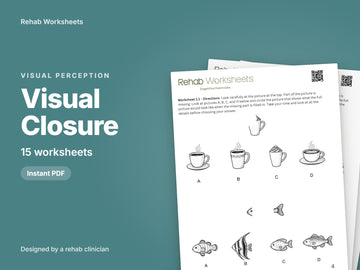
This page covers the visual closure worksheet: a picture with part of it missing, and four candidates for the complete version. You can download a free moderate-level worksheet below, see what the task asks for and which skills it draws on, read how it relates to the visual closure subtests on standardized instruments such as the TVPS and the MVPT (and why a practice page is not the test), and find out how the 15-worksheet set is graded and scored.
Download the free visual closure worksheet
Download the PDFWorksheet VCT2A, the first page of the moderate level. Two pictures to complete: a key drawn as a dashed outline above four complete keys labeled A to D, then a cow with a strip missing from the middle above four cows labeled A to D. Circle one answer under each picture. Free for personal, classroom, and session use.
Want the full set?
Personal-use license. Buying for a team? Choose the clinic license on the set's page.
- Level: moderate (level 2 of 3)
- Pictures: 2 per page, 4 options each
- Response: circle A to D, no drawing
- Timing: untimed, the directions say to take your time
- Paper: US Letter

What is a visual closure task?
Each worksheet holds two problems. At the top of each one is a picture with part of it missing, and underneath are four versions of the same kind of object, labeled A to D. The person looks at the fragment, works out what the whole object must look like, and circles the option that matches. The wrong options are not random. They are the same object with a small change, a different cut on the key or a different pose on the cow, so a quick guess based on the object’s name is often wrong. The printed directions say it plainly: take your time and look at all the details before choosing.
Across the set the missing part is presented in several ways. Sometimes a large section is simply cut away. Sometimes a strip is removed from the middle, or the outline is drawn in dashes with nothing inside it, or a patch is covered over with hatching. Each version asks for the same thing: hold the fragment in mind, fill in what is not there, and check that guess against four close candidates. Because the answer is circled rather than drawn, the task stays open to people whose handwriting is slow or effortful, and it keeps the perceptual work separate from the motor work.
Visual closure
Recognizing a whole object from an incomplete view. The core of the task: the fragment has to become a key before it can be matched.
Visual discrimination
Telling four near-identical options apart. Where most errors happen at the moderate and complex levels.
Working memory
Holding the fragment in mind while each option is checked against it. The eyes travel between the top picture and the options many times per problem.
Attention to detail
Checking every part of every option instead of stopping at the first plausible one. The first option that looks right is not always the one that is.
The TVPS and MVPT visual closure subtests, and how these worksheets differ
Visual closure is one of the areas covered by standardized visual perception instruments such as the Test of Visual-Perceptual Skills (TVPS) and the Motor-Free Visual Perception Test (MVPT). Both are published, normed tests that are administered and interpreted by trained professionals, and both are motor-free: the person answers by pointing to a choice or naming it, so no drawing or handwriting is involved. Each has a visual closure section in which the person matches an incomplete form with its complete version among several choices, alongside other sections covering skills such as visual discrimination, figure-ground, spatial relationships, and visual memory.
Occupational therapists use these subtests to look at how a person completes a picture from partial information, as one part of a broader picture of visual perception. Results are compared with norms, and the interpretation sits inside a full evaluation that takes in history, vision, and how the person manages everyday tasks. The worksheets on this page borrow the format of the visual closure subtest: an incomplete picture, several complete candidates, one correct answer. They share nothing else with the tests.
Worth knowing: these worksheets are practice materials, not the TVPS, the MVPT, or any other test. The pictures are different, there are no norms, and nothing on the page produces a score that can be compared with a population or used to reach a conclusion about anyone. They are not an assessment and not a substitute for an evaluation by a qualified professional. If someone is due to be assessed on a visual perception instrument, tell the clinician about any visual closure practice, since familiarity with the format can affect how a score is read.
How the visual closure worksheets are graded
Fifteen worksheets, five at each of three levels, and every worksheet holds two pictures to complete, so the full set is 30 problems. The scoring sheet at the back lists both correct answers for every worksheet, and the pictures change at every level:
Basic, level 1 (5 worksheets, VCT1A to VCT1E)
Large, clearly outlined pictures of everyday objects: a coffee cup, a fish, an apple, a chair, a light bulb, a wristwatch. A sizeable section is missing, often most of the object, and the four options differ obviously, such as a cup on a saucer next to a tall mug and one topped with cream.
Moderate, level 2 (5 worksheets, VCT2A to VCT2E)
More detailed pictures (a key, a cow, a lamp, a book, an airplane, a potted plant) with smaller missing parts, sometimes shown as a dashed outline or a strip removed from the middle. The options differ in finer ways: the cut of a key, the base of a lamp. The free sample above is the first page of this level.
Complex, level 3 (5 worksheets, VCT3A to VCT3E)
Intricate pictures, many of them abstract three-dimensional forms such as clusters of cubes, faceted polyhedra, and crystal shapes, with a house and a pair of glasses among them. The omissions are subtle, sometimes a patch covered with hatching, and the four options are near-identical, so each has to be compared with the fragment part by part.
| What you get | Free sample | Full set |
|---|---|---|
| Worksheets | 1 | 15 |
| Levels | Moderate | Basic, moderate, complex |
| Pictures to complete | 2 | 30, two per worksheet |
| Kinds of picture | A key and a cow | Everyday objects, animals, and abstract three-dimensional forms |
| Response format | Circle A to D | Circle A to D |
| Scoring sheet with correct answers | No | Yes, both answers for every worksheet |
| Repeat sessions without reusing a page | One page | Weeks of practice |
Visual closure activities for a session or at home
- Leave the clock off. The directions say to take your time, and accuracy is the point of this format. If pace is something you want to track later, note the time per page as a side measure rather than setting a limit.
- Cover the options first. Slide a sheet of paper over A to D and ask the person to say what the top picture is before looking at the choices. Naming the object from the fragment is the closure step; matching it to an option is the discrimination step, and it helps to know which of the two is the hard one.
- Compare part by part. When two options look the same, go around the fragment feature by feature: the bow of the key, then the shoulder, then the teeth. Cross out each option that fails a feature until one is left.
- Point or say the letter. Nothing has to be written. If holding a pen is slow or effortful, the person points or says the letter and a partner circles it. The task is unchanged.
- Record the letter, not just the score. Write down the letter chosen for each of the two pictures and compare with the scoring sheet. A wrong answer that was nearly right says something different from one that was a different object altogether.
- Step up, or step back. When both pictures on the moderate pages are correct across a few sessions, the complex pages are ready. If a moderate page is frustrating, the basic pages have the same format with larger objects and larger differences between the options.
Prefer a screen? We also offer a free interactive version, Visual Closure on our tools site, which hides part of a picture and asks for the complete one. A visibility dial sets how much of the picture shows, from 80 percent down to 20, and a progressive reveal mode fills the fragment in a little every two seconds until the person answers. It records correct answers out of the total, the time taken on correct answers, and, in progressive reveal, how much of the picture was visible when the person got it right. Nothing to print, free to use.
Who uses visual closure worksheets
- Occupational therapists and speech-language professionals
- Hospital, outpatient, and community programs
- Educators working with adult learners
- Caregivers supporting cognitive practice at home
- Adults looking for structured, printable visual perception activities
All of our worksheets are designed to be adult-appropriate, visually clean, and easy to understand without unnecessary visual clutter.
The free worksheet above is a single moderate-level page. If you want the full graded progression, our Visual Closure set includes 15 worksheets across basic, moderate, and complex levels, plus the scoring sheet. It is also part of the Visual Perception Worksheets Bundle, 70 worksheets, alongside the figure-ground, visual discrimination, and visual spatial sets. If the difficulty is finding an object against a busy background rather than completing one, the figure ground worksheet is the neighboring format, and the visual perception guide explains how the whole family fits together.
These materials support cognitive stimulation and structured practice. They are not medical treatment or an assessment, and no specific therapeutic outcomes are claimed.


