
It is two o’clock in the lounge of a senior living community. Lunch is over, the chair exercise class has finished, and four residents sit at the table by the window with nothing in front of them. One finds shuffling hard on stiff fingers, one tires quickly, one finished the large-print crossword before breakfast, and one has a memory that is not what it was. All four would enjoy a game, as long as it is played sitting down and works for each of them. Family visits at home reach the same quiet moment once the news has been shared.
This page is a guide to sit-down games for senior citizens, with a free game to print and play today: one complete set of picture matching cards, no email required. Below the download: the four kinds of sit-down games, how to play picture matching at three levels, card games for seniors that suit tired eyes and stiff hands, how to choose games for seniors with dementia, and how the full 60-card set is organized.
Download the free picture matching cards
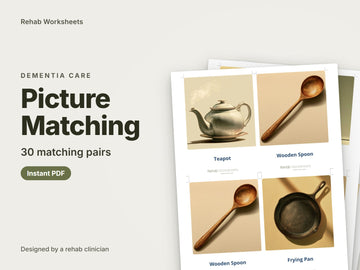
Download the PDFThe complete garden set from Picture Matching Cards for Dementia, pages 13 to 16 of the US Letter file: two cards each of a sunflower, rose, watering can, shovel, basket, and garden hat, four to a page with corner marks for cutting. Free for personal, family, and care-program use.
Want all 30 pairs?
Personal-use license. Buying for a team? Choose the clinic license on the set's page.
- Set: the garden set, 1 of 5
- Cards: 12, making 6 pairs
- Card size: 3.5 by 5 inches, 4 per page
- Labels: the name in large print on every card
- Paper: US Letter, portrait

What are sit-down games for seniors?
Sit-down games for seniors are games played from a chair, usually around a table, that ask nothing of balance, speed, or stamina. They are the everyday games of senior centers, assisted living, adult day programs, and family visits. The good ones share a few traits: they are quick to explain, the pieces and print are large, a turn can be skipped without fuss, and everyone can take part at their own level. Most fall into four kinds:
Card games
Rummy, Go Fish, crazy eights, cribbage, and solitaire, often with large-print cards. Many players learned them decades ago, so the rules need little explaining.
Word games
Finishing a familiar saying, naming things in a category, or a large-print word search. Nearly everyone can finish “a penny saved is…”, which makes old sayings an easy way in.
Picture games
Matching pairs, spot the difference, and picture riddles, where the picture carries most of the game. The free garden set is one: finding a match takes no words at all.
Trivia and reminiscence games
Easy questions about the past, such as old prices, songs, or school days, played for stories more than points. Asking “what was yours like?” keeps everyone in the game, whatever their answer.
How to play picture matching
Picture matching is about as simple as a card game gets: find the two cards that show the same thing. The how-to-use guide in the full set describes three ways to play, from every card face up to the classic face-down game, and the free garden set works at each. The steps below follow the guide:
Print and cut
Print the four pages at actual size, on cardstock if you have it, and cut along the corner marks. Laminating the cut cards is optional and makes them last longer.
Choose a quiet table
Sit at eye level with the player in a quiet, well-lit space, with the television off and the table clear.
Start face up
Spread the 12 cards face up, point to one, and ask: “Can you find another one like this?” If 12 cards feel like a lot, start with two or three pairs.
Talk about each match
Read the name aloud and let the picture lead: “What do you do with a watering can?” A story about a garden is worth more than a quick match.
Add more when it feels easy
Once the set goes smoothly face up, add a second set, or lay the cards face down in a grid and take turns flipping two at a time, keeping any pair you find and turning the rest back over.
Stop while it is still enjoyable
The guide suggests 10 to 20 minutes as plenty. End on an easy match, so the game finishes on a good note.
Card games for seniors: keeping everyone at the table
Card games are the most familiar games for senior citizens, and a few small changes keep most of them in play. Large-print playing cards, with oversized numbers and suits, are easier to read than a standard deck. A card holder or a simple book stand keeps a hand upright for anyone with arthritis or the use of one hand, and a helper or an automatic shuffler can take over the shuffling.
Choose the game by the group, not by the box. Simple games such as war, Go Fish, and crazy eights suit a mixed table and a visit from grandchildren; rummy, cribbage, and bridge suit players who want more to think about. When the rules start to slip, play with open hands, play in pairs, or end the game at a lower score. The picture matching cards also make a gentle card game of their own: deal a few to each player, put the rest face down in the middle, and play Go Fish by asking for a picture (“Do you have the rose?”) instead of a number.
Games for seniors with dementia: finding the right level
A useful general pattern: recognizing something familiar that is in front of you tends to stay within reach longer than recalling a word or a fact with no cue. That is why matching, which asks only “find another one like this,” often works for someone living with dementia when a quiz or a game with many rules does not. Every person is different, and ability can change from morning to evening, so let the person’s response set the level.
- When games still feel easy. The classic face-down game with one set, two sets mixed together, card games with their usual rules, and gentle trivia.
- When recall gets harder. One set face up, a choice of two answers in place of an open question, and picture riddles with the photo shown.
- When words are scarce. Two or three pairs on the table, or simply look at the pictures together and talk about what each one brings to mind. As the guide puts it, “The activity is engagement, not winning.”
- When it stops being fun. Looking away, fidgeting, or standing up to leave are signs to stop or switch to something easier. Ending early is never a failure.
Tips for a good game, whatever you play
- Start small. One set of six pairs is plenty for a first game. The guide warns that all 60 cards spread out at once can feel overwhelming.
- Never say “wrong.” If someone picks the wrong card, try the guide’s line, “That’s a great pick too. Let’s look together,” and guide gently. If the sunflower gets called a daisy, smile and carry on.
- Leave the clock out. Do not time anyone or make the game a test. Speed is not the point.
- Play alongside, not over. Take your own turns and miss a match now and then. A game between equals feels very different from a quiz.
- Let the pictures start conversations. The garden hat card invites the guide’s question, “Who used to wear a hat like this in your family?” The answer may be the best part of the afternoon.
Are games for seniors therapy?
Not on their own. Occupational therapists and speech-language pathologists sometimes use games inside therapy they plan for a person, with goals of their own, and the guide in the full set includes a short note for them on using the cards for picture naming. A game at a senior center table, in an assisted living lounge, or on a family visit is something different: a pastime, chosen for enjoyment and company.
Picture matching is also not a memory test. Nothing is timed or scored, and nobody needs to get anything right. When memory or thinking needs checking, that is a job for the person’s own clinicians and their standardized tools, not for a game of pairs.
Worth knowing: these cards are an engagement activity, for enjoyment and company. They are not therapy, an assessment, or a treatment, and they make no claim to change memory, thinking, or mood. They do not replace advice from the person’s own healthcare team.
How the full set is organized
The full Picture Matching Cards for Dementia is 18 pages, in US Letter and in A4: 60 photo-realistic cards printed four to a page, making 30 pairs in five themed sets of six pairs (things from the kitchen, food, clothes and accessories, everyday things around the house, and the garden), followed by the two-page how-to-use guide.
| What you get | Free sample | Full set |
|---|---|---|
| Cards | 12, making 6 pairs | 60, making 30 pairs |
| Themed sets | The garden set | All 5: kitchen, food, clothes, around the house, and garden |
| Name printed on every card | Yes | Yes, all 60 |
| How-to-use guide | Summarized on this page | 2 pages: three ways to play, tips, and what to avoid |
| Bigger games | One set | Mix sets, up to all 30 pairs |
| Paper sizes | US Letter | US Letter and A4 |
Who uses sit-down games for seniors
- Activity staff in senior centers, assisted living, and memory care
- Adult day programs and memory cafes running small table groups
- Families looking for something to share on a visit, grandchildren included
- Occupational therapists and speech-language pathologists planning engagement activities
- Volunteers and visitors who want an easy way to start a conversation
The free cards above come from the full Picture Matching Cards for Dementia (30 Pairs): all five themed sets, the how-to-use guide, and US Letter and A4 files. For a picture game read aloud, the Guess It! picture riddle cards pair a close-up photo clue with a short riddle; four are free in our guide to free games and puzzles for dementia patients. The Finish the Phrase worksheets turn 80 familiar sayings into a word game, and our free spot the difference pictures for adults offer a realistic scene with its answer page. For a table where nothing needs printing, the Wipe-Clean Dementia Activity Boards hold 30 activities on 15 laminated boards, tic-tac-toe and dots and boxes among them. Picture matching is also part of the Dementia Activities Bundle, and everything is in the Dementia & memory care collection.
These materials support engagement and connection. They are not medical treatment, and no specific therapeutic outcomes are claimed. If you have concerns about a loved one’s memory, please speak with their physician.


