
A road sign that lays a slash across an arrow. A step in assembly instructions that shows one part added and another taken away. A floor plan where the new bookcase has to be pictured next to the furniture already there. Each of these asks for the same quiet piece of thinking: holding two pictures in mind, putting them together, and sometimes taking part of one away, with nothing to move by hand. After a stroke, a brain injury, or another neurological change, that picture-in-the-mind work can take real effort, even when each picture on its own is easy to see.
This page offers free figure combination worksheets for adults: the first moderate page from our set, a worked example and four items, with the moderate answer key. It also explains what a figure combination task is, how it relates to the spatial relations test in standardized cognitive batteries such as the Woodcock-Johnson (and why a practice page is not the test), and how the 90 exercises are graded. The format is language-free, which makes it simple spatial ability practice when reading or speech takes effort.
Download the free figure combination worksheet
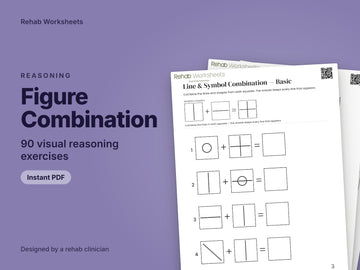
Download the PDFThe first page of the moderate level, titled Line & Symbol Combination: a worked example and items 1 to 4. Each item shows three squares of lines and circles joined by a plus and a minus sign, then an empty square for the answer. Page 2 is the moderate answer key, with all 30 moderate answers drawn in; items 1 to 4 belong to the free page. Free for personal, classroom, and session use.
Want the full set?
Personal-use license. Buying for a team? Choose the clinic license on the set's page.
- Level: moderate (level 2 of 3)
- Items: 4, plus a worked example
- Steps per item: add two squares, take away a third
- Timing: untimed, note the minutes if you want a record
- Paper: US Letter

What is a figure combination task?
Each item shows two or more squares with simple line figures inside: straight lines in four directions, circles, and at the complex level, arrows and arrowheads. The squares are joined by plus and minus signs. A plus means put the figures together, keeping every line that appears; a minus means take away the lines shown in that square. The person works it out in their head, then draws the result in the empty square at the end of the row. Nothing moves or turns: each line stays exactly where it sits in its square.
The worked example at the top of the free page shows the idea. A cross plus an X gives four lines through the center, and taking the cross away again leaves only the X. Item 4 on the same page adds a wrinkle: the same rising diagonal appears in both squares being added, so it is drawn once, and taking away the circle leaves a vertical line and that diagonal. No words are needed at any point, which is why this kind of spatial reasoning question works when language is hard.
Visualization
Building a picture in the mind that is not on the page yet. The answer square stays empty until the combined figure has been seen in the head.
Working memory
Holding the lines from one square while looking at the next. At the moderate level, the sum of the first two squares has to be held while the third is taken away.
Attention to detail
Telling a rising diagonal from a falling one, and a line through a circle from a line beside it. On the free page, items 1 and 2 use the falling diagonal and items 3 and 4 the rising one.
Following steps in order
Working left to right, one sign at a time. The complex pages print the rule outright: add each plus square, then take away the lines in every minus square.
The spatial relations test, and how these worksheets differ
Putting shapes together in the mind is a standard ingredient of spatial reasoning items in cognitive testing. A well-known example is in the Woodcock-Johnson IV Tests of Cognitive Abilities (WJ IV COG), where Spatial Relations is one of two parts of the Visualization test. The person looks at a target shape and identifies the two or three pieces that would form it, and items get harder as the pieces are flipped, rotated, and made more alike. The other part, Block Rotation, asks which two patterns of blocks match a target. Together they are scored as a measure of visual processing.
The WJ IV COG is a published, normed battery, given and interpreted by trained professionals as one part of a broader evaluation. The name spatial relations is also used outside clinical testing, for example for a section of some aptitude tests and for online quizzes of spatial reasoning questions. The worksheets on this page share the core demand, building a whole from parts in the mind, but the format differs: nothing is rotated or flipped, there are no answer choices to pick from, and the person draws the result, with a step of taking lines away at the moderate and complex levels.
Worth knowing: these worksheets are practice materials, not the Woodcock-Johnson Visualization test, any other spatial relations test, or an aptitude test. The items are our own, there are no norms or time limits, and nothing here produces a score that can be compared with a population. They are not an assessment and not a substitute for an evaluation by a qualified professional. If someone is due to have a cognitive assessment, tell the clinician about regular practice with spatial puzzles, since familiarity can affect how a result is read.
How the figure combination worksheets are graded
Ninety exercises in a 33-page PDF, thirty at each of three levels. Each level opens with a title page and a worksheet page with a worked example, and closes with a drawn answer key for all 30 items. The figures stay simple; what grows is the number of steps:
Basic (30 items on 8 pages)
Two squares joined by a plus sign: combine them and keep every line. The figures are straight lines (vertical, horizontal, and both diagonals) and circles, four items to a page. The first basic page and its key are in our free cognitive exercises sampler, linked at the end of this page.
Moderate (30 items on 8 pages)
Two squares added, then the lines in a third square taken away. The same lines and circles, four items to a page, and some answers come down to a single line or a lone circle. This is the level of the free sample above.
Complex (30 items on 10 pages)
Busier starting figures with arrows and loose arrowheads, three items to a page, and two minus steps in every item. Twenty-six items add one square and then take away two; four skip the plus and take away twice from a single busy figure.
| What you get | Free sample | Full set |
|---|---|---|
| Exercises | 4 | 90, in a 33-page PDF |
| Levels | Moderate | Basic, moderate, complex |
| Steps per item | Add, then take away once | Add only, add and take away, or two take-away steps |
| Figures | Lines and circles | Lines and circles, plus arrows and arrowheads at complex |
| Worked example | Yes | One at the start of each level |
| Answer key | Moderate key | A drawn key for every exercise |
| Repeat sessions without reusing a page | One page | Weeks of practice |
Spatial reasoning practice for a session or at home
- Start with the worked example. Talk it through together: the cross and the X make four lines through the center, and taking the cross away leaves the X. Then do item 1 together before the person works alone.
- Use a pencil step at first. The person can lightly sketch the two added squares as one figure in the margin, then cross out the lines from the minus square. When that feels easy, try the same items in the head only.
- Watch the diagonals and the doubles. The most common slip is a diagonal drawn the wrong way. Another is a line that appears in both added squares: it is drawn once, as in item 4. In item 1, the vertical line is added and then taken straight back out.
- Check against the key line by line. Compare each answer with the key one line at a time and note the kind of slip: a missing line, an extra line, or a line in the wrong direction. The pattern says more than a simple right or wrong.
- Adapt when drawing is hard. The person can describe the answer aloud (“the circle and the line from top left to bottom right”) while a partner sketches it, or the partner draws two or three possible answers and the person points to the right one. A ruler helps steady the lines.
- Move up, or step back. When moderate items come right without the pencil step, try the complex pages, which add arrows and a second minus step. If the moderate page is frustrating, step back to the basic pages, where every item is a plus only.
Who uses figure combination worksheets
- Occupational therapists working on visual reasoning and spatial skills with adults after a stroke or brain injury
- Speech-language professionals who want a reasoning task that needs no reading or speaking
- Psychology and neuropsychology teams who want practice material kept separate from test kits
- Hospital, outpatient, and community programs running cognitive stimulation groups
- Adults who want structured, non-verbal spatial ability practice at home, and the family members who help them
All of our worksheets are designed to be adult-appropriate and visually clean, with no cartoons or childish decoration.
The free page above holds four of ninety exercises. The full Figure Combination Worksheets set includes all three levels, a worked example at the start of each, and a drawn answer key for every exercise. It is also part of the Reasoning Worksheets Bundle, alongside everyday problem solving, safety reasoning, social reasoning, and pattern recognition. The first basic page is in the free cognitive exercises sampler. For more language-free practice, try the free pattern recognition worksheet; for turning shapes rather than combining them, the free visual spatial worksheet; and for building patterns with real cubes, the free block design pattern cards. Our guide to executive function worksheets for adults shows how the reasoning sets fit together.
These materials support cognitive stimulation and structured practice. They are not medical treatment or an assessment, and no specific therapeutic outcomes are claimed.


