
A lot of everyday thinking is noticing a rule and using it. The bins go out every other Thursday. House numbers run odd on one side of the street and even on the other. A bill that climbs by the same amount each month makes the one month that jumps stand out. None of this feels like reasoning until it gets harder. After a stroke, a brain injury, or a period of illness, seeing the rule can take longer, and a guess can take the place of working it out.
This page covers pattern recognition worksheets for adults. You can download a free page below (worksheet PRW2A, four non-verbal rule boxes), see how the 15-worksheet set moves from “what comes next” rows to rule boxes to sequences completed by drawing, and read how the format relates to matrix and series reasoning tests such as Raven's Progressive Matrices, and why a practice page is not the test.
Download the free pattern recognition worksheet
Download the PDFWorksheet PRW2A (worksheet 2.1, Pattern Rule Application), the first page of section 2 of the set: four numbered items down the page. Each is a two-by-two grid in which the top two boxes show a change and the lower right box is empty and marked with a question mark, with four answer choices, A to D, to the right. Answers are further down this page. Free for personal, classroom, and session use.
Want the full set?
Personal-use license. Buying for a team? Choose the clinic license on the set's page.
- Section: 2 of 3, non-verbal reasoning and logic
- Items: 4, each with 4 choices
- Format: two-by-two grid, one missing box
- Timing: untimed, no time field on the page
- Paper: US Letter

What is a pattern recognition worksheet?
A pattern recognition worksheet shows shapes, colors, or numbers that follow a hidden rule, and asks the person to find the rule and use it: to say what comes next in a row, to spot the item that breaks the rule, or, on the free page, to apply a rule from one row of a grid to the next. The directions read “Based on the above two boxes, identify the pattern rule and apply it to the lower two boxes.” In the first item, two circles become one circle across the top row, so two triangles below should become one triangle, and the answer is the choice that shows exactly that.
The format is mostly non-verbal. The shape items need no reading beyond the directions and no speaking, so they suit people for whom reading or speech is effortful. What they ask for is careful looking: what changed, what stayed the same, and whether a choice that looks close is actually right.
Rule finding
Working out what links one box, number, or shape to the next. Naming the rule before looking at the choices is the core of every item.
Visual analysis
Noticing exactly what changed: how many, how big, which way it faces, where it sits. Item 3 on the free page changes two things at once, which is where a quick choice goes wrong.
Working memory
Holding the rule in mind while checking it against four possible answers. Glancing back up at the top row for every choice is the tell.
Cognitive flexibility
Letting go of one rule when the next item uses a different one. Each of the four items on the free page has its own rule.
Raven's Progressive Matrices and matrix reasoning tests, and how these worksheets differ
The rule-box format borrows from matrix and series reasoning tests, where the person looks at an incomplete pattern and picks what completes it. The best known is Raven's Progressive Matrices, first published in 1938 by the British psychologist John C. Raven. Each item shows a pattern or a grid of figures with one piece missing, and the person chooses the missing piece from a set of options. The items get harder as the test goes on, hence the word progressive, and there are versions for different ages and ability levels. Because it relies so little on language, it is used in research and in clinical and educational settings as a measure of non-verbal reasoning.
A similar task appears in the Wechsler intelligence scales, including the Wechsler Adult Intelligence Scale, as the Matrix Reasoning subtest: the person looks at an incomplete grid or series of pictures and chooses the option that completes it. It is one subtest within a larger battery. Both instruments have published norms and manuals, and both are given and interpreted by trained professionals.
Worth knowing: the worksheets on this page borrow the format, not the test. The items are the set's own, there are no norms, and nothing here produces a score that can be compared to a population. They are structured cognitive practice materials. They are not Raven's Progressive Matrices or the Wechsler Matrix Reasoning subtest, they are not an assessment, and they are not a substitute for evaluation by a qualified professional. If someone is going to be assessed with a matrix reasoning test, tell the clinician about any practice with this format, since familiarity can affect how a result is read.
How the pattern recognition worksheets are graded
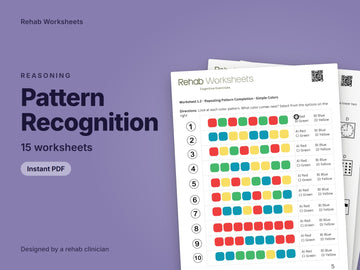
Fifteen worksheets in three sections of five, 90 items in all, in a 24-page PDF with answer pages at the back. The sections change the format rather than the size of the page: from naming what comes next in a row, to applying a rule across a grid with four choices, to completing a sequence with no choices given.
Section 1: pattern recognition
Worksheets 1.1 to 1.5 (PRW1A to PRW1E), ten items each, with the first item on every page answered as an example. Repeating shape patterns (what shape comes next, draw it in the box), repeating color patterns (choose red, blue, green, or yellow, A to D), repeating number patterns (write the next two numbers), growing number patterns (write the next number, with items 5 to 10 marked as complex), and pattern anomaly detection (which item does not fit). It includes numbers, letters, and a few words.
Section 2: non-verbal reasoning and logic
Worksheets 2.1 to 2.5 (PRW2A to PRW2E), four items each. Every item is a two-by-two grid with one missing box and four choices, A to D. The rules change the number of shapes, their size, position, direction, or shading. The free sample above is the first page of this section.
Section 3: sequence completion
Worksheets 3.1 to 3.5 (PRW3A to PRW3E), four items each. The directions read “Complete the last shape to reflect the continuation of the sequence.” Three figures show the steps, and the fourth is an empty outline to finish by drawing, such as a shaded quarter of a circle or a filled cell in a grid. With no choices to pick from, the answer has to come from the rule alone.
| What you get | Free sample | Full set |
|---|---|---|
| Worksheets | 1 | 15, in a 24-page PDF |
| Sections | Section 2 | Pattern recognition, non-verbal reasoning and logic, sequence completion |
| Items | 4 | 90 |
| Formats | Rule boxes with choices A to D | Next shape, color, and number patterns, odd one out, rule boxes, and draw-the-next-step sequences |
| Number patterns | None | Repeating and growing, 20 items |
| Answer key | Listed on this page | Answer pages for all 15 worksheets, with notes on the number rules |
| Repeat sessions without reusing a page | One page | Weeks of practice |
Pattern recognition practice in a session or at home
- Ask for the rule before the letter. Have the person say what changed across the top row (two became one, it flipped, it moved) before choosing. The set's own notes put the reasoning ahead of the answer: when a choice is wrong, ask how it was reached.
- Check the free page together. The answers are 1 C, 2 D, 3 B, and 4 A. In item 3, choices B and D differ only in where the rectangle sits, and choice C copies the top row instead of applying its rule, so a wrong answer there is worth talking through.
- Cover the choices for a harder round. Put a card over A to D and ask the person to describe or sketch what belongs in the empty box, then uncover and compare. That removes guessing and leads naturally into section 3, where no choices are given.
- Leave the clock off. The pages have no time field, and speed is not the point. If pace matters, note the minutes in the margin and compare pages from the same section.
- Adapt when speech, writing, or color is the problem. Pointing to a choice works as well as circling it. On section 3, the person can point to where the shading or the dot should go while a partner draws it. The color page in section 1 leans on telling red from green, so skip it or name the colors together for anyone who cannot rely on color.
- Move on when the rule comes easily. When section 1 items are mostly right and the rule can be explained, try the rule boxes, then the section 3 sequences. Looking for harder pattern recognition activities for adults? Items 5 to 10 of worksheet 1.4 use triangular numbers, doubling, powers of three, a Fibonacci sequence, primes, and square numbers.
Prefer a screen? We also offer a free interactive version, Pattern Recognition on our tools site, which generates fresh shape, color, number, and rule-box items every round, times every choice, and reports correct answers out of the items, median time on correct answers, and a score for each rule when more than one appears. Nothing to print, free to use.
Who uses pattern recognition worksheets
- Occupational therapists and speech-language professionals
- Hospital, outpatient, and community programs
- Educators working with adult learners
- Caregivers supporting cognitive practice at home
- Adults looking for structured, printable non-verbal reasoning activities
All of our worksheets are designed to be adult-appropriate and visually clean, with bold outlines, large numbers, and no childish decoration.
The free worksheet above is one page from section 2. If you want the full set, our Pattern Recognition set includes all 15 worksheets across the three sections, with answer pages at the back. It is also part of the Reasoning Worksheets Bundle, and our executive function guide explains how pattern recognition fits alongside the other reasoning formats. For reasoning about everyday situations in words rather than shapes, try the free problem solving worksheet.
These materials support cognitive stimulation and structured practice. They are not medical treatment or an assessment, and no specific therapeutic outcomes are claimed.


