
Finding the right jar on a crowded shelf when three labels look almost the same. Hearing your own name called in a busy waiting room. Staying with what matters while other things compete for it is a quiet demand of the day, and after a stroke or a brain injury it is often the near miss that wins: the wrong jar comes home, or the name goes by unheard. In the clinical model of attention described by Sohlberg and Mateer this is selective attention, the level above sustained attention and below alternating and divided attention.
This page covers selective attention worksheets for adults, where something on every page is designed to pull the person off the target. Below are a free moderate-level page with its answer key, how the formats relate to cancellation tests, the Stroop task and the Test of Everyday Attention (and why a practice page is none of them), how the 30-worksheet set is graded, and ways to run the pages in a session or at home.
Download the free selective attention worksheet
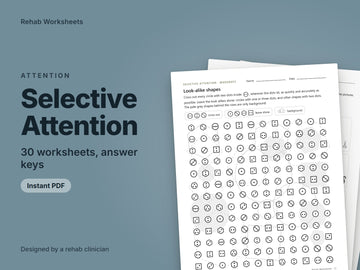
Download the PDFWorksheet SEL2A from the set, Look-alike shapes: 13 rows of 12 outlined shapes, each with one to three dots inside, over pale gray background shapes. The person crosses out every circle with two dots and leaves four kinds of look-alike alone: circles with one or three dots, and six-sided shapes and squares with two dots. Page two is the answer key, with all 33 targets ringed and a count at the end of every row. Free for personal, classroom, and session use.
Want all 30 worksheets?
Selective Attention Worksheets for Adults (30 Worksheets)$4.25
Personal-use license. Buying for a team? Choose the clinic license on the set's page.
- Level: moderate
- Grid: 13 rows of 12 shapes
- Targets: 33, among four kinds of look-alike
- Timing: untimed, with a line for time taken
- Paper: US Letter

What is a selective attention task?
A selective attention task asks the person to stay with one thing while other things compete for it. On an ordinary cancellation page the target stands out, like a star among letters. On these worksheets the distractors are near misses, and they compete in three ways: they look like the target, as on the free page; they say the wrong thing, like a horse drawn smaller than an egg; or they sound like it, when a partner reads hat, cap and cut around the word cat with a radio on.
On the free page no single feature finds the target. Looking for circles turns up circles with one or three dots; looking for two dots turns up six-sided shapes and squares with two dots. Only the pair is the target, so every shape has to be checked twice. That makes the errors worth reading: a crossed-out circle with three dots is a counting slip, a crossed-out six-sided shape is an outline slip, and a check against the key shows which look-alike pulled hardest.
Selective attention
Staying with the target while near misses compete. The whole point of every page in the set.
Inhibitory control
Letting a strong but wrong answer go by. On the size pages, the bigger drawing pulls toward the wrong picture.
Visual scanning
Working each row left to right without skipping. Missed targets that cluster in one area show where the scan broke.
Auditory attention
Catching one word in a stream of similar ones. The listening pages put a radio behind the list.
Cancellation tests, the Stroop, and how these worksheets differ
Several standardized measures are built on a target among things that compete with it. Cancellation tests ask the person to mark targets among distractors on a printed page. In the d2 Test of Attention, for example, the rows hold the letters d and p with one to four small dashes above and below them, and the person marks every d with exactly two dashes while a time limit runs for each row. Neglect screens such as the Bells Test and Star Cancellation scatter small targets among distractors across a whole page.
The Stroop task, first described in 1935, asks the person to name the ink color of color words printed in a different color, so reading has to be held back; it is widely used as a measure of inhibition and selective attention. The Test of Everyday Attention has a listening version: in Elevator Counting with Distraction, the person counts low tones as floors and ignores high tones played among them. All of these are given and scored by trained professionals against published norms.
The worksheets borrow the shape of these ideas and nothing more: the d2 logic of one feature pair among near misses, with outlines and dots instead of letters; the Stroop conflict with pictures instead of words, so nothing has to be read; and a word list over a radio in place of tones.
Worth knowing: these worksheets borrow formats, not tests. The shapes, pictures and word lists are our own, there are no norms, and nothing on the page produces a score that can be compared to a population. They are structured cognitive practice materials, not an assessment, and not a substitute for evaluation by a qualified professional. If someone is going to be assessed with an attention measure, tell the clinician about any practice they have done with this kind of page.
How the selective attention worksheets are graded
Ten worksheets at each of three levels, in three formats. As the levels rise, the look-alikes move closer, more pictures are drawn the other way, and the background sound gets louder. Every worksheet has an answer key, four keys to a page:
Basic
10 rows of 10 large shapes with two kinds of look-alike and a faint background. 9 boxes of two pictures, 2 drawn the other way, with things at least ten times apart in real size. 48 words read about one every two seconds in a quiet room, the word 9 times and no sound-alikes.
Moderate
13 rows of 12 shapes with four kinds of look-alike, one of them close in outline, such as a six-sided shape among circles. 16 boxes of two pictures, 8 drawn the other way. 80 words at about one a second with a radio on low, the word 14 times among 20 sound-alikes. The level of the free sample above.
Complex
16 rows of 14 smaller shapes with five kinds of look-alike, including an eight-sided shape or a rectangle beside the target, and the background running through the shapes. 12 boxes of three pictures, 9 drawn the other way. 96 words with the radio at talking volume and two words to listen for at once. Not a starting level.
The three formats, spread across each level, are Look-alike shapes (worksheets A to C), with a new target and set of look-alikes on each page; Bigger in real life (D to F), where the person circles the picture that is bigger in real life while some are drawn the wrong size on purpose; and Listen for your word (G to J), where a partner reads the list aloud and the person marks a box on a strip cut from the bottom of the page each time they hear their word.
| What you get | Free sample | Full set |
|---|---|---|
| Worksheets | 1 | 30 |
| Levels | Moderate | Basic, moderate, complex |
| Formats | Look-alike shapes | Three: look-alike shapes, bigger in real life, listen for your word |
| What competes | Four kinds of look-alike | Two to five kinds of look-alike, misleading sizes, sound-alike words |
| Grid size | 13 rows of 12 | 10 rows of 10 to 16 rows of 14 |
| Answer key | Yes | Every page, four to a sheet |
| Name and date fields | Yes | Yes, every page |
| Repeat sessions without reusing a page | One page | Weeks of practice |
Using it in a session or at home
- Go over the rule bar first. The three chips under the instructions show what to cross out, what to leave alone and what is background. Point to each one together before the first row.
- Check both features on every shape. The outline alone is not enough, and neither are the dots. A steady look at both is the habit the page asks for; speed comes later.
- Read the errors by kind. Wrong dot counts, wrong outlines and missed targets clustered in one area each tell a different story, and the next page can be chosen to match.
- Leave the clock off at first. Once the look-alikes are left alone reliably, write the time taken at the foot and compare pages at the same level.
- Set the listening page up as written. The radio or TV at the volume the page names, the stated pace, the same even voice for every word, and no slowing down before the target. A late mark is fine; keep going.
- Adapt when writing is hard. A single slash works as well as a cross, and on the size pages the person can point while a partner circles. On the listening page a tap on the table can replace the mark, with someone else keeping the boxes.
Prefer a screen? We also offer a free interactive version of the look-alike idea, Visual Search on our tools site, where conjunction rounds hide the target among distractors that each share one feature with it. It records the time, the targets found out of the total, false positives, and the left and right sides of the board separately. Nothing to print, free to use.
Who uses selective attention worksheets
- Occupational therapists working on everyday tasks where distraction gets in the way
- Speech-language pathologists running listening tasks with background sound
- Brain injury, stroke and community programs sending pages home with a family member
- Educators and support workers working with adult learners
- Caregivers and families practicing at the kitchen table
All of our worksheets are designed to be adult-appropriate and visually clean. On these pages the clutter is deliberate and named: the background shapes are labeled as background, and the key marks every box drawn the other way.
The free worksheet above is a single moderate-level page with its key. If you want the full graded progression, our Selective Attention Worksheets for Adults set includes 30 worksheets across basic, moderate and complex levels in three formats, with an answer key for every page. It is also part of the Attention Worksheets Bundle. The attention worksheets guide explains how selective attention fits with the other kinds of attention, and our letter cancellation pages cover the simpler scan, where the target stands out, that comes before it.
These materials support cognitive stimulation and structured practice. They are not medical treatment or an assessment, and no specific therapeutic outcomes are claimed.


