
Talking with a passenger while driving. Counting out tablets while someone asks what time the appointment is. Keeping an eye on the pan while reading the next line of the recipe. Two things at once is the ordinary texture of a day, and after a stroke or a brain injury it is often the second thing that drops: the count is lost when the question comes, or the question goes unanswered while the count is kept. In the clinical model of attention described by Sohlberg and Mateer this is divided attention, the top of the hierarchy, above sustained, selective and alternating attention.
This page covers divided attention worksheets built for adults, where the second job is printed on the page or spoken by a partner rather than left to chance. You can download a free moderate-level page below, read how the format relates to the Test of Everyday Attention (and why a practice page is not the test), see how the 30-worksheet set is graded across three levels, and get a few ways to run the pages in a session or at home, including in speech therapy sessions where talking while working is the point.
Download the free divided attention worksheet
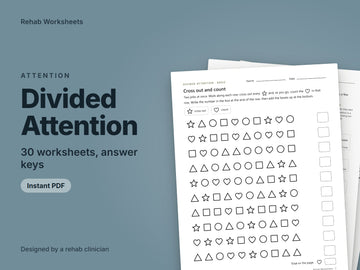
Download the PDFWorksheet DIV2F from the set, Cross out while you talk: 12 numbered rows of 11 outline shapes, and a partner script down the right margin. The person crosses out every diamond while the partner asks six easy questions at rows 2, 4, 6, 8, 10 and 12 and checks answered, paused or none for each. Page two is the answer key, with every diamond circled, a count per row and the expected answers. Free for personal, classroom, and session use.
Want all 30 worksheets?
Divided Attention Worksheets for Adults (30 Worksheets)$4.25
Personal-use license. Buying for a team? Choose the clinic license on the set's page.
- Level: moderate
- Grid: 12 rows of 11 shapes
- Second job: 6 partner questions
- Timing: untimed, with a line for time taken
- Paper: US Letter

What is a divided attention task?
A divided attention task asks for two things at the same time, not one after the other. On these worksheets the first job is always a scan: work along each row and mark a target. The second job is built in. On some pages it is a running count of another shape, written in a box at the end of every row. On some it is a second mark, a circle around one shape while crossing out another. On the free page it is a conversation: a partner sits beside the person and asks a question just as a marked row begins, and the person answers out loud without putting the pen down.
What makes the page useful is that both jobs leave a trace. The scan shows missed diamonds and the rows where they cluster. The script shows which questions were answered, which caused a pause, and which went unanswered. Put side by side, they say whether the person protected the scan at the cost of the conversation, or the other way round, which is the pattern worth watching from session to session.
Divided attention
Carrying a second job while scanning. The whole point of every page in the set.
Working memory
Holding a running count while the eyes keep moving. A count that resets when the question lands is the tell.
Visual scanning
Working each row left to right without skipping. Missed targets just after a question show where the scan broke.
Sustained attention
Keeping both jobs going to the bottom of the page. Compare the first rows with the last.
The Test of Everyday Attention, and how these worksheets differ
The clinical instrument most often linked with divided attention is the Test of Everyday Attention, a standardized battery published in the 1990s that uses everyday materials: a map, a telephone directory, a lottery broadcast. Its telephone search while counting subtest asks the person to search a directory page for matching symbols while counting strings of tones at the same time, and the cost of doing both is read against published norms. Other dual-task formats used by clinicians pair a walking or tapping task with a spoken one in the same way. All of them are given and scored by trained professionals.
The worksheets on this page keep the dual-task idea and leave out the apparatus. The second job is printed on the page, as a count or a second mark, or spoken by a partner from a script, so a session needs nothing but the sheet, a pen and a person to sit beside. The pages that pair a scan with questions are the closest in spirit to the clinical subtest; the counting and two-mark pages make the same demand without a partner.
Worth knowing: these worksheets borrow the dual-task format, not the test. The layouts, shapes, pictures and questions are our own, there are no norms, and nothing on the page produces a score that can be compared to a population. They are structured cognitive practice materials, not an assessment, and not a substitute for evaluation by a qualified professional. If someone is going to be assessed with a divided attention measure, tell the clinician about any dual-task practice they have done.
How the divided attention worksheets are graded
Ten worksheets at each of three levels, mixing four formats. Every worksheet has an answer key at the back of the set, with the targets circled and every count box filled in:
Basic
Grids of 10 rows with large shapes, one shape to cross out and one to count, 4 partner questions on the script pages, and five pictures to a row on the picture pages.
Moderate
Grids of 12 to 14 rows with more distractor shapes, 6 partner questions, and six pictures to a row. This is the level of the free sample above.
Complex
Grids of 14 to 17 rows with smaller shapes, two things to count at once with two boxes per row, 7 partner questions, seven pictures to a row, and striped and solid shapes that still count as targets.
The four formats, spread across each level, are: Cross out and count (worksheets A to C), where the person crosses out one shape while keeping a running count of another, with a box at every row end and a total at the foot; Cross out one, count the other (D and E), the same task with color pictures, for example cross out every food picture while counting the animals; Cross out while you talk (F and G), the partner script page; and Two marks at once (H to J), where every star is crossed out and every heart circled in a single pass along the row.
| What you get | Free sample | Full set |
|---|---|---|
| Worksheets | 1 | 30 |
| Levels | Moderate | Basic, moderate, complex |
| Formats | Partner script | Four: count, pictures, partner script, two marks |
| Second job | 6 questions | Counts, second marks, 4 to 7 questions |
| Grid size | 12 rows of 11 | 10 rows of 10 to 17 rows of 15 |
| Answer key | Yes | Every page, four to a sheet |
| Name, date and time fields | Yes | Yes, every page |
| Repeat sessions without reusing a page | One page | Weeks of practice |
Using it in a session or at home
- Run the scan alone first. If a page of this kind is new, let the person cross out the diamonds once with no questions, so the dual task is added to a scan they already own. The basic pages are built for exactly that step.
- Ask in a normal voice, and keep going. The partner asks the question as the marked row begins, does not repeat it unless asked, and checks what happened. A pause is a result, not a failure, and it is worth recording.
- Read the two traces together. Check the scan against the key, then look at the check boxes. Missed diamonds in the rows just after a question, or a run of “paused” checks with a clean scan, each tell a different story.
- Leave the clock off until both jobs are steady. Then write the time taken on the line at the foot and compare pages at the same level. Speed is the last thing to add.
- Choose the format to fit the person. The counting pages need no partner and suit home practice; the script pages suit a session; the two-mark pages suit someone who finds talking while working the hardest part. The complex level adds a second count and striped and solid targets.
- Change the questions once they are familiar. The script is a starting point. A partner can swap in questions of their own at the same rows, which keeps a repeated page fresh and, in speech therapy sessions, lets the questions carry the language goal while the page carries the attention load.
Who uses divided attention worksheets
- Occupational therapists working on everyday tasks that need two things at once
- Speech-language pathologists who pair attention activities with conversation in adult sessions
- Brain injury, stroke and community programs that need pages to send home with a family member
- Educators and support workers working with adult learners
- Caregivers and families supporting structured practice at the kitchen table
All of our worksheets are designed to be adult-appropriate, visually clean, and easy to understand without unnecessary visual clutter. The shapes are plain outlines, the pictures are everyday objects, and the partner script is written to be read in a normal voice by anyone.
The free worksheet above is a single moderate-level page with its key. If you want the full graded progression, our Divided Attention Worksheets for Adults set includes 30 worksheets across basic, moderate and complex levels with an answer key for every page. The attention worksheets guide explains how divided attention fits with the other kinds of attention, and our visual vigilance pages cover the single-task sustained practice that comes before it.
These materials support cognitive stimulation and structured practice. They are not medical treatment or an assessment, and no specific therapeutic outcomes are claimed.


