
Cooking from a recipe means reading a line, turning to the pan, and coming back to the right line. Filling in a form while the phone rings means answering, then finding the box you were on. Most days are made of switches like these, and after a stroke or a brain injury the switch itself is where things go wrong: the old rule carries on a little too long, or the new one never quite takes over. In the clinical model of attention described by Sohlberg and Mateer, this is alternating attention, moving between two rules without losing either, and it sits between selective attention (holding one rule against distraction) and divided attention (running two at once).
This page covers alternating attention worksheets built for adults. You can download a free moderate-level page below, read how the format relates to part B of the Trail Making Test (and why a practice page is not the test), see how the 30-worksheet set is graded across three levels, and get a few ways to run the pages in a session or at home, including in speech therapy sessions where attention work sits alongside language goals.
Download the free alternating attention worksheet
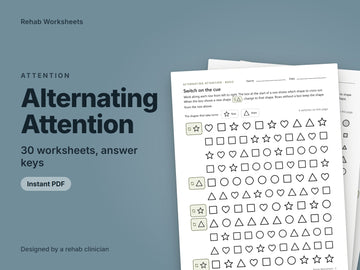
Download the PDFWorksheet ALT2A from the set, Switch on the cue: 15 rows of 14 outline shapes. The person crosses out every star until a switch sign in the row shows a triangle, then crosses out triangles until the next sign, and so on through 7 switches. Page two is the answer key, with every target circled and a count at the end of each row. Free for personal, classroom, and session use.
Want all 30 worksheets?
Alternating Attention Worksheets for Adults (30 Worksheets)$4.25
Personal-use license. Buying for a team? Choose the clinic license on the set's page.
- Level: moderate
- Grid: 15 rows of 14 shapes
- Switches: 7, placed mid-row
- Timing: untimed, with a line for time taken
- Paper: US Letter

What is an alternating attention task?
An alternating attention task asks the person to follow one rule, then another, then the first again, with the change signaled from outside rather than chosen by the person. On these worksheets the signal is printed on the page: a small olive box with an arrows icon and the new target inside it. Everything before the box follows the old rule; everything after it follows the new one, until the next box. The person works along each row from left to right, so a switch sign in the middle of a row has to be noticed in passing, not at a natural pause.
That is what separates these pages from ordinary cancellation. A letter cancellation page asks for one rule held steadily to the bottom; here the rule in force keeps changing, and the two kinds of slip are easy to see on the finished page. A target from the old rule crossed out after a switch means the change was missed. A run of untouched targets after a switch means the new rule was never picked up.
Alternating attention
Dropping one rule and taking up another on cue. The whole point of every page in the set.
Working memory
Holding the rule in force until the next sign, with no reminder on the row. Rows between switches test whether the rule stuck.
Visual scanning
Working each row left to right without skipping a switch sign. A missed sign shows up as a run of wrong targets.
Inhibition
Leaving the old target alone once the rule has moved on. Crossed-out stars after a triangle sign are the tell.
The Trail Making Test part B, and how these worksheets differ
The best known clinical task for switching is part B of the Trail Making Test, a short paper test used by neuropsychologists and other clinicians since the 1940s. Part A asks the person to join numbered circles in order; part B scatters numbers and letters across the page and asks for an alternating sequence, 1 to A to 2 to B and so on, drawn as one continuous line. The time taken, and the errors made along the way, are read against published norms as a window on set shifting, visual scanning and divided attention. Our free trail making worksheet covers that format and where to find the official test forms.
The Test of Everyday Attention, a standardized battery built around everyday materials such as maps and telephone directories, also includes subtests that ask the person to switch between counting rules on a signal. Those tasks, like part B, are given and scored by trained professionals.
The worksheets on this page take the idea of switching and change who drives it. In part B the person sets the rhythm, and every step is a switch. Here the switch comes from the page, at points the person cannot predict, and the stretches between switches are long enough that the current rule has to be held rather than simply alternated.
Worth knowing: these worksheets borrow the idea of a switching task, not the test. The layouts, shapes and rules are our own, there are no norms, and nothing on the page produces a score that can be compared to a population. They are structured cognitive practice materials, not an assessment, and not a substitute for evaluation by a qualified professional. If someone is going to be assessed with the Trail Making Test, tell the clinician about any switching practice they have done.
How the alternating attention worksheets are graded
Ten worksheets at each of three levels, mixing four formats. Every worksheet has an answer key at the back of the set, with the targets circled and every count box filled in:
Basic
Grids of 10 to 11 rows with large shapes, two shapes or two rules, and every change marked at the start of its row, 4 changes a page. Picture pages have one switch and five pictures to a row.
Moderate
Grids of 12 to 15 rows, two shapes or two rules, with the switch sign landing in the middle of a row at unpredictable places, 5 to 7 changes a page. Picture pages have two switches and six pictures to a row. This is the level of the free sample above.
Complex
Grids of 15 to 18 rows with smaller shapes, three shapes or three rules in rotation, 8 to 10 changes a page, and the other targets used as distractors. Picture pages have three switches and seven pictures to a row.
The four formats, spread across each level, are: Switch on the cue (worksheets A to C), where two or three shapes take turns as the target at switch boxes in the rows; Switch the rule (D to F), where the rule moves between fills, sizes and shapes, striped, solid, big or triangle, so the same shape can be a target under one rule and not the next; Sort by the rule that changes (G and H), rows of color pictures with switch bands between them, for example circle every food picture, then every animal, then food again; and Count what the row asks for (I and J), where the shape to count changes at a cue box and the count goes in a box at the end of the row.
| What you get | Free sample | Full set |
|---|---|---|
| Worksheets | 1 | 30 |
| Levels | Moderate | Basic, moderate, complex |
| Formats | Switch on the cue | Four: shapes, rules, pictures, counting |
| Switches per page | 7 | 4 to 10 |
| Rules in play | 2 shapes | 2 or 3 shapes or rules |
| Answer key | Yes | Every page, four to a sheet |
| Name, date and time fields | Yes | Yes, every page |
| Repeat sessions without reusing a page | One page | Weeks of practice |
Using it in a session or at home
- Read the rule bar together first. Point to the two shapes and the switch sign in the instructions, and have the person say what they will do when they reach one. The format is simple, but the first page goes better when the sign has been seen before it appears in a row.
- Leave the clock off at first. Accuracy around the switches is the thing to watch. Once a level is going well, write the time taken on the line at the foot of the page and compare it with the next page at the same level.
- Check the page against the key. Circled targets and a count per row make it quick. Look at the three or four shapes after each switch sign: that is where the slips cluster.
- Name the two kinds of slip. Crossing out the old target after a switch is different from missing the new one. Saying which happened helps the person watch for it on the next row.
- Move up when the switches go clean. When a moderate page has no slips at the switch signs for a few sessions, the complex pages add a third rule and put the other targets in the way.
- Say it instead of marking it. If a pen is hard to hold, the person can point and say “cross” for each target while a partner marks the page. In speech therapy sessions, naming each target aloud turns the same page into an attention and word-finding task.
Prefer a screen? We also offer a free interactive version of the classic switching task, Trail Making on our tools site, where part B alternates numbers and letters and every round records the time taken and the errors made. Nothing to print, free to use.
Who uses alternating attention worksheets
- Occupational therapists running attention practice after stroke or brain injury
- Speech-language pathologists who pair attention activities with language goals in adult sessions
- Brain injury, stroke and community programs that need pages to send home
- Educators and support workers working with adult learners
- Caregivers and families supporting structured practice at the kitchen table
All of our worksheets are designed to be adult-appropriate, visually clean, and easy to understand without unnecessary visual clutter. The shapes are plain outlines and the pictures are everyday objects.
The free worksheet above is a single moderate-level page with its key. If you want the full graded progression, our Alternating Attention Worksheets for Adults set includes 30 worksheets across basic, moderate and complex levels with an answer key for every page. The attention worksheets guide explains how alternating attention fits with the other kinds of attention and which of our sets, including letter cancellation for selective attention, lean on each.
These materials support cognitive stimulation and structured practice. They are not medical treatment or an assessment, and no specific therapeutic outcomes are claimed.


