
A parent who always paid the bills now leaves them in a pile. A husband who cooked every night has started to skip meals. A sister living on her own has had two near misses on the stairs and says nothing is wrong. Families notice these changes one at a time, usually in passing, and then struggle to describe them in the ten minutes of a doctor’s appointment. Clinicians have a shorthand for the activities involved: the basic activities of daily living (ADLs), such as washing, dressing and eating, and the instrumental activities of daily living (IADLs), such as shopping, cooking, laundry, the phone, medicines and money.
This page offers a free activities of daily living checklist in plain words: two printable pages a family member, support worker or care team fills in on paper to see which everyday tasks a person does alone, which need reminders or some help, and which someone else now does. It has no score and is not an assessment. The page also explains where the two lists of activities come from, how clinicians use them, and which printable worksheets practice the everyday tasks on page two.
Download the free activities of daily living checklist
Download the PDFPage 1 lists eight basic activities, from washing and dressing to walking around the home and eating a meal. Page 2 lists eleven everyday tasks, from using the phone and shopping to medicines, money, mail and staying safe at home. Each row has four tick boxes (does it alone, with reminders or some help, someone else does it, safety worry) and a line for the kind of help and since when. Page 2 ends with three boxes: what has changed in the last six months, what matters most to the person, and questions for the next appointment. Free for personal, classroom, and session use.
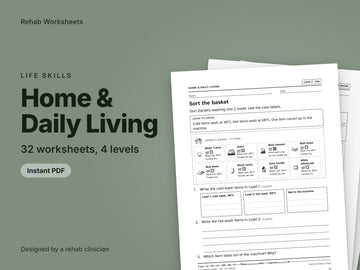
Want the full set?
Personal-use license. Buying for a team? Choose the clinic license on the set's page.
- Activities: 8 basic, 11 everyday
- Columns: 4 tick boxes and a notes line per row
- Scoring: none, by design
- Filled in by: family, support worker or care team, with the person
- Paper: US Letter

What is an activities of daily living checklist?
It is a list of the everyday activities a person needs to manage to live at home, with a way of noting how much help each one takes. Clinicians sort these activities into two groups. The basic activities of daily living are the ones that look after the body: bathing, dressing, grooming, using the toilet, moving from a bed to a chair, walking indoors, and eating. The instrumental activities of daily living are the ones that run a life: the phone, shopping, cooking, housework, laundry, getting around, medicines and money. A good checklist uses plain words for each one and leaves room for the detail that matters, such as what kind of help and since when.
The free checklist adds three everyday tasks that the two classic lists leave out but families ask about: keeping a calendar and appointments, dealing with mail and paperwork, and staying safe at home. It is written to be filled in with the person wherever possible, and it ends with the three things a care team most wants to hear: what changed recently, what the person cares about most, and the questions nobody got to ask last time.
Noticing change
Seeing the difference between a bad day and a new pattern. The checklist asks what the person usually does now, and what changed in the last six months.
Describing help
Saying what kind of help, not just that help is needed. Reminders, setting up, standing by and doing part of the task are four different answers.
Spotting safety worries
Marking the activities that have led to a near miss. A fall, a burn, a missed dose or a scam each gets a tick in the safety column.
Preparing a conversation
Bringing something concrete to the appointment. Two filled-in pages say more than “Mum is not coping.”
The Katz and Lawton scales, and how this checklist differs
The two groups of activities come from two clinical instruments that occupational therapists, nurses and doctors have used for decades. The Katz Index of Independence in Activities of Daily Living, published in 1963, looks at six basic activities: bathing, dressing, toileting, transferring, continence and feeding. The Lawton Instrumental Activities of Daily Living Scale, published in 1969, looks at eight everyday tasks: using the telephone, shopping, food preparation, housekeeping, laundry, transportation, taking medications and handling finances. Both are scored by a clinician, and both are used in hospitals, home care and research to describe how much support a person needs and to follow change over time.
The free checklist borrows the two groups of activities, in plain words, and nothing else. It has no scoring, no cut-offs and no total, because a number on its own does not tell a care team what to do, and because a family filling in a form at the kitchen table is not giving a standardized assessment. What it gives is a clear starting point: which activities, what kind of help, since when, and whether anything has become unsafe.
Worth knowing: this checklist is general information for families and care teams. It is not the Katz Index, the Lawton Scale or any other test, it produces no score, and it is not an assessment or a substitute for evaluation by a qualified professional. If an activity has become unsafe, or if the changes came on quickly, raise it with the person’s doctor or care team promptly.
How the checklist is laid out
Two pages, each a table with the same five columns, so the two groups of activities read the same way:
Page 1: looking after yourself
A short how-to, lines for a first name or initials, the date and who filled it in, then 8 basic activities: washing, getting dressed, hair, teeth and shaving, using the toilet, managing bladder and bowel needs, getting in and out of bed or a chair, walking around the home, and eating a meal once it is on the table.
Page 2: running everyday life
11 everyday tasks: using the phone, shopping, preparing meals, housework, laundry, getting around, taking medicines, handling money, keeping a calendar and appointments, dealing with mail and paperwork, and staying safe at home. Then three boxes: what has changed in the last six months, what matters most to the person, and questions for the next appointment.
The four columns
Does it alone. With reminders or some help. Someone else does it. Safety worry. One tick per row, and a line for the kind of help and since when. The columns are deliberately few: the aim is a clear picture, not a precise measurement.
| What you get | Free checklist | Home & Daily Living worksheets |
|---|---|---|
| Purpose | See which activities need support | Practice the everyday tasks on paper |
| Pages | 2 | 104, in two PDFs |
| Activities covered | 8 basic, 11 everyday | Laundry, meals, shopping lists, phone, chores, buses, mail, emergency contacts |
| Graded levels | None | 4 levels, 8 worksheets each |
| Answer pages | Not applicable | One for every worksheet |
| Who fills it in | Family, support worker or care team | The person, with a helper |
| Repeat sessions without reusing a page | Print again when things change | Weeks of practice |
Using it in a session or at home
- Fill it in with the person, not about them. Ask how each task is going now and tick together. Where you disagree, write both views in the notes column.
- Tick the usual day. Not the best day and not the worst. If it varies a lot, say so in the notes, and say what makes the difference.
- Name the help. A reminder, laying the clothes out, standing by in the shower, and doing the task are four different levels of support. The notes column is for that detail.
- Take the safety column as a prompt to talk. A tick there is a reason to raise the activity with the person’s doctor or occupational therapist, not a verdict.
- Date it and keep it. A second copy filled in three months later shows change far better than memory does.
- Turn page 2 into practice. Several of the everyday tasks can be practiced on paper. The Home & Daily Living worksheets cover laundry, meals, shopping lists, phone messages, chores, buses, mail and emergency contacts in four graded levels, and the Daily Routine Cards Bundle supports the basic self-care steps on page 1 with step-by-step picture cards.
Who uses an activities of daily living checklist
- Family members noticing change in a parent, partner or sibling and preparing for an appointment
- Occupational therapists and nurses in home care, outpatient and community programs, as a conversation starter before a formal evaluation
- Support workers and supported living staff who share the care of one person and need a common picture
- Care homes and day programs describing what a new resident or client can do and prefers to do
- Adults returning home after a hospital stay, with the people helping them settle back in
Once the checklist shows where support is needed, the Home & Daily Living set practices the everyday tasks on page 2, the Bills, Banking & Paychecks set practices money, and the Medication Management Worksheets practice medicines; all three are in the Entire Shop Mega Bundle. For the basic activities on page 1, the Daily Routine Cards Bundle and the Dementia Home Labels support the person at the sink, the wardrobe and the bathroom door. The guide to money and medication management worksheets explains how these sets fit together.
These materials support cognitive stimulation and structured practice. They are not medical treatment or an assessment, and no specific therapeutic outcomes are claimed.


