
Over Sunday lunch, an 81-year-old mother mentions the small gaps she has noticed lately: a new neighbor’s name, the one thing she went to the store for. She still does the crossword every morning, but she would like something to share with her daughter on visits: a little challenge, never a quiz. Downstairs, her building’s activity coordinator wants the same for the Thursday morning table: memory activities for seniors that a whole group can join, each at their own pace.
This page is a practical guide to memory activities for adults, with three complete activities to print today, free and with no email required: a short story with questions, a kitchen scene with its answer page, and five faces to put names to. Below: what memory activities are, a session plan for all three, everyday ideas, how to adapt them and set the level, and how the full bundle is organized.
Download the free memory activities
Download the PDFThree complete activities from the Memory Worksheets Bundle. Page 1 is story recall worksheet STS2G (moderate): an eight-sentence story about an evening art class above a “Hide” fold line, with five questions below it. Page 2 is picture recall worksheet PRT1J (moderate): a line drawing of a kitchen to study for one minute, with a “What do you remember?” box. Page 3 is its answer page. Page 4 is face-name worksheet FNM1E (basic): five faces to study, each with a full name. Page 5 is its recall page: the same faces in new places, with a blank line under each. Free for personal, family, and care-program use.
Want all 120 worksheets?
Personal-use license. Buying for a team? Choose the clinic license on the set's page.
- Activities: 3, from 3 of the bundle’s 5 sets
- Levels: moderate story and scene, basic faces
- Study time: 1 minute for the scene, a few minutes for the faces
- Answer page: included for the kitchen scene
- Paper: US Letter, portrait

What are memory activities for adults?
Memory activities are short, structured tasks that ask a person to take something in, hold on to it, and bring it back: a story, a picture, a list, a name. Some come on paper, like the free pages here; many are already part of ordinary days. Most fall into four kinds:
Remembering what you read or hear
A story, a news item, or a set of instructions, recalled once it is out of sight. The free art class story can be read silently or aloud by a partner.
Remembering what you see
A busy scene, a pattern, or where things sat on a table. The free kitchen scene gets one minute of study.
Remembering people
Putting names to faces: a new neighbor, a care worker, a grandchild’s partner. The free face-name page has five to learn.
Remembering what to do
A shopping list, an errand, or a route, held in mind until it is time to act. No worksheet needed; ideas follow below.
How to run a memory activity session, step by step
Each free activity works on its own, but together they make one unhurried session. The order matters: the face-name set lists a delay before the recall page as a way to add challenge, and doing the story while the names wait builds it in.
Set the table
Print the pages single-sided, so no names show through, and put out a pencil, a clock, and a blank sheet for covering. Glasses and hearing aids go on first.
Study the faces
Give the face-name study page a few minutes, as its instructions say. Try one of its printed strategies, such as making an association: Isabella Green wears a green shirt. Then turn it face down.
Do the story while the names wait
Read the art class story silently or aloud, fold it back along the “Hide” line, and answer the five questions. Unfold it to check: the story is its own answer key.
Come back to the names
On the recall page, the same faces sit in new places, so position cannot do the remembering. Write each name under its face, then check against the study page.
Finish with the kitchen
Study the kitchen scene for one minute by the clock, cover it, and write down every person, object, and part of the setting that comes back. Check against the answer page.
Stop on a good note
Count what came back, not what was missed. The error fields are optional.
At home, one helper is plenty: they keep time, read the story aloud if needed, and can play along on a second copy. In a small group, give everyone their own pages, read the story aloud once, and collect answers on paper before anyone speaks. Then build one shared list for the kitchen scene.
Everyday memory activities for seniors, no worksheet needed
Plenty of memory practice needs no paper at all, and it is useful too:
- A shopping list. Read a list of five or six items twice, pocket it, and see how many come back in the store before checking.
- A recipe. Read a short recipe once, gather the ingredients from memory, then check the card.
- A news story to retell. Hear one news item in the morning and retell it at lunch: who, what, where, and one detail. Retelling is also a variation the story recall set suggests.
- Names at a family gathering. Before a reunion, look through photos of new partners and grandchildren with their names, then greet each person by name.
- A route. Before walking somewhere new, say the turns aloud from the map (left at the bank, right at the park), then set off with the map in a pocket.
Adapting cognitive activities for seniors: eyes, ears, hands, and energy
Small changes keep the same activity within reach:
- Eyes. Use good light, print at actual size, and enlarge a page on a copier if needed. If reading is hard, read the story aloud; the scene and faces need little reading.
- Ears. Sit face to face, turn off the television, and read slowly. If listening is hard, the person reads the story silently instead.
- Hands. If writing is hard, the person says the answers and a helper writes them. For the faces, the helper says a name and the person points to the face, which turns recall into recognition.
- Energy. Pick the person’s most alert time of day, and split the session if needed: the faces and the story together, the kitchen another day.
How to pitch cognitive exercises for seniors at the right level
The right level takes some effort but ends with most answers back. If nearly everything comes back easily, step up; if fewer than half do, or the person looks tense, step down. Every set in the bundle is graded:
- Stories. About four sentences at basic, seven to eight at moderate, and eight to ten at complex, with times and numbers to hold. The free story is moderate.
- Scenes. Busier at each level, and four of the five complex scenes get two minutes of study instead of one. The free kitchen is moderate.
- Faces. Five per page at basic and eight at complex. For a lighter start, the face-name set suggests first names only.
Small changes work within a level too. Easier: recall straight after studying, or offer two choices (“Was the class at a library or a community center?”). Harder: add a delay of 30 seconds or a minute, ask for a retell before the questions, or shorten the study time step by step, from 2 minutes down to 30 seconds.
Tips for memory activities that stay enjoyable
- Keep it short. One or two activities is plenty. Stop while it is still enjoyable.
- Choose a strategy first. The pages print their own, such as splitting a scene into left, center, and right. Pick one before the clock starts.
- Leave the pressure out. Say “let’s see what comes back,” not “you should know this.” A blank is just a blank.
- Play alongside. Do the activity on a second copy and compare lists. A helper who misses things too makes it feel shared.
- Let it lead to conversation. The art class story invites its own question: “Did you ever take a class like that?” The answer may be the best part.
Can memory activities keep your memory sharp?
Many searches for brain exercises for seniors come down to that question, and the honest answer here is plain: these pages make no such promise. They are activities for practice, engagement, and enjoyment, and no claim is made that they change memory, or that they prevent or slow memory decline.
Nor is a memory activity a memory test. The pages have no norms, and the error fields are only for anyone who likes to keep track. If you are worried about your own memory or a family member’s, raise it with a doctor.
Worth knowing: these pages are for cognitive stimulation, practice, and enjoyment. They are not treatment or therapy, and they are not an assessment or a memory test. They make no claim to change memory or to prevent or slow memory decline, and they are not a substitute for the person’s own clinicians.
How the full memory bundle is organized
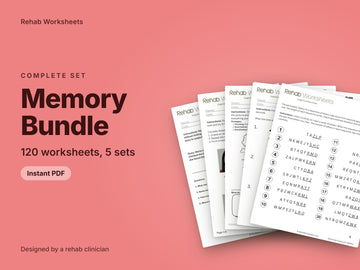
The full Memory Worksheets Bundle is 120 graded worksheets in five sets, as printable US Letter PDFs: Story Recall (30), Pattern Recall (30), Auditory Working Memory (25), Face-Name Memory (20), and Picture Recall (15). The free pages come from three of them.
| What you get | Free sample | Full set |
|---|---|---|
| Worksheets | 3 | 120 |
| Memory sets | Story, picture, and face-name recall | All 5, adding pattern recall and auditory working memory |
| Levels | Moderate story and scene, basic faces | Graded levels in every set |
| Scenes with an answer page | 1, the kitchen | 15 |
| Face and name pairs | 5 | 130, five or eight to a page |
| Listening and drawing tasks | Not included | Letter sequences read aloud, and dot patterns to redraw |
| Sessions without repeating a page | One | Weeks of practice |
Who uses memory activities like these
- Older adults who enjoy puzzles and want something new to try
- Families looking for an activity to share on visits
- Activity staff in senior centers, assisted living, and adult day programs
- Occupational therapists and speech-language pathologists planning memory practice
- Educators and community programs running memory groups for adults
The free pages above come from the full Memory Worksheets Bundle. Each set also has its own free guide with a different sample page: story recall, picture recall, face-name memory, pattern recall, and auditory working memory. Our guide to memory worksheets for adults explains every format in depth, and every set is in the memory collection. If you care for someone living with dementia, our guides to memory care activities and sit-down games for senior citizens have activities chosen for that situation.
These materials support cognitive stimulation and structured practice. They are not medical treatment or an assessment, and no specific therapeutic outcomes are claimed. If you have concerns about memory, please speak with a physician.


