
Sunday visits with Dad have settled into a pattern. You ask how his week was, he says it was fine, and the conversation runs out before the coffee is poured. Questions about today are often the hardest kind when memory is changing, and they can start to feel like a quiz. Ask instead about the first job he ever had, the boss who gave him a chance, or what retiring was like, and you are asking about something only he knows.
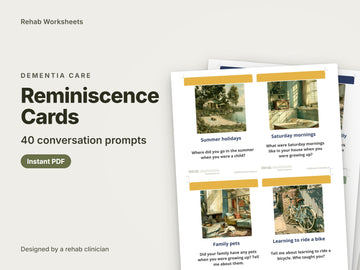
This page explains reminiscence therapy activities and how to borrow them for everyday conversation, at home or in a care setting, with a free sheet of illustrated reminiscence cards to print, no email required. Below: what reminiscence therapy is, a step-by-step way to run a reminiscence conversation, questions and conversation starters for seniors, what to do when a prompt draws a blank, and how the full set of 40 cards is organized.
Download the free reminiscence cards
Download the PDFPage 1 is a full sheet of four cards from the Working Life & Achievements section of Dementia Reminiscence Cards: “An accomplishment you’re proud of,” “A mentor or someone who helped you,” “Colleagues you remember,” and “Retirement.” Page 2 is the guide page “If they can’t remember,” with what to do when a prompt draws a blank or a difficult memory comes up, and a short template for writing down what you heard. Free for personal, family, and care-program use.
Want all 40 cards?
Personal-use license. Buying for a team? Choose the clinic license on the set's page.
- Cards: 4 of the 40
- Life theme: working life and achievements
- Card size: 3.5 by 5 inches, four to a sheet
- Guide page: “If they can’t remember”
- Paper: US Letter, portrait

What are reminiscence therapy activities?
Reminiscence therapy is a structured way of talking about the past, run by trained professionals, often with small groups in care homes, day programs, and hospitals. Sessions usually follow a theme, such as school days or working life, and use photographs, familiar objects, and music as prompts.
The activities themselves are simple, and families and care staff use the same reminiscence therapy ideas every day without the formal structure. At home it is better called reminiscing: two people talking about a life, with the person living with dementia as the expert. Many free reminiscence activities for the elderly use what is already in the house, and most start from one of four kinds of prompt:
Picture and prompt cards
A scene and one open question, small enough to hold. The free cards are this kind: the picture gives you both something to look at before anyone has to answer.
Photographs
Family albums, wedding pictures, a school class photo, old postcards. Ask who is in the photo and what was happening, never whether they remember it.
Objects to hold
A small box of familiar things from the person’s home or working life: a tool, a recipe card, a sewing tin. Something in the hands gives the conversation a place to start.
Music and songs
Songs from the person’s teens and twenties, played quietly or sung together. Humming along is reminiscing too.
How to run a reminiscence conversation, step by step
These steps follow the cards’ how-to-use guide and work with the free sheet as it is.
Choose a calm moment
Pick a time of day when the person is usually rested, turn off the television, and sit side by side so you look at the card together. Glasses and hearing aids go on first.
Offer one card, or a choice
The guide suggests one card a day, or four or five cards from one section and the question “Which one would you like to talk about?” The free sheet, cut along the crop marks, works both ways.
Look at the picture first
Give the person time with the illustration before you read anything, and say what you notice yourself: “That porch looks like a good place for a cup of tea.”
Ask the prompt as an open question
Read it as written, or turn it into a wondering, as the guide suggests: “I wonder who helped you along the way” rather than “Who helped you?”
Follow their lead
Let the story wander off the card. If a detail does not match what you know, go with it: there are no wrong answers, and the point is connection, not accuracy. Small follow-ups keep it going: who was there, what it looked like, what it sounded like.
Stop while it is still pleasant
End when the conversation winds down by itself, and thank the person for the story. Then jot down a line or two, using the five-point template on the free guide page: the card, the date, what stood out, how they seemed, and what to come back to.
Reminiscence questions and conversation starters for seniors
Good reminiscence questions for seniors share three habits. They are open, they ask about long ago rather than last week, and they invite the senses: what a place looked like, sounded like, or smelled like. A few to borrow, grouped by the cards’ six life themes (skip any that do not fit the person’s life):
- Childhood and growing up. “What was the street you grew up on like?” “What did you do on a rainy day?”
- Home and family life. “Who did the cooking in your house, and what was their best dish?” “What chores did you have growing up?”
- Young adulthood. “What did you buy with your first paycheck?” “How did you get around when you were twenty?”
- Marriage and children. “How did the two of you meet?” “What were weekends like when the children were small?”
- Working life and achievements. “What did a normal day at work look like?” “What did you have to learn in your first week?”
- Travel, hobbies, and pleasures. “What did you like to do on a day off?” “What was the best day out you ever had?”
Conversation starters for seniors do not have to be questions at all. “I was thinking about your old shop today” opens a door without asking for anything. Leave out questions that test, such as “Do you remember…?” or “What year was that?” and questions about this morning.
What is a benefit of reminiscing activities for seniors?
The plainest answer is connection. For much of the day, other people hold the answers for someone living with dementia: what day it is, what happens next, where the glasses went. A reminiscing activity turns that around. Only the person knows what their first boss was like or how it felt to retire, so for the length of the conversation they are the expert and you are the one learning.
It is also time together that is not about care tasks, with nothing to finish and nothing to get right. Families often hear stories they have never heard before; some write a few sentences down after each conversation and, over time, gather them into a small book for the grandchildren.
When a reminiscence conversation does not go to plan
Some prompts land and some do not, and both are fine. The first four tips come from the free guide page:
- Wait before you help. The guide suggests a full thirty seconds of quiet after a prompt draws a blank. It feels long, so count it in your head.
- Offer a tiny detail. Say something small and likely, such as “I bet that office always had a radio on,” and see if anything comes back.
- Move on lightly. “That’s okay, let’s look at this one instead.” A card that draws a blank on Tuesday may bring a long story on Thursday, so try it again another day.
- Acknowledge a hard memory. A prompt can bring back a loss or a painful time. Say “That sounds like it was hard,” do not probe or argue it away, and after a quiet moment gently offer another card. If they keep returning to it, put the cards away for the day.
- Hear a favorite story again. Good stories come around more than once. Listen as if for the first time, and ask a different follow-up.
- In a group, invite but never require. Read the prompt aloud, pass the card around, and let anyone who would rather listen simply listen. Listening is taking part too.
Is this reminiscence therapy?
No. Reminiscence therapy is a structured approach run by trained professionals, often with groups in care settings. These cards are everyday conversation prompts: a picture and a question for reminiscing together at a kitchen table, a bedside, or in an activity room. Nobody is scored, and how much the person remembers is never the point.
If you would like a structured reminiscence group, ask the person’s care home, day program, or care team whether one runs nearby.
Worth knowing: these cards are an engagement and conversation aid. They are not reminiscence therapy, an assessment, or a treatment, and they make no claim to change memory, mood, or behavior. They do not replace advice from the person’s own healthcare team.
How the full set is organized
The full Dementia Reminiscence Cards set has 40 illustrated cards on 11 card sheets, then the three-page how-to-use guide, in US Letter and A4 layouts. The cards are grouped into six life themes, each with its own color band: childhood and growing up (8 cards), home and family life (8), young adulthood (7), marriage and children (7), working life and achievements (6), and travel, hobbies, and pleasures (4).
| What you get | Free sample | Full set |
|---|---|---|
| Cards | 4 | 40, on 11 card sheets |
| Life themes | Working life and achievements | All six, from childhood to travel and hobbies |
| How-to-use guide | The “If they can’t remember” page | All 3 pages, including how to lead a reminiscence conversation |
| Ways to use the cards | Summarized on this page | Three, from one card a day to letting the person choose |
| Paper sizes | US Letter | US Letter and A4 |
| Conversations without repeating a card | 4 | 40 |
Who uses reminiscence cards
- Family caregivers looking for something to talk about on visits
- Activity coordinators running reminiscence groups in memory care and assisted living
- Memory cafes, adult day programs, and volunteer visitors
- Occupational therapists, speech-language pathologists, and recreation therapists
- Grandchildren and other relatives who want to hear the family stories
The free cards above come from the full Dementia Reminiscence Cards: 40 illustrated prompts in six life themes, the three-page guide, and US Letter and A4 layouts. The set is also part of the Dementia Activities Bundle. To keep the stories you hear, the All About Me care profile has a section for the person’s life story, and our free All About Me template is an easy place to start. For another kind of conversation, Finish the Phrase has 80 familiar sayings to complete together, and our guides to free dementia activities and memory care activities each include two more sheets of these cards. Everything is in the Dementia & memory care collection.
These materials support engagement and connection. They are not medical treatment, and no specific therapeutic outcomes are claimed. If you have concerns about a loved one’s memory, please speak with their physician.


