

Scam & Online Safety: Life Skills Worksheets for Adults (32 Worksheets)
Personal use
$9.99
Skip to product information


Scam & Online Safety: Life Skills Worksheets for Adults (32 Worksheets)
$9.99
See all 32 worksheets
-
 Spot the rush
-
 Who really sent it?
-
 Never share the code
-
 Too good to be true
-
 A strange link
-
 Gift card payment
-
 Pop-up warning
-
 Safe or not?
-
 Three red flags
-
 Check the number
-
 Make a strong password
-
 Real or fake web address?
-
 What should I do?
-
 A friend who needs money
-
 A too-cheap deal
-
 Lock it down
-
 Two delivery texts
-
 Two emails from the bank
-
 The phone call
-
 A family emergency call
-
 The overpaying buyer
-
 An easy-money job
-
 Order on hold?
-
 Who to call to check
-
 Inbox cleanup
-
 I clicked the link
-
 Money sent to a scammer
-
 My scam-safe plan
-
 A new online friend
-
 Password reset plan
-
 Teach it back
-
 Find the mistakes


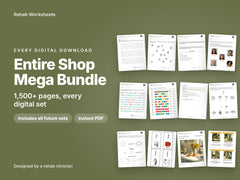
Get all our digital worksheets and save
Life skills worksheets for adults on scams and online safety, built from the messages people really get: scam texts and fake delivery fees, phishing emails, fake bank and tax calls, a virus pop-up, marketplace deals, a money-mule job ad and an online friend who needs money. 32 worksheets climb through 4 levels, from spotting the rush in one text to sorting an inbox and acting after money is sent, and every worksheet has its own answer page.
Designed by a registered Occupational Therapist with 10+ years in brain injury and cognitive rehabilitation.
What's included (115 pages in two PDFs, US Letter):
- 32 worksheets, 8 at each level: Find, Use, Compare and decide, Plan and check
- An answer key in its own PDF: an answer page for every worksheet, with what else to accept and a note for the helper
- How to use the pack, a contents page, and a cue and progress sheet for all 32 worksheets
- 8 real-life practice cards and 2 blank templates: a scam-safe plan for the fridge and red-flag bookmarks
- A red flags page and a "Where to report" page with U.S. reporting contacts
- U.S. edition: U.S. scams, U.S. spelling and U.S. reporting contacts
Skills practiced: spotting a rush, a secret and an unusual way to pay; checking a sender's address and a web address; keeping codes and PINs private; closing a fake virus pop-up; sorting safe and unsafe messages; calling back on the number from your own card; making strong passwords and choosing safer phone settings; spotting fake delivery texts, bank emails, marketplace deals, a money-mule job and the "grandchild in trouble" call; what to do after clicking a link or sending money; reporting a scam; making a scam-safe plan; and finding the mistakes in someone else's choices.
How it's graded: Level 1 finds one fact in one message. Level 2 works something out, such as which number to call. Level 3 compares two messages under a rule and gives a reason. Level 4 plans across several papers, copes with a change partway, then checks the work. Levels 3 and 4 use two pages, so every document prints full size, and a cue tally on every worksheet records how much help was needed.
Calm and plain: the pack shows the red flags in everyday words, with no scare tactics, and never explains how a scam is run.
Who it's for: occupational therapists, speech-language pathologists, special education and transition teachers, day programs, group homes, support staff and families working with adults with a brain injury or an intellectual disability, and older adults.
Personal or clinic license: Personal use covers one therapist, teacher, support staff member or family printing copies for the people they work with. The clinic license covers up to 10 staff at one organization.
Why buy direct from RehabWorksheets.com
- Our lowest price anywhere, always cheaper than our Etsy and TPT stores
- Instant digital download after checkout
- Designed by a registered Occupational Therapist
Please note: these are practice materials, not an assessment, and not legal or financial advice. No specific therapeutic outcomes are claimed. Every person, company, phone number and web address in the pack is made up, except the real reporting contacts on the "Where to report" page.